Department of Epidemiology and Program on Genomics and Nutrition, School of Public Health, and Center for Metabolic Diseases Prevention, UCLA, Los Angeles, California, USA.
Diabetes Care. 2010 Feb;33(2):304-10. doi: 10.2337/dc09-1402. Epub 2009 Nov 10.
Although magnesium may favorably affect metabolic outcomes, few studies have investigated the role of magnesium intake in systemic inflammation and endothelial dysfunction in humans.
Among 3,713 postmenopausal women aged 50-79 years in the Women's Health Initiative Observational Study and free of cardiovascular disease, cancer, and diabetes at baseline, we measured plasma concentrations of high-sensitivity C-reactive protein (hs-CRP), interleukin-6 (IL-6), turnor necrosis factor-alpha receptor 2 (TNF-alpha-R2), soluble intercellular adhesion molecule-1 (sICAM-1), soluble vascular cell adhesion molecule-1 (sVCAM-1), and E-selectin. Magnesium intake was assessed using a semiquantitative food frequency questionnaire.
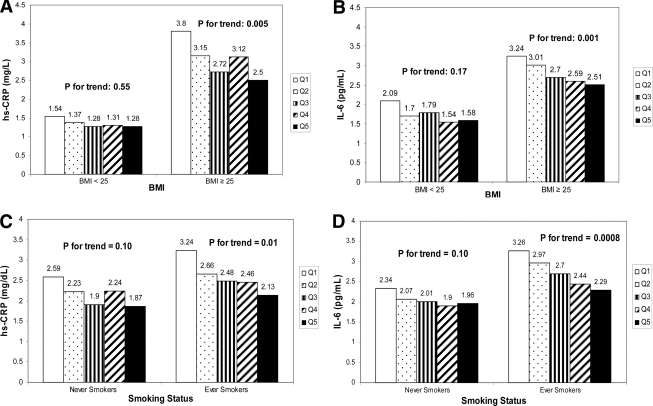
After adjustment for age, ethnicity, clinical center, time of blood draw, smoking, alcohol, physical activity, energy intake, BMI, and diabetes status, magnesium intake was inversely associated with hs-CRP (P for linear trend = 0.003), IL-6 (P < 0.0001), TNF-alpha-R2 (P = 0.0006), and sVCAM-1 (P = 0.06). Similar findings remained after further adjustment for dietary fiber, fruit, vegetables, folate, and saturated and trans fat intake. Multivariable-adjusted geometric means across increasing quintiles of magnesium intake were 3.08, 2.63, 2.31, 2.53, and 2.16 mg/l for hs-CRP (P = 0.005); 2.91, 2.63, 2.45, 2.27, and 2.26 pg/ml for IL-6 (P = 0.0005); and 707, 681, 673, 671, and 656 ng/ml for sVCAM-1 (P = 0.04). An increase of 100 mg/day magnesium was inversely associated with hs-CRP (-0.23 mg/l +/- 0.07; P = 0.002), IL-6 (-0.14 +/- 0.05 pg/ml; P = 0.004), TNF-alpha-R2 (-0.04 +/- 0.02 pg/ml; P = 0.06), and sVCAM-1 (-0.04 +/- 0.02 ng/ml; P = 0.07). No significant ethnic differences were observed.
High magnesium intake is associated with lower concentrations of certain markers of systemic inflammation and endothelial dysfunction in postmenopausal women.
尽管镁可能对代谢结果有有利影响,但很少有研究调查镁摄入对人体全身炎症和内皮功能障碍的作用。
在妇女健康倡议观察研究中,我们纳入了 3713 名年龄在 50-79 岁之间的绝经后妇女,这些妇女在基线时没有心血管疾病、癌症和糖尿病,我们测量了血浆中高敏 C 反应蛋白(hs-CRP)、白细胞介素-6(IL-6)、肿瘤坏死因子-α受体 2(TNF-α-R2)、可溶性细胞间黏附分子-1(sICAM-1)、可溶性血管细胞黏附分子-1(sVCAM-1)和 E-选择素的浓度。镁的摄入量通过半定量食物频率问卷进行评估。
在校正年龄、种族、临床中心、采血时间、吸烟、饮酒、体力活动、能量摄入、BMI 和糖尿病状态后,镁摄入量与 hs-CRP(P 趋势=0.003)、IL-6(P<0.0001)、TNF-α-R2(P=0.0006)和 sVCAM-1(P=0.06)呈负相关。进一步调整膳食纤维、水果、蔬菜、叶酸、饱和脂肪和反式脂肪的摄入量后,仍有类似的发现。在镁摄入量逐渐增加的五个五分位组中,hs-CRP 的几何均数分别为 3.08、2.63、2.31、2.53 和 2.16mg/L(P=0.005);IL-6 的几何均数分别为 2.91、2.63、2.45、2.27 和 2.26pg/ml(P=0.0005);sVCAM-1 的几何均数分别为 707、681、673、671 和 656ng/ml(P=0.04)。镁日摄入量增加 100mg,与 hs-CRP(-0.23mg/L±0.07;P=0.002)、IL-6(-0.14±0.05pg/ml;P=0.004)、TNF-α-R2(-0.04±0.02pg/ml;P=0.06)和 sVCAM-1(-0.04±0.02ng/ml;P=0.07)呈负相关。未观察到明显的种族差异。
高镁摄入与绝经后妇女某些全身炎症和内皮功能障碍标志物的浓度降低有关。