Laboratory of Molecular Biology and Endocrinology, Vinca Institute of Nuclear Sciences, PO Box 522, 11001 Belgrade, Serbia.
Reprod Biol Endocrinol. 2009 Dec 23;7:149. doi: 10.1186/1477-7827-7-149.
Oxidative stress and impaired antioxidant system have been proposed as a potential factors involved in the pathophysiology of diverse disease states, including carcinogenesis. In this study, we explored the lipid peroxidation levels and antioxidant enzyme activities in women diagnosed with different forms of gynecological diseases in order to evaluate the antioxidant status in endometrium of such patients.
Endometrial tissues of gynecological patients with different diagnoses were collected and subjected to assays for superoxide dismutase, catalase, glutathione peroxidase, glutathione reductase and lipid hydroperoxides.
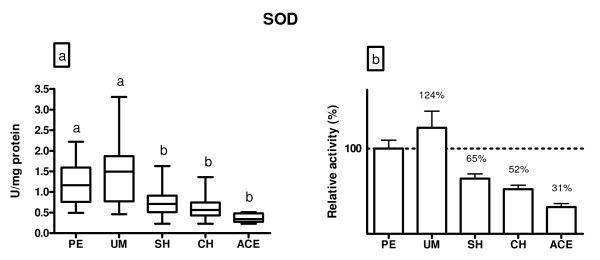
Superoxide dismutase activity was significantly decreased (50% in average) in hyperplastic and adenocarcinoma patients. Activities of both glutathione peroxidase and glutathione reductase were increased 60% and 100% on average, in hyperplastic patients, while in adenocarcinoma patients only glutathione reductase activity was elevated 100%. Catalase activity was significantly decreased in adenocarcinoma patients (47%). Lipid hydroperoxides level was negatively correlated to superoxide dismutase and catalase activities, and positively correlated to glutathione peroxidase and glutathione reductase activities.
This study provided the first comparison of antioxidant status and lipid peroxidation in endometrial tissues of patients with polyps, myoma, hyperplasia and adenocarcinoma. The results showed that patients with premalignant (hyperplastic) and malignant (adenocarcinoma) lesions had enhanced lipid peroxidation and altered uterine antioxidant enzyme activities than patients with benign uterine diseases, polyps and myoma, although the extent of disturbance varied with the diagnosis. Further investigation is needed to clarify the mechanisms responsible for the observed alterations and whether lipid hydroperoxide levels and antioxidant enzyme activities in uterus of gynecological patients might be used as additional parameter in clinical evaluation of gynecological disorders.
氧化应激和抗氧化系统受损被认为是多种疾病状态包括癌症发生的病理生理学中的潜在因素。在这项研究中,我们探索了不同妇科疾病患者的子宫内膜中的脂质过氧化水平和抗氧化酶活性,以评估这些患者的抗氧化状态。
收集了不同诊断的妇科患者的子宫内膜组织,并进行了超氧化物歧化酶、过氧化氢酶、谷胱甘肽过氧化物酶、谷胱甘肽还原酶和脂质过氧化物的测定。
增生和腺癌患者的超氧化物歧化酶活性显著降低(平均降低 50%)。增生患者的谷胱甘肽过氧化物酶和谷胱甘肽还原酶活性均升高了 60%和 100%,而腺癌患者仅谷胱甘肽还原酶活性升高了 100%。过氧化氢酶活性在腺癌患者中显著降低(47%)。脂质过氧化物水平与超氧化物歧化酶和过氧化氢酶活性呈负相关,与谷胱甘肽过氧化物酶和谷胱甘肽还原酶活性呈正相关。
本研究首次比较了息肉、肌瘤、增生和腺癌患者子宫内膜的抗氧化状态和脂质过氧化。结果表明,与良性子宫疾病、息肉和肌瘤患者相比,具有癌前病变(增生)和恶性(腺癌)病变的患者具有增强的脂质过氧化和改变的子宫抗氧化酶活性,尽管干扰的程度因诊断而异。需要进一步研究阐明观察到的变化的机制,以及妇科患者子宫中的脂质过氧化物水平和抗氧化酶活性是否可以作为妇科疾病临床评估的附加参数。