Health Informatics Research and Evaluation Unit, Faculty of Health Sciences, The University of Sydney, Australia.
BMC Health Serv Res. 2009 Dec 31;9:247. doi: 10.1186/1472-6963-9-247.
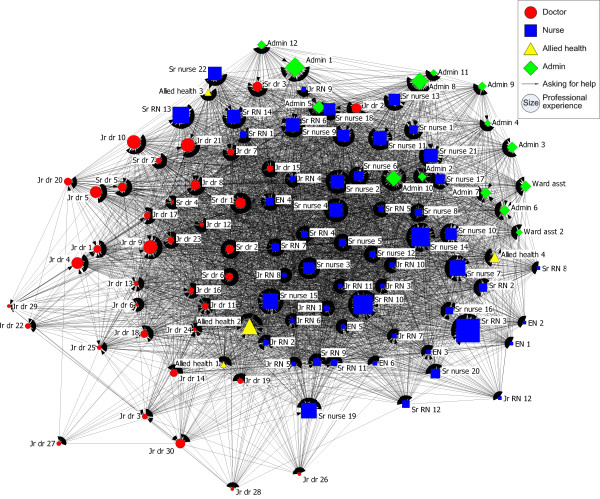
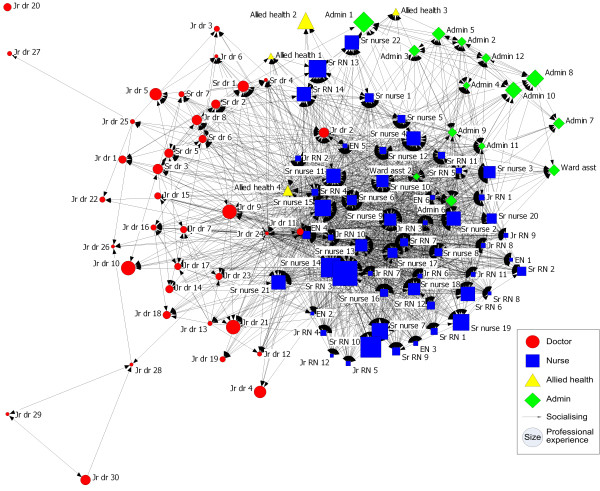
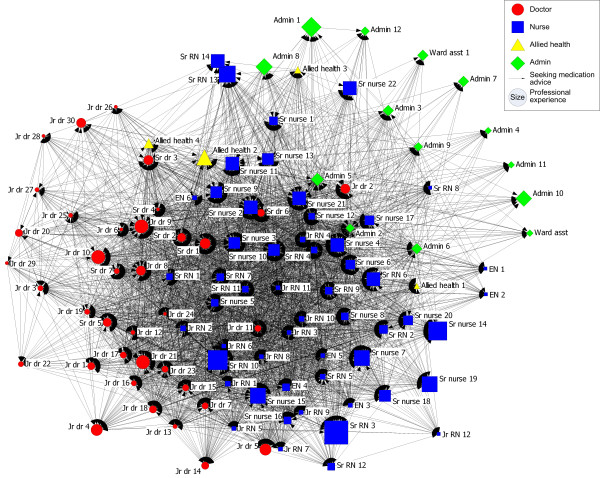
Emergency departments (EDs) are high pressure health care settings involving complex interactions between staff members in providing and organising patient care. Without good communication and cooperation amongst members of the ED team, quality of care is at risk. This study examined the problem-solving, medication advice-seeking and socialising networks of staff working in an Australian hospital ED.
A social network survey (Response Rate = 94%) was administered to all ED staff (n = 109) including doctors, nurses, allied health professionals, administrative staff and ward assistants. Analysis of the network characteristics was carried out by applying measures of density (the extent participants are concentrated), connectedness (how related they are), isolates (how segregated), degree centrality (who has most connections measured in two ways, in-degree, the number of ties directed to an individual and out-degree, the number of ties directed from an individual), betweenness centrality (who is important or powerful), degree of separation (how many ties lie between people) and reciprocity (how bi-directional are interactions).
In all three networks, individuals were more closely connected to colleagues from within their respective professional groups. The problem-solving network was the most densely connected network, followed by the medication advice network, and the loosely connected socialising network. ED staff relied on each other for help to solve work-related problems, but some senior doctors, some junior doctors and a senior nurse were important sources of medication advice for their ED colleagues.
Network analyses provide useful ways to assess social structures in clinical settings by allowing us to understand how ED staff relate within their social and professional structures. This can provide insights of potential benefit to ED staff, their leaders, policymakers and researchers.
急诊科(ED)是一个高压的医疗保健环境,涉及到工作人员在提供和组织患者护理方面的复杂互动。如果急诊科团队成员之间没有良好的沟通和合作,护理质量就会受到威胁。本研究考察了在澳大利亚一家医院急诊科工作的员工的解决问题、寻求药物建议和社交网络。
对所有急诊科工作人员(n=109)进行了社会网络调查(响应率=94%),包括医生、护士、辅助医疗专业人员、行政人员和病房助理。通过应用密度(参与者集中的程度)、连通性(他们之间的关系有多密切)、孤立度(隔离程度)、度中心性(以两种方式测量谁有最多的连接,入度,指向个人的联系数量和出度,从个人发出的联系数量)、中间中心性(谁是重要或有权力的)、分离度(人与人之间有多少联系)和互惠性(互动的双向程度)来分析网络特征。
在所有三个网络中,个体与各自专业群体内的同事联系更为紧密。解决问题的网络是连接最紧密的网络,其次是药物咨询网络,社交网络连接较为松散。急诊科工作人员在工作中相互寻求帮助解决问题,但一些高级医生、一些初级医生和一位高级护士是他们的急诊科同事寻求药物建议的重要来源。
网络分析通过允许我们了解急诊科员工在其社交和专业结构中的关系,为评估临床环境中的社会结构提供了有用的方法。这可以为急诊科员工、他们的领导、政策制定者和研究人员提供潜在的有益见解。