Institute of Medical Microbiology and Hospital Hygiene, Heinrich-Heine-University, Universitätsstrasse 1, 40225 Düsseldorf, Germany.
Ann Clin Microbiol Antimicrob. 2010 Jan 22;9:5. doi: 10.1186/1476-0711-9-5.
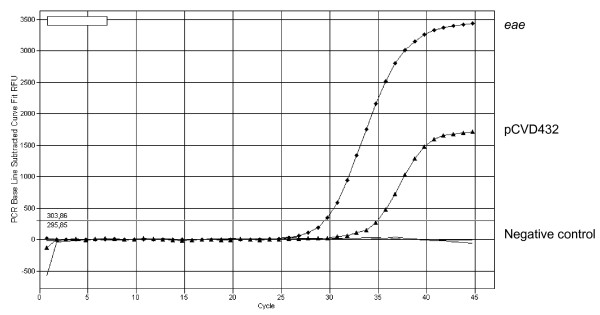
Accurate measurement of the incidence of diarrhoeagenic E. coli in patients with diarrhoea is hindered by the current methods of detection and varies from country to country. In order to improve the diagnosis of diarrhoeagenic E. coli (DEC), we developed a set of multiplex TaqMan real-time PCRs designed to detect the respective pathogens from an overnight stool culture.
Over the period Jan. 2006 to Dec. 2006 all stool specimens (n = 1981) received were investigated for EPEC and EAEC.
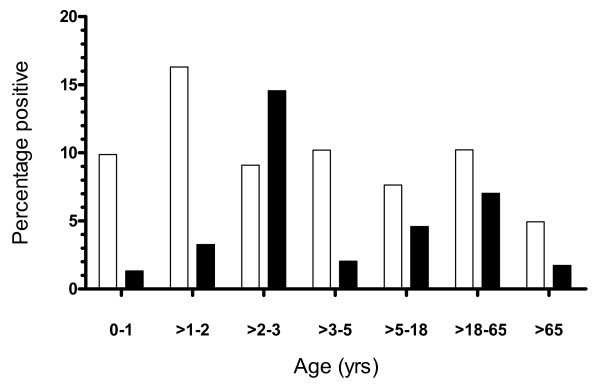
Of these, 371 specimens had no growth of Enterobacteriaceae. Of the remaining 1610 specimens 144 (8,9%) were positive for EPEC and 78 (4,8%) positive for EAEC. Among the EPEC positive stool specimens 28 (19,4%) were received from the tropical diseases unit, 49 (34%) from the paediatric dept. and 67 (46,5%) from the remainder of the wards. The EAEC were distributed as follows: 39 (50%) - tropical diseases, 19 (24,4%) -paediatrics and 20 (25,6%) other wards. Proportionately more EAEC and EPEC were found in children less than 3 years of age than other age groups. In only 22,2% of the detected EPEC and 23% of EAEC was the investigation requested by hospital staff.
This is, to our knowledge, the first study using a multiplex TaqMan PCR for the successful detection of diarrhoeagenic E. coli. In conclusion, due to the high prevalence of DEC detected, investigation of EPEC and EAEC should be recommended as a routine diagnostic test for patients with infectious diarrhoea.
目前的检测方法和国家的不同,阻碍了对腹泻患者中肠致病性大肠杆菌发病率的准确测量。为了改善肠致病性大肠杆菌(DEC)的诊断,我们开发了一套多重 TaqMan 实时 PCR 检测方法,用于检测隔夜粪便培养物中的相应病原体。
2006 年 1 月至 2006 年 12 月期间,对所有收到的粪便标本(n=1981)进行了 EPEC 和 EAEC 检测。
其中 371 份标本无肠杆菌科生长。在其余 1610 份标本中,144 份(8.9%)为 EPEC 阳性,78 份(4.8%)为 EAEC 阳性。在 EPEC 阳性粪便标本中,28 份(19.4%)来自热带病科,49 份(34%)来自儿科,67 份(46.5%)来自其他病房。EAEC 的分布情况如下:39 份(50%)-热带病科,19 份(24.4%)-儿科,20 份(25.6%)-其他病房。小于 3 岁的儿童中 EAEC 和 EPEC 的比例高于其他年龄组。在检测到的 EPEC 中,只有 22.2%和 EAEC 中 23%是医院工作人员要求进行的调查。
这是我们所知的首次使用多重 TaqMan PCR 成功检测腹泻性肠致病性大肠杆菌的研究。总之,由于 DEC 的高检出率,建议将 EPEC 和 EAEC 检测作为感染性腹泻患者的常规诊断试验。