New England Region, American Red Cross Blood Services, Dedham, Massachusetts 02026, USA.
Transfusion. 2010 Jun;50(6):1265-75. doi: 10.1111/j.1537-2995.2009.02578.x. Epub 2010 Jan 22.
Whole blood donation in the United States is restricted in volume to 10.5 mL/kg or less in an effort to prevent hypovolemic reactions, but still may exceed more than 15% of a donor's estimated blood volume (EBV). We analyzed the association of EBV with prefaint and systemic vasovagal reactions (SVRs) among whole blood donors and the potential impact of an EBV-based deferral policy.
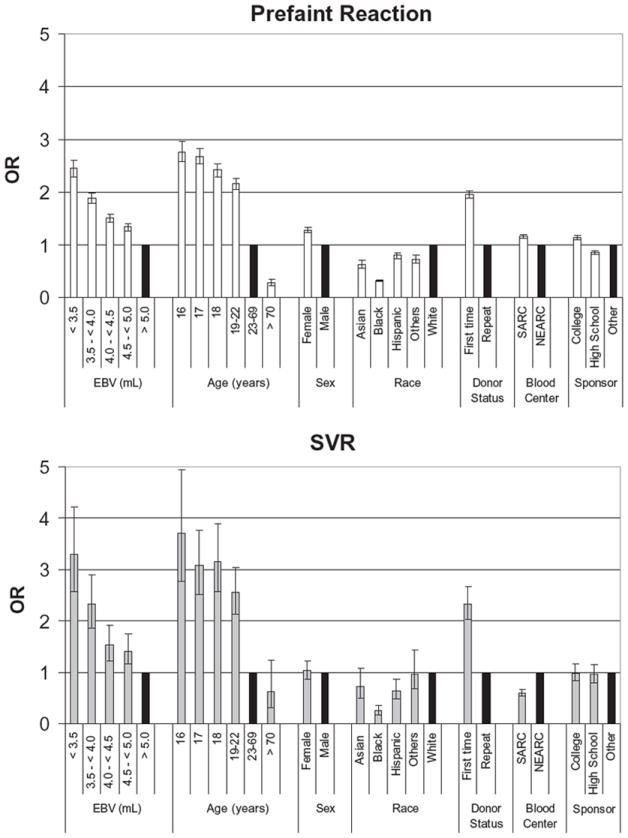
Independent predictors for prefaint reactions and SVRs were assessed by multivariate logistic regression analysis on 591,177 unique donors participating in the Retrovirus Epidemiology Donor Study-II study.
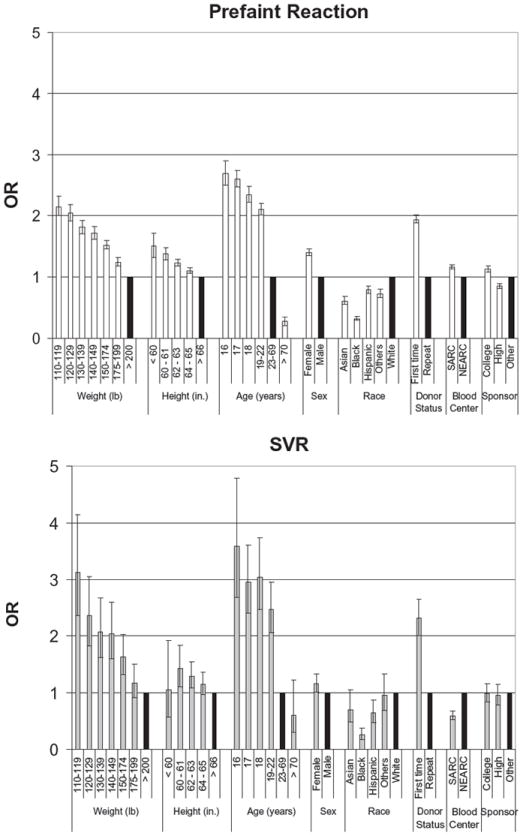
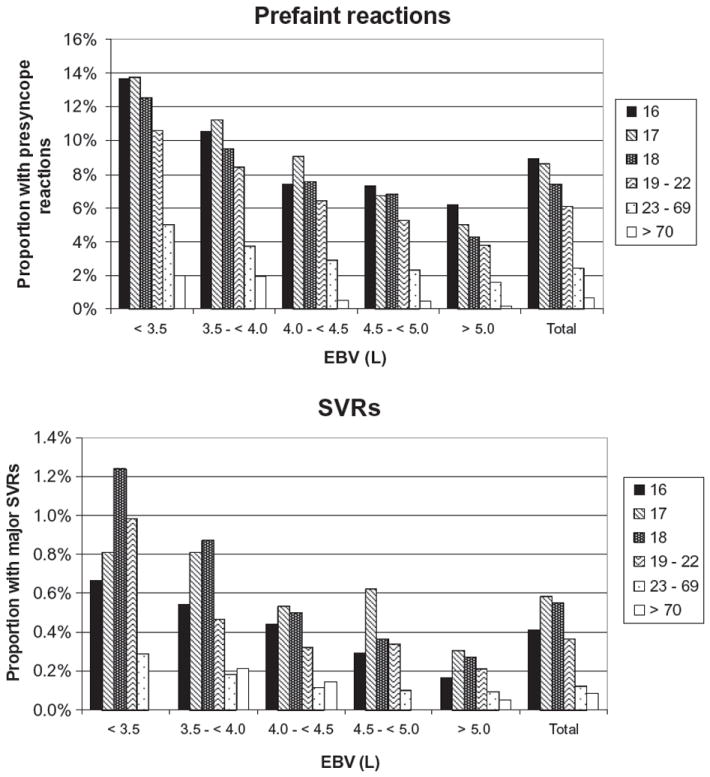
Young age (16 years old odds ratio [OR], 3.70; 95% confidence interval [CI], 2.78-4.94), low EBV (<3.5 L OR, 3.30; 95% CI, 2.57-4.23), and first-time donation status (OR, 2.33; 95% CI, 2.03-2.67) were the strongest predictors for SVRs, with similar trends seen for prefaint reactions. Sex, height, race, blood center, and donation site were weakly associated predictors. A total of 5.6% of all donors had an EBV of less than 3.5 L and experienced 12.5% of all prefaint reactions and 14.5% of SVRs. The highest reaction rates were seen in donors less than 23 years old with an EBV of less than 3.5 L who comprised 2.7% of all donors, who were mostly female (99.9%), and who experienced 8.8% of prefaint reactions and 11.0% of SVRs.
Young age, low EBV, and first-time donation status are the major correlates of prefaint reactions and SVRs, suggesting that high school and college donors are at particular risk. Deferral of donors with low EBV who are less than 23 years old may offer a rational approach to protecting donors at greater risk of reactions without jeopardizing the adequacy of the blood supply.
为了预防低血容量反应,美国限制全血捐献量不超过 10.5 毫升/公斤或更少,但仍可能超过献血者估计血容量(EBV)的 15%以上。我们分析了 EBV 与全血献血者预晕厥和全身血管迷走反应(SVR)之间的关联,以及基于 EBV 的延期政策的潜在影响。
对参加逆转录病毒流行病学献血者研究 II 的 591177 名独特献血者进行多变量逻辑回归分析,评估预晕厥反应和 SVR 的独立预测因素。
年轻(16 岁的优势比[OR],3.70;95%置信区间[CI],2.78-4.94)、低 EBV(<3.5 L OR,3.30;95%CI,2.57-4.23)和首次献血状态(OR,2.33;95%CI,2.03-2.67)是 SVR 的最强预测因素,预晕厥反应也有类似趋势。性别、身高、种族、血库和献血地点是较弱的关联预测因素。共有 5.6%的献血者 EBV 小于 3.5 L,经历了所有预晕厥反应的 12.5%和 SVR 的 14.5%。反应率最高的是 EBV 小于 3.5 L 的年龄小于 23 岁的献血者,占所有献血者的 2.7%,这些献血者主要为女性(99.9%),经历了 8.8%的预晕厥反应和 11.0%的 SVR。
年轻、低 EBV 和首次献血状态是预晕厥反应和 SVR 的主要相关因素,表明高中和大学献血者面临特别高的风险。对于 EBV 较低且年龄小于 23 岁的献血者进行延期,可能是一种保护反应风险较高的献血者而又不危及血液供应充足性的合理方法。