Systems Biology Doctoral Training Centre and Department of Physics, University of Oxford, Clarendon Laboratory, Parks Road, Oxford OX1 3PU, UK.
BMC Bioinformatics. 2010 Jan 18;11 Suppl 1(Suppl 1):S29. doi: 10.1186/1471-2105-11-S1-S29.
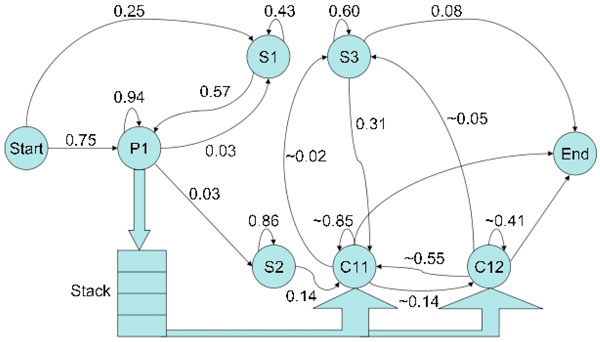
It has been apparent in the last few years that small non coding RNAs (ncRNA) play a very significant role in biological regulation. Among these microRNAs (miRNAs), 22-23 nucleotide small regulatory RNAs, have been a major object of study as these have been found to be involved in some basic biological processes. So far about 706 miRNAs have been identified in humans alone. However, it is expected that there may be many more miRNAs encoded in the human genome. In this report, a "context-sensitive" Hidden Markov Model (CSHMM) to represent miRNA structures has been proposed and tested extensively. We also demonstrate how this model can be used in conjunction with filters as an ab initio method for miRNA identification.
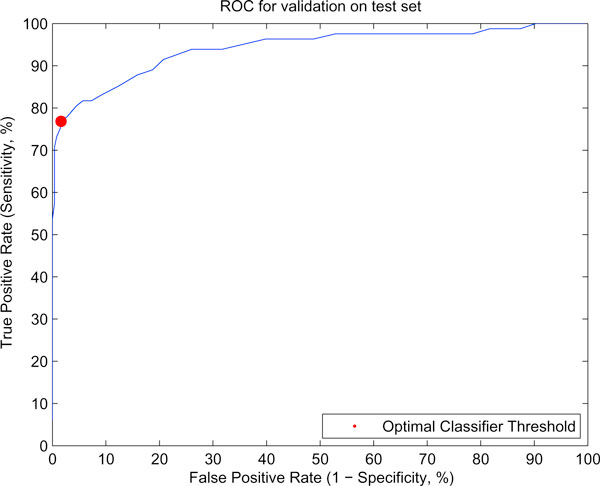
The probabilities of the CSHMM model were estimated using known human miRNA sequences. A classifier for miRNAs based on the likelihood score of this "trained" CSHMM was evaluated by: (a) cross-validation estimates using known human sequences, (b) predictions on a dataset of known miRNAs, and (c) prediction on a dataset of non coding RNAs. The CSHMM is compared with two recently developed methods, miPred and CID-miRNA. The results suggest that the CSHMM performs better than these methods. In addition, the CSHMM was used in a pipeline that includes filters that check for the presence of EST matches and the presence of Drosha cutting sites. This pipeline was used to scan and identify potential miRNAs from the human chromosome 19. It was also used to identify novel miRNAs from small RNA sequences of human normal leukocytes obtained by the Deep sequencing (Solexa) methodology. A total of 49 and 308 novel miRNAs were predicted from chromosome 19 and from the small RNA sequences respectively.
The results suggest that the CSHMM is likely to be a useful tool for miRNA discovery either for analysis of individual sequences or for genome scan. Our pipeline, consisting of a CSHMM and filters to reduce false positives shows promise as an approach for ab initio identification of novel miRNAs.
在过去几年中,人们已经明显认识到,小型非编码 RNA(ncRNA)在生物调控中发挥着非常重要的作用。在这些 miRNA(miRNA)中,22-23 个核苷酸的小调节 RNA 是主要的研究对象,因为它们被发现参与了一些基本的生物学过程。到目前为止,仅在人类中就已经鉴定出了约 706 种 miRNA。然而,预计在人类基因组中可能还有更多的 miRNA 编码。在本报告中,提出并广泛测试了一种表示 miRNA 结构的“上下文敏感”隐马尔可夫模型(CSHMM)。我们还展示了如何将该模型与滤波器结合使用,作为 miRNA 鉴定的从头方法。
使用已知的人类 miRNA 序列估计 CSHMM 模型的概率。基于此“训练”CSHMM 的似然评分的 miRNA 分类器通过以下方式进行评估:(a)使用已知人类序列的交叉验证估计,(b)对已知 miRNA 数据集的预测,以及(c)对非编码 RNA 数据集的预测。CSHMM 与两种最近开发的方法 miPred 和 CID-miRNA 进行了比较。结果表明 CSHMM 的性能优于这两种方法。此外,CSHMM 被用于包括过滤器的管道中,这些过滤器检查是否存在 EST 匹配和 Drosha 切割位点的存在。该管道用于扫描和识别来自人类染色体 19 的潜在 miRNA。它还用于通过深度测序(Solexa)方法获得的人类正常白细胞小 RNA 序列中识别新的 miRNA。从染色体 19 和小 RNA 序列中分别预测到 49 个和 308 个新的 miRNA。
结果表明,CSHMM 很可能成为 miRNA 发现的有用工具,无论是用于单个序列的分析还是基因组扫描。由 CSHMM 和过滤器组成的我们的管道,用于减少假阳性,作为从头鉴定新 miRNA 的方法具有很大的前景。