Zhang Wen-Yi, Guo Wei-Dong, Fang Li-Qun, Li Chang-Ping, Bi Peng, Glass Gregory E, Jiang Jia-Fu, Sun Shan-Hua, Qian Quan, Liu Wei, Yan Lei, Yang Hong, Tong Shi-Lu, Cao Wu-Chun
Beijing Institute of Microbiology and Epidemiology, China.
Environ Health Perspect. 2010 Jul;118(7):915-20. doi: 10.1289/ehp.0901504. Epub 2010 Feb 8.
The transmission of hemorrhagic fever with renal syndrome (HFRS) is influenced by climatic variables. However, few studies have examined the quantitative relationship between climate variation and HFRS transmission.
We examined the potential impact of climate variability on HFRS transmission and developed climate-based forecasting models for HFRS in northeastern China.
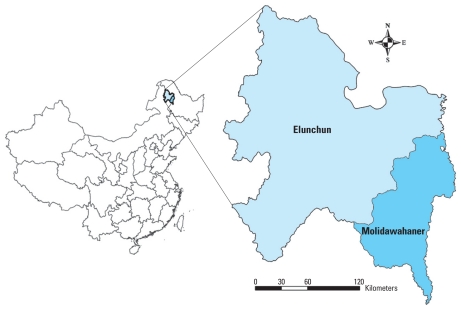
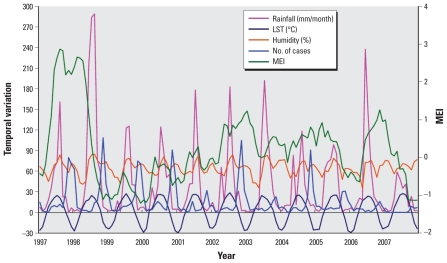
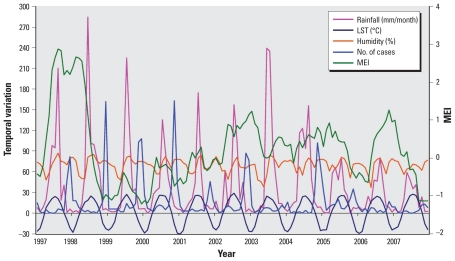
We obtained data on monthly counts of reported HFRS cases in Elunchun and Molidawahaner counties for 1997-2007 from the Inner Mongolia Center for Disease Control and Prevention and climate data from the Chinese Bureau of Meteorology. Cross-correlations assessed crude associations between climate variables, including rainfall, land surface temperature (LST), relative humidity (RH), and the multivariate El Niño Southern Oscillation (ENSO) index (MEI) and monthly HFRS cases over a range of lags. We used time-series Poisson regression models to examine the independent contribution of climatic variables to HFRS transmission.
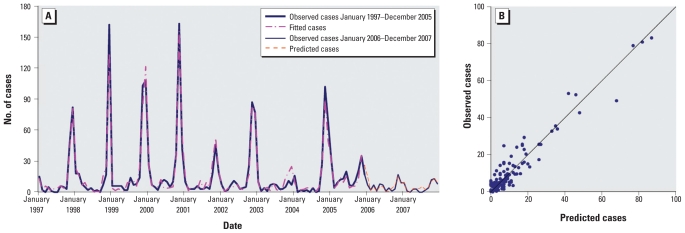
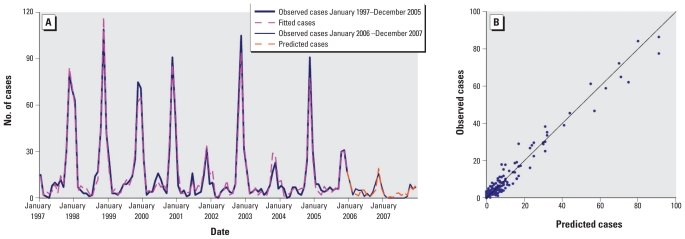
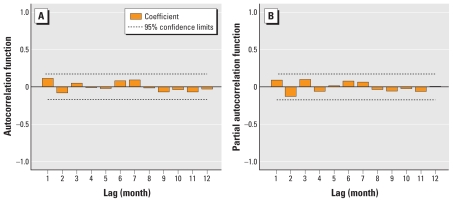
Cross-correlation analyses showed that rainfall, LST, RH, and MEI were significantly associated with monthly HFRS cases with lags of 3-5 months in both study areas. The results of Poisson regression indicated that after controlling for the autocorrelation, seasonality, and long-term trend, rainfall, LST, RH, and MEI with lags of 3-5 months were associated with HFRS in both study areas. The final model had good accuracy in forecasting the occurrence of HFRS.
Climate variability plays a significant role in HFRS transmission in northeastern China. The model developed in this study has implications for HFRS control and prevention.
肾综合征出血热(HFRS)的传播受气候变量影响。然而,很少有研究探讨气候变化与HFRS传播之间的定量关系。
我们研究了气候变异性对HFRS传播的潜在影响,并建立了中国东北地区基于气候的HFRS预测模型。
我们从内蒙古疾病预防控制中心获得了1997 - 2007年鄂伦春自治旗和莫力达瓦达斡尔族自治旗报告的HFRS病例月度计数数据,以及来自中国气象局的气候数据。交叉相关性评估了包括降雨量、地表温度(LST)、相对湿度(RH)和多元厄尔尼诺南方涛动(ENSO)指数(MEI)在内的气候变量与不同滞后时间的月度HFRS病例之间的粗略关联。我们使用时间序列泊松回归模型来检验气候变量对HFRS传播的独立贡献。
交叉相关性分析表明,在两个研究区域,降雨量、LST、RH和MEI与滞后3 - 5个月的月度HFRS病例显著相关。泊松回归结果表明,在控制了自相关、季节性和长期趋势后,滞后3 - 5个月的降雨量、LST、RH和MEI与两个研究区域的HFRS均相关。最终模型在预测HFRS发生方面具有良好的准确性。
气候变异性在中国东北地区HFRS传播中起重要作用。本研究建立的模型对HFRS的控制和预防具有重要意义。