Marjuki Henju, Wernery Ulrich, Yen Hui-Ling, Franks John, Seiler Patrick, Walker David, Krauss Scott, Webster Robert G
Department of Infectious Diseases, St. Jude Children's Research Hospital, Memphis, TN 38105, U.S.A.
Adv Virol. 2009 Jan 1;2009:1. doi: 10.1155/2009/294520.
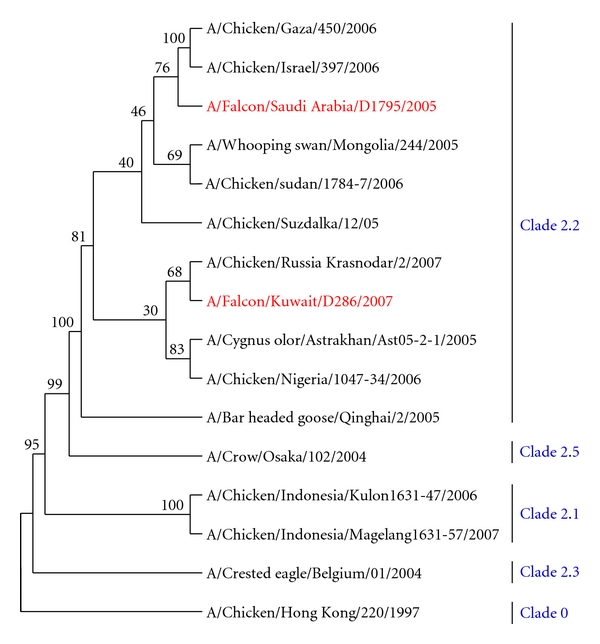
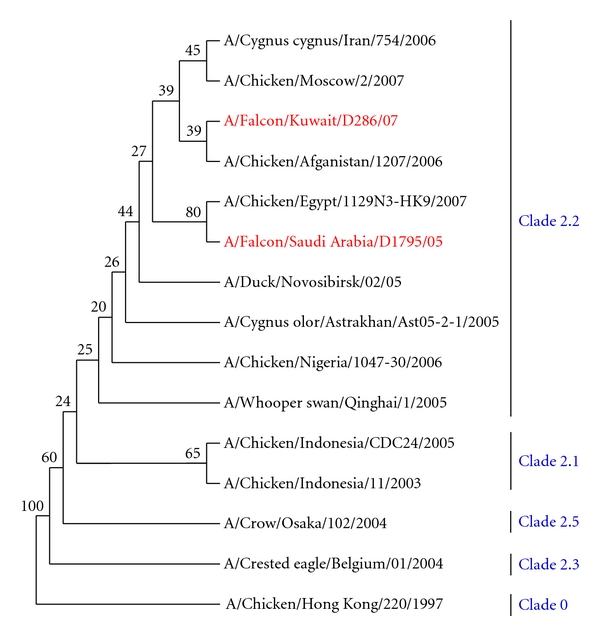
There is accumulating evidence that birds of prey are susceptible to fatal infection with highly pathogenic avian influenza (HPAI) virus. We studied the antigenic, molecular, phylogenetic, and pathogenic properties of 2 HPAI H5N1 viruses isolated from dead falcons in Saudi Arabia and Kuwait in 2005 and 2007, respectively. Phylogenetic and antigenic analyses grouped both isolates in clade 2.2 (Qinghai-like viruses). However, the viruses appeared to have spread westward via different flyways. It remains unknown how these viruses spread so rapidly from Qinghai after the 2005 outbreak and how they were introduced into falcons in these two countries. The H5N1 outbreaks in the Middle East are believed by some to be mediated by wild migratory birds. However, sporting falcons may be at additional risk from the illegal import of live quail to feed them.
越来越多的证据表明,猛禽易感染高致病性禽流感(HPAI)病毒并导致死亡。我们分别对2005年和2007年从沙特阿拉伯和科威特死亡猎鹰中分离出的2株HPAI H5N1病毒的抗原性、分子特性、系统发育和致病性进行了研究。系统发育和抗原分析将这两株病毒归类为2.2分支(青海样病毒)。然而,这些病毒似乎是通过不同的飞行路线向西传播的。2005年疫情爆发后,这些病毒如何从青海如此迅速地传播,以及它们如何传入这两个国家的猎鹰体内,仍然未知。一些人认为,中东地区的H5N1疫情是由野生候鸟介导的。然而,用于狩猎的猎鹰可能因非法进口活鹌鹑作为饲料而面临额外风险。