Department of Physiology/Endocrinology, Sahlgrenska Academy, Institute of Neuroscience and Physiology, University of Gothenburg, Gothenburg, Sweden.
Int J Obes (Lond). 2010 Jun;34(6):1011-9. doi: 10.1038/ijo.2010.27. Epub 2010 Feb 16.
Regulation of fat mass appears to be associated with immune functions. Studies of knockout mice show that endogenous interleukin (IL)-6 can suppress mature-onset obesity.
To systematically investigate associations of single nucleotide polymorphisms (SNPs) near the IL-6 (IL6) and IL-6 receptor (IL6R) genes with body fat mass, in support for our hypothesis that variants of these genes can be associated with obesity.
The Gothenburg Osteoporosis and Obesity Determinants (GOOD) study is a population-based cross-sectional study of 18- to 20-year-old men (n=1049), from the Gothenburg area (Sweden). Major findings were confirmed in two additional cohorts consisting of elderly men from the Osteoporotic Fractures in Men (MrOS) Sweden (n=2851) and MrOS US (n=5611) multicenter population-based studies.
The genotype distributions and their association with fat mass in different compartments, measured with dual-energy X-ray absorptiometry.
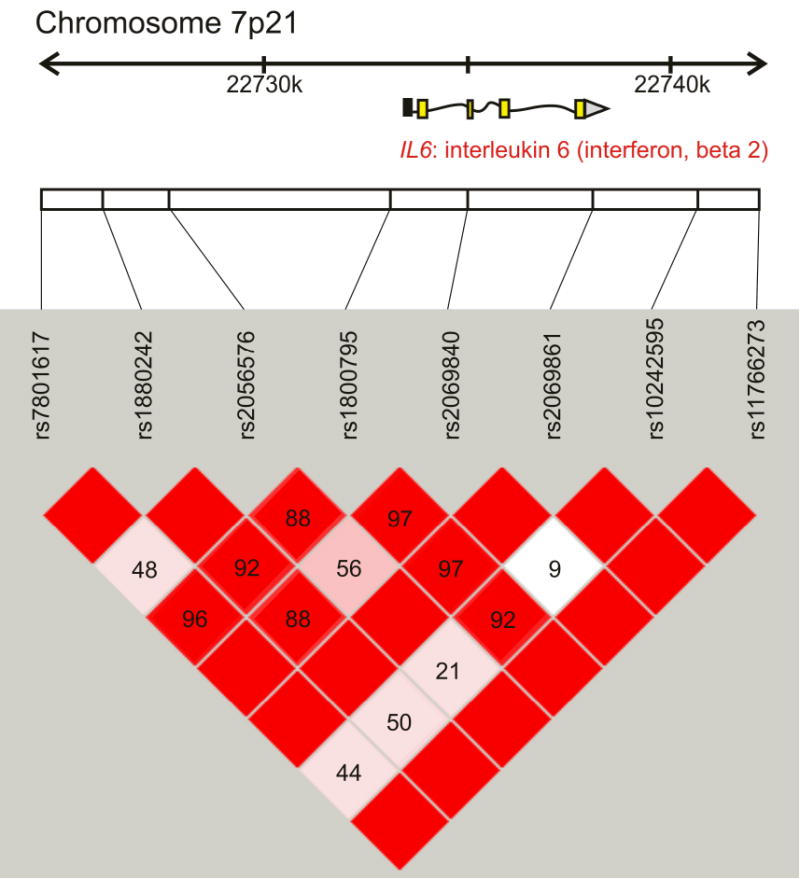
Out of 18 evaluated tag SNPs near the IL6 and IL6R genes, a recently identified SNP rs10242595 G/A (minor allele frequency=29%) 3' of the IL6 gene was negatively associated with the primary outcome total body fat mass (effect size -0.11 standard deviation (s.d.) units per A allele, P=0.02). This negative association with fat mass was also confirmed in the combined MrOS Sweden and MrOS US cohorts (effect size -0.05 s.d. units per A allele, P=0.002). When all three cohorts were combined (n=8927, Caucasian subjects), rs10242595()A showed a negative association with total body fat mass (effect size -0.05 s.d. units per A allele, P<0.0002). Furthermore, the rs10242595()A was associated with low body mass index (effect size -0.03, P<0.001) and smaller regional fat masses. None of the other SNPs investigated in the GOOD study were reproducibly associated with body fat.
The IL6 gene polymorphism rs10242595(*)A is associated with decreased fat mass in three combined cohorts of 8927 Caucasian men.
脂肪量的调节似乎与免疫功能有关。敲除小鼠的研究表明,内源性白细胞介素(IL)-6 可以抑制成年肥胖。
系统研究白细胞介素 6(IL6)和白细胞介素 6 受体(IL6R)基因附近的单核苷酸多态性(SNP)与体脂肪量的相关性,以支持我们的假设,即这些基因的变体可能与肥胖有关。
哥德堡骨质疏松症和肥胖决定因素(GOOD)研究是一项针对 18 至 20 岁男性(n=1049)的基于人群的横断面研究,来自瑞典哥德堡地区。主要发现通过两项额外的队列研究得到了证实,这些队列包括来自骨质疏松性骨折男性(MrOS)瑞典(n=2851)和 MrOS 美国(n=5611)多中心基于人群的研究中的老年男性。
用双能 X 射线吸收法测量不同部位的基因型分布及其与脂肪量的相关性。
在 IL6 和 IL6R 基因附近评估的 18 个标记 SNP 中,IL6 基因 3'端最近鉴定的 SNP rs10242595 G/A(次要等位基因频率=29%)与主要结局总体脂肪量呈负相关(效应大小-0.11 个标准差(s.d.)单位/等位基因,P=0.02)。这种与脂肪量的负相关在合并的 MrOS 瑞典和 MrOS 美国队列中也得到了证实(效应大小-0.05 s.d.单位/等位基因,P=0.002)。当三个队列合并(n=8927,白种人受试者)时,rs10242595()A 与总体脂肪量呈负相关(效应大小-0.05 s.d.单位/等位基因,P<0.0002)。此外,rs10242595()A 与低体重指数(效应大小-0.03,P<0.001)和较小的区域脂肪量有关。GOOD 研究中研究的其他 SNP 均未重现性地与体脂肪相关。
IL6 基因多态性 rs10242595(*)A 与 8927 名白种人男性的三个合并队列中的脂肪量减少有关。