Energy and Infrastructure Analysis Group, Decisions Applications Division, Los Alamos National Laboratory, Los Alamos, New Mexico, United States of America.
PLoS One. 2010 Feb 10;5(2):e9018. doi: 10.1371/journal.pone.0009018.
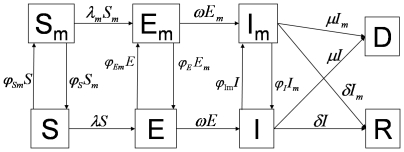
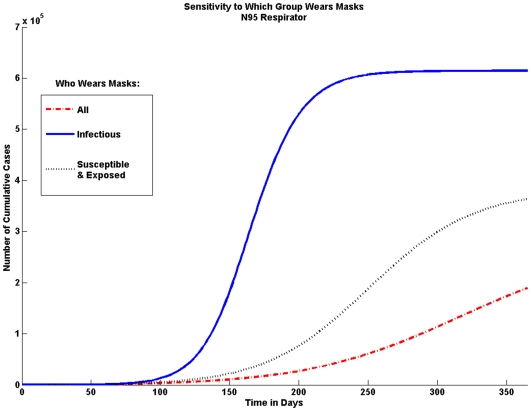
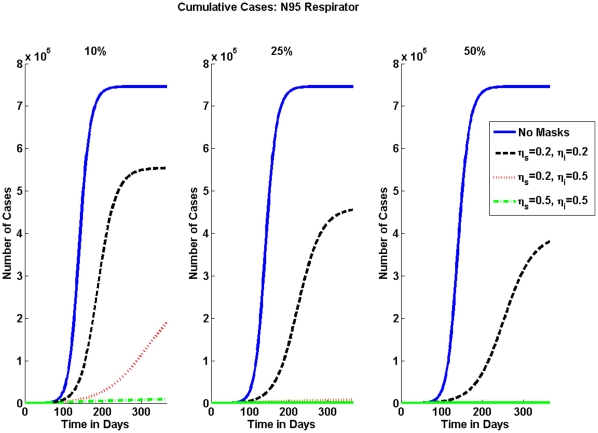
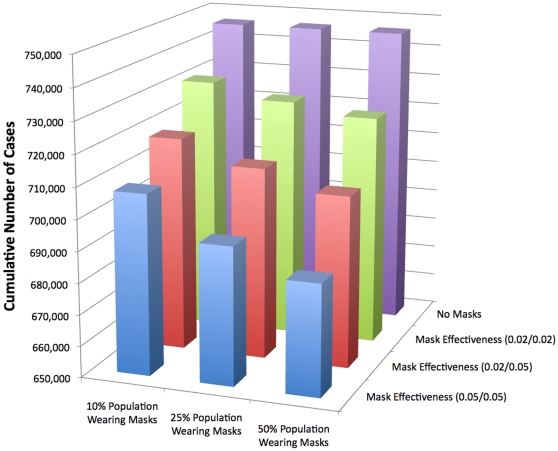
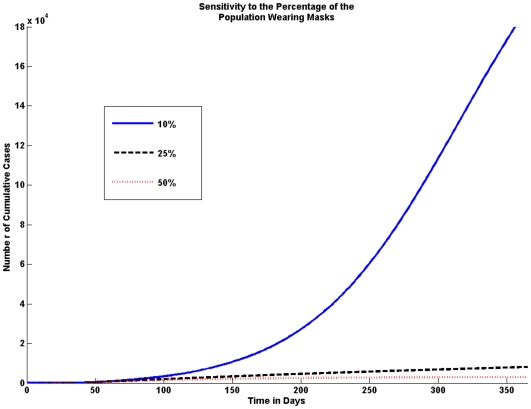
On June 11, 2009, the World Health Organization declared the outbreak of novel influenza A (H1N1) a pandemic. With limited supplies of antivirals and vaccines, countries and individuals are looking at other ways to reduce the spread of pandemic (H1N1) 2009, particularly options that are cost effective and relatively easy to implement. Recent experiences with the 2003 SARS and 2009 H1N1 epidemics have shown that people are willing to wear facemasks to protect themselves against infection; however, little research has been done to quantify the impact of using facemasks in reducing the spread of disease. We construct and analyze a mathematical model for a population in which some people wear facemasks during the pandemic and quantify impact of these masks on the spread of influenza. To estimate the parameter values used for the effectiveness of facemasks, we used available data from studies on N95 respirators and surgical facemasks. The results show that if N95 respirators are only 20% effective in reducing susceptibility and infectivity, only 10% of the population would have to wear them to reduce the number of influenza A (H1N1) cases by 20%. We can conclude from our model that, if worn properly, facemasks are an effective intervention strategy in reducing the spread of pandemic (H1N1) 2009.
2009 年 6 月 11 日,世界卫生组织宣布新型甲型 H1N1 流感爆发为大流行。由于抗病毒药物和疫苗的供应有限,各国和个人正在寻找其他方法来减少大流行(H1N1)2009 的传播,特别是那些具有成本效益且相对易于实施的方法。最近的 2003 年 SARS 和 2009 年 H1N1 流感疫情表明,人们愿意戴口罩来保护自己免受感染;然而,很少有研究来量化使用口罩在减少疾病传播方面的影响。我们构建并分析了一个人群模型,在这个模型中,一些人在大流行期间戴口罩,并量化了口罩对流感传播的影响。为了估计口罩有效性的参数值,我们使用了 N95 呼吸器和外科口罩研究中的可用数据。结果表明,如果 N95 呼吸器在降低易感性和传染性方面仅有效 20%,那么只需 10%的人口戴口罩就可以将甲型 H1N1 流感病例数量减少 20%。我们可以从我们的模型中得出结论,如果正确佩戴口罩,那么口罩是减少大流行(H1N1)2009 传播的有效干预策略。