Department of Parasitology and Tropical Medicine and Institute of Endemic Diseases, Seoul National University College of Medicine, Seoul, Korea.
PLoS Negl Trop Dis. 2010 Feb 16;4(2):e601. doi: 10.1371/journal.pntd.0000601.
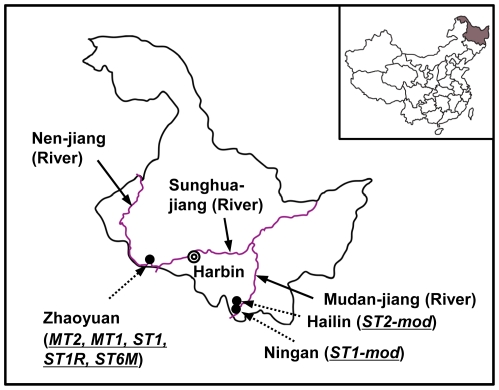
A pilot clonorchiasis control project was implemented to evaluate the efficacies of various chemotherapy strategies on prevalence, incidence and re-infection in Heilongjiang Province, China.
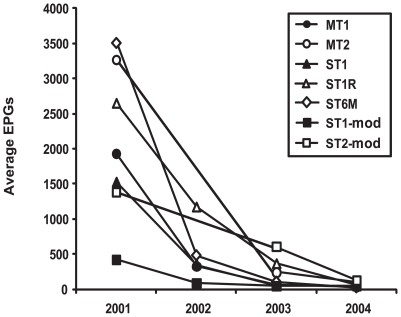
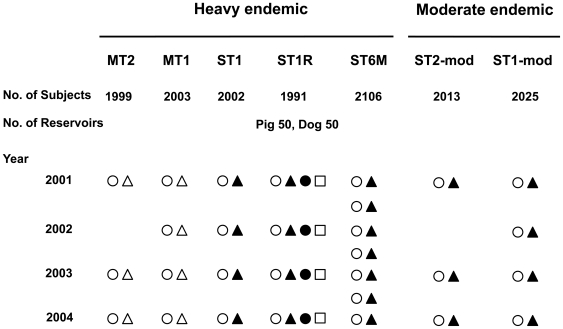
Seven intervention groups (14,139 residents, about 2000 in each group) in heavily or moderately endemic areas were subjected to repeated praziquantel administration from 2001 to 2004. In the selective chemotherapy groups, residents were examined for fecal eggs, and those who tested positive were treated with three doses of 25 mg/kg praziquantel at 5-hour-intervals in one day. However, all residents were treated in the mass chemotherapy groups. In heavily endemic areas, two mass treatments of all residents in 2001 and 2003 reduced the prevalence from 69.5% to 18.8%, while four annual mass treatments reduced the prevalence from 48.0% in 2001 to 8.4% in 2004. Selective annual treatments for egg-positive subjects reduced the egg-positive rates from 54.9% in 2001 to 15.0% in 2004 or from 73.2% in 2001 to 12.3% in 2004. Selective treatments every 6 months significantly reduced the prevalence from 59.5% in 2001 to 7.5% in 2004. All of the repeated treatments reduced EPG (eggs per gram of feces) significantly. The annual mass treatment and selective treatment every 6 months produced lower prevalence and re-infection rates and higher egg reduction rate than annual selective treatments did. In the moderate endemic areas, egg positive rates were 24.8% and 29.7% in 2001 but were 1.9% and 1.3% after 2 or 3 selective treatments. The prevalence, incidence, re-infection rates in a moderately endemic area were significantly lower than those of heavy endemic areas.
Repeated mass treatment or selective treatment with praziquantel every 6 to 12 months is highly effective for clonorchiasis control in heavily endemic areas. In contrast, one or two selective treatments with health education is effective in moderately endemic areas.
在中国黑龙江省,实施了一项试点华支睾吸虫病防治项目,以评估各种化疗方案对流行率、发病率和再感染的疗效。
在高度或中度流行地区的 7 个干预组(14139 名居民,每组约 2000 人)从 2001 年到 2004 年接受了重复的吡喹酮治疗。在选择性化疗组中,对居民进行粪便虫卵检查,检测结果阳性者在一天内每隔 5 小时服用 3 次 25mg/kg 的吡喹酮。然而,所有居民都在大规模化疗组中接受了治疗。在高度流行地区,2001 年和 2003 年对所有居民进行两次大规模治疗,将流行率从 69.5%降至 18.8%,而 2001 年和 2003 年每年四次大规模治疗将流行率从 48.0%降至 2004 年的 8.4%。对阳性卵居民进行选择性年度治疗,将阳性卵率从 2001 年的 54.9%降至 2004 年的 15.0%,或从 2001 年的 73.2%降至 2004 年的 12.3%。每 6 个月进行一次选择性治疗可显著降低 2001 年的流行率至 2004 年的 7.5%。所有重复治疗均显著降低 EPG(粪便中虫卵数/克)。年度大规模治疗和每 6 个月进行一次选择性治疗的效果优于年度选择性治疗,可降低流行率和再感染率,提高卵减少率。在中度流行地区,2001 年阳性率为 24.8%和 29.7%,但经过 2 次或 3 次选择性治疗后,阳性率分别为 1.9%和 1.3%。中度流行地区的流行率、发病率和再感染率明显低于高度流行地区。
在高度流行地区,反复进行大规模或每 6 至 12 个月进行一次选择性吡喹酮治疗对华支睾吸虫病的防治非常有效。相比之下,在中度流行地区,一次或两次选择性治疗结合健康教育是有效的。