Institute of Nursing Science at the University of Bielefeld, Bielefeld, Germany.
BMC Health Serv Res. 2010 Feb 25;10:51. doi: 10.1186/1472-6963-10-51.
Although international scientific research on health issues has been dealing with the problem of aggression and violence towards those employed in health care, research activities in Germany are still at an early stage. In view of this, the aim of this study was to examine the frequency and consequences of aggressive behaviour towards nurses and health care workers in different health sectors in Germany and to assess the need for preventive measures.
We conducted a cross-sectional retrospective survey. Nurses and health care workers from two nursing homes, a psychiatric clinic and a workshop for people with disabilities were interviewed using a standardised questionnaire. The sample covered 123 individuals (response rate 38.8%). The survey assessed the frequency, the type and the consequences of aggressive behaviour, and social support in connection with coping with aggression in the workplace. Odds ratios (OR) and 95% confidence intervals (CI) for putative risk factors which may influence the stress induced by aggression at the workplace were calculated using conditional logistic regression.
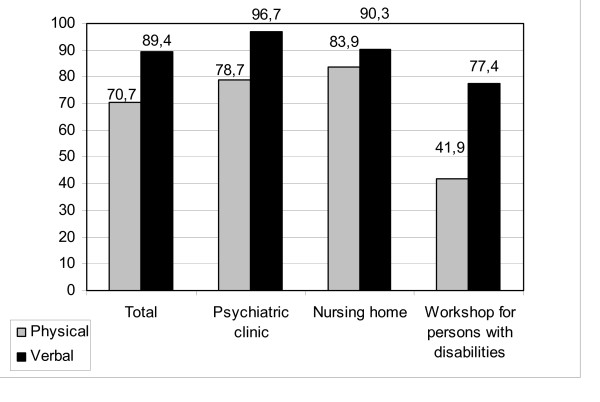
During the previous twelve months 70.7% of the respondents experienced physical and 89.4% verbal aggression. Physical aggression more frequently occurred in nursing homes (83.9% of the employees) and verbal aggression was more common in the psychiatric clinic (96.7% of the employees). The proportion of the individuals affected in the workshop for people with disabilities was lower (41.9% and 77.4% respectively). The incidents impaired the physical (55%) and emotional well-being (77.2%) of the employees. The frequency of incidents (weekly: OR 2.7; 95% CI 1.1-6.4) combined with the lack of social support (OR 2.8; 95% CI 1.2-6.6) increased the probability of higher stress due to aggression.
This study corroborates previous reports of frequent physical and verbal aggression towards care workers in the various areas of health care. The present study highlights differences between various areas of health care in Germany and the aggravating effect of prevention neglect such as missing social support at the workplace. Therefore our data suggest the need for improved target group specific prevention of aggressive incidents towards care workers and the need for effective aftercare in Germany.
尽管国际上针对医疗保健人员遭受攻击和暴力的问题进行了医学研究,但德国的研究活动仍处于早期阶段。鉴于此,本研究旨在调查德国不同卫生部门护士和保健工作者遭受攻击的频率和后果,并评估预防措施的需求。
我们进行了一项横断面回顾性调查。使用标准化问卷对来自两家疗养院、一家精神病诊所和一家残疾人车间的护士和保健工作者进行访谈。样本涵盖 123 人(回应率 38.8%)。该调查评估了工作场所遭受攻击的频率、类型和后果,以及与应对攻击有关的社会支持。使用条件逻辑回归计算了可能影响工作场所因攻击而产生压力的潜在危险因素的比值比(OR)和 95%置信区间(CI)。
在过去的 12 个月中,70.7%的受访者经历了身体上的攻击,89.4%经历了言语上的攻击。身体攻击更常发生在疗养院(83.9%的员工),言语攻击更常见于精神病诊所(96.7%的员工)。残疾人车间的员工受影响的比例较低(分别为 41.9%和 77.4%)。这些事件损害了员工的身体(55%)和情绪健康(77.2%)。事件发生的频率(每周:OR 2.7;95%CI 1.1-6.4)加上缺乏社会支持(OR 2.8;95%CI 1.2-6.6)增加了因攻击而产生更高压力的可能性。
本研究证实了之前关于医疗保健各个领域护理人员经常遭受身体和言语攻击的报告。本研究强调了德国不同卫生保健领域之间的差异以及预防忽视(例如工作场所缺乏社会支持)的加重效应。因此,我们的数据表明,需要针对护理人员有针对性地改进特定群体的预防攻击事件,并需要在德国进行有效的善后护理。