Department of Medicine and Biosystemic Science, Kyushu University Graduate School of Medical Sciences, Fukuoka, Japan.
Rheumatology (Oxford). 2010 Jul;49(7):1215-28. doi: 10.1093/rheumatology/keq031. Epub 2010 Mar 1.
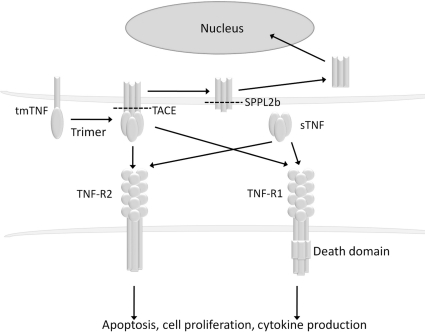
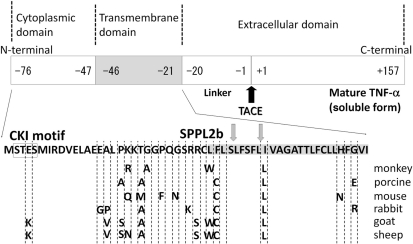
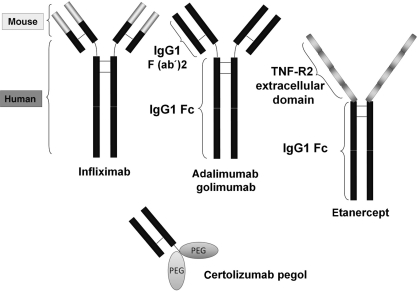
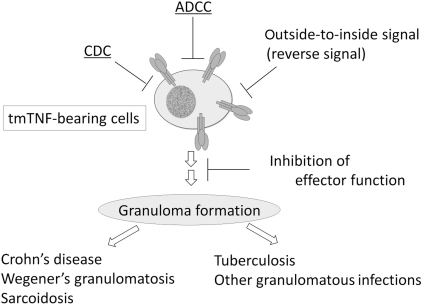
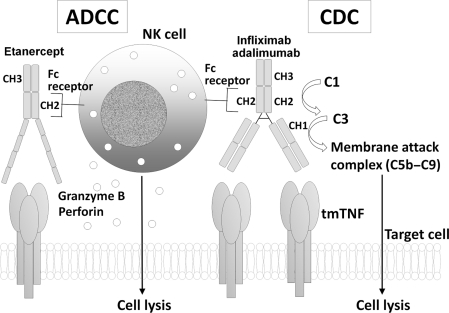
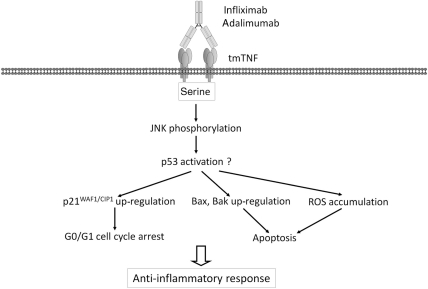
Transmembrane TNF-alpha, a precursor of the soluble form of TNF-alpha, is expressed on activated macrophages and lymphocytes as well as other cell types. After processing by TNF-alpha-converting enzyme (TACE), the soluble form of TNF-alpha is cleaved from transmembrane TNF-alpha and mediates its biological activities through binding to Types 1 and 2 TNF receptors (TNF-R1 and -R2) of remote tissues. Accumulating evidence suggests that not only soluble TNF-alpha, but also transmembrane TNF-alpha is involved in the inflammatory response. Transmembrane TNF-alpha acts as a bipolar molecule that transmits signals both as a ligand and as a receptor in a cell-to-cell contact fashion. Transmembrane TNF-alpha on TNF-alpha-producing cells binds to TNF-R1 and -R2, and transmits signals to the target cells as a ligand, whereas transmembrane TNF-alpha also acts as a receptor that transmits outside-to-inside (reverse) signals back to the cells after binding to its native receptors. Anti-TNF agents infliximab, adalimumab and etanercept bind to and neutralize soluble TNF-alpha, but exert different effects on transmembrane TNF-alpha-expressing cells (TNF-alpha-producing cells). In the clinical settings, these three anti-TNF agents are equally effective for RA, but etanercept is not effective for granulomatous diseases. Moreover, infliximab induces granulomatous infections more frequently than etanercept. Considering the important role of transmembrane TNF-alpha in granulomatous inflammation, reviewing the biology of transmembrane TNF-alpha and its interaction with anti-TNF agents will contribute to understanding the bases of differential clinical efficacy of these promising treatment modalities.
跨膜 TNF-α是可溶性 TNF-α的前体,可在活化的巨噬细胞和淋巴细胞以及其他细胞类型上表达。在 TNF-α转换酶(TACE)的作用下,可溶性 TNF-α从跨膜 TNF-α上切割下来,并通过与远程组织的 1 型和 2 型 TNF 受体(TNF-R1 和 -R2)结合来介导其生物学活性。越来越多的证据表明,不仅可溶性 TNF-α,而且跨膜 TNF-α都参与了炎症反应。跨膜 TNF-α作为一种双极分子,以细胞间接触的方式既作为配体又作为受体传递信号。TNF-α产生细胞上的跨膜 TNF-α与 TNF-R1 和 -R2 结合,并作为配体向靶细胞传递信号,而跨膜 TNF-α也作为受体,在与天然受体结合后将外部到内部(反向)信号传递回细胞。抗 TNF 药物英夫利昔单抗、阿达木单抗和依那西普与可溶性 TNF-α结合并中和其活性,但对表达跨膜 TNF-α的细胞(TNF-α产生细胞)有不同的作用。在临床环境中,这三种抗 TNF 药物对 RA 均同样有效,但依那西普对肉芽肿性疾病无效。此外,英夫利昔单抗比依那西普更频繁地诱导肉芽肿性感染。考虑到跨膜 TNF-α在肉芽肿性炎症中的重要作用,回顾跨膜 TNF-α的生物学及其与抗 TNF 药物的相互作用将有助于理解这些有前途的治疗方式在临床疗效上的差异基础。