Department of Primary Medical Care, Center of Psychosocial Medicine, University Medical Center Hamburg-Eppendorf, Martinistr 52, 20246 Hamburg, Germany.
BMC Health Serv Res. 2010 Mar 3;10:55. doi: 10.1186/1472-6963-10-55.
In summer 2003 a disease management program (DMP) for type 2 diabetes was introduced on a nationwide basis in Germany. Patient participation and continuity of care within the DMP are important factors to achieve long-term improvements in clinical endpoints. Therefore it is of interest, if patients experience any positive or negative effects of the DMP on their treatment that would support or hamper further participation. The main objective of the study was to find out if the German Disease Management Program (DMP) for type 2 diabetes improves process and outcome quality of medical care for patients in the light of their subjective experiences over a period of one year.
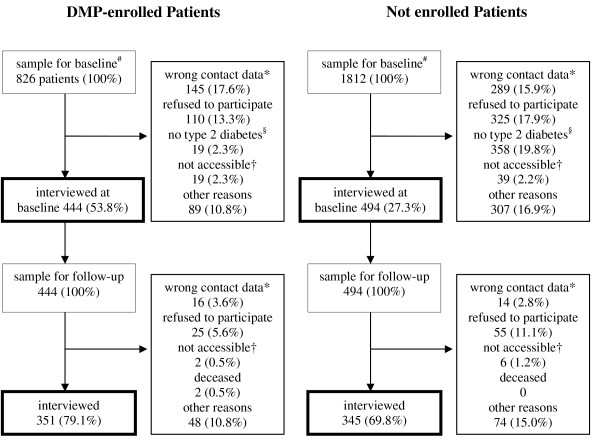
Cohort study with a baseline interview and a follow-up after 10.4 +/- 0.64 months. Data on process and outcome measures were collected by telephone interviews with 444 patients enrolled and 494 patients not enrolled in the German DMP for type 2 diabetes. Data were analyzed by multivariate logistic regression analyses.
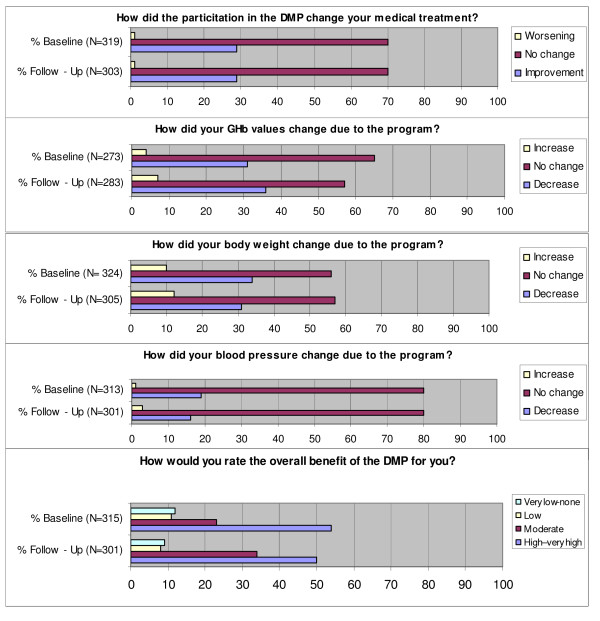
DMP enrolment was significantly associated with a higher process quality of care. At baseline enrolled patients more often reported that they had attended a diabetes education course (OR = 3.4), have > or = 4 contacts/year with the attending physician (OR = 3.3), have at least one annual foot examination (OR = 3.1) and one referral to an ophthalmologist (OR = 3.4) and possess a diabetes passport (OR = 2.4). Except for the annual referral to an ophthalmologist these parameters were also statistically significant at follow-up. In contrast, no differences between enrolled and not enrolled patients were found concerning outcome quality indicators, e.g. self-rated health, Glycated hemoglobin (GHb) and blood pressure. However, 16-36% of the DMP participants reported improvements of body weight and/or GHb and/or blood pressure values due to enrolment - unchanged within one year of follow-up.
In the light of patient's experiences the DMP enhances the process quality of medical care for type 2 diabetes in Germany. The lack of significant differences in outcome quality between enrolled and not enrolled patients might be due to the short program duration. Our data suggest that the DMP for type 2 diabetes should not be withdrawn unless an evidently more promising approach is found.
2003 年夏季,德国在全国范围内推出了 2 型糖尿病疾病管理计划(DMP)。患者参与和 DMP 内的连续性护理是实现临床终点长期改善的重要因素。因此,了解患者在治疗过程中是否经历任何对其进一步参与有支持或阻碍作用的 DMP 的积极或消极影响是很重要的。该研究的主要目的是确定德国 2 型糖尿病疾病管理计划(DMP)是否会根据患者在一年期间的主观体验改善医疗护理的过程和结果质量。
采用队列研究,在基线时进行访谈,并在 10.4±0.64 个月后进行随访。通过电话访谈收集了 444 名登记患者和 494 名未登记患者的过程和结果措施数据。通过多变量逻辑回归分析对数据进行分析。
DMP 登记与更高的护理过程质量显著相关。在基线时,登记患者更经常报告他们参加了糖尿病教育课程(OR=3.4),与主治医生有≥4 次/年的接触(OR=3.3),每年至少进行一次足部检查(OR=3.1)和一次转诊给眼科医生(OR=3.4),并且拥有糖尿病护照(OR=2.4)。除了每年转诊给眼科医生外,这些参数在随访时也具有统计学意义。相比之下,在登记患者和未登记患者之间,结果质量指标(例如自我评估健康状况、糖化血红蛋白(GHb)和血压)没有差异。然而,16%-36%的 DMP 参与者报告由于登记而改善了体重和/或 GHb 和/或血压值 - 在随访的一年中没有变化。
根据患者的经验,DMP 提高了德国 2 型糖尿病的医疗护理过程质量。在登记患者和未登记患者之间,结果质量没有显著差异,这可能是由于计划持续时间短。我们的数据表明,除非找到明显更有前途的方法,否则不应取消 2 型糖尿病的 DMP。