Comenius University in Bratislava, Department of Microbiology and Virology, Bratislava, Slovak Republic.
BMC Genomics. 2010 Mar 4;11:153. doi: 10.1186/1471-2164-11-153.
CTBT (7-chlorotetrazolo [5,1-c]benzo[1,2,4]triazine) increases efficacy of commonly used antifungal agents by an unknown mechanism. It increases the susceptibility of Saccharomyces cerevisiae, Candida albicans and Candida glabrata cells to cycloheximide, 5-fluorocytosine and azole antimycotic drugs. Here we elucidate CTBT mode of action with a combination of systematic genetic and transcriptome analysis.
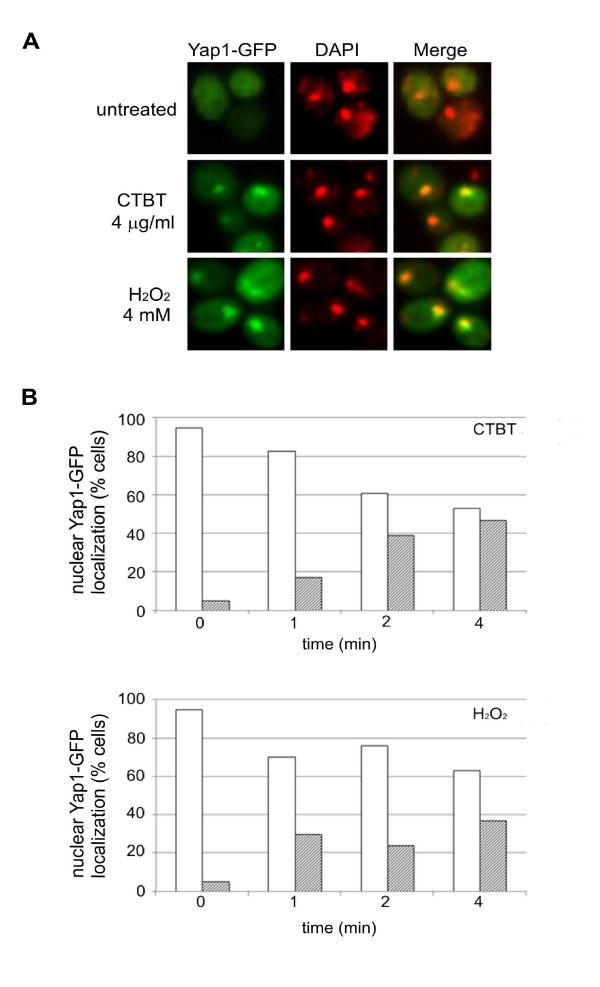
To identify the cellular processes affected by CTBT, we screened the systematic haploid deletion mutant collection for CTBT sensitive mutants. We identified 169 hypersensitive deletion mutants. The deleted genes encode proteins mainly involved in mitochondrial functions, DNA repair, transcription and chromatin remodeling, and oxidative stress response. We found that the susceptibility of yeast cells to CTBT depends on molecular oxygen. Transcriptome analysis of the immediate early response to CTBT revealed rapid induction of oxidant and stress response defense genes. Many of these genes depend on the transcription factors Yap1 and Cin5. Yap1 accumulates rapidly in the nucleus in CTBT treated cells suggesting acute oxidative stress. Moreover, molecular calculations supported a superoxide generating activity of CTBT. Superoxide production in vivo by CTBT was found associated to mitochondria as indicated by oxidation of MitoSOX Red.
We conclude that CTBT causes intracellular superoxide production and oxidative stress in fungal cells and is thus enhancing antimycotic drug effects by a secondary stress.
CTBT(7-氯四唑并[5,1-c]苯并[1,2,4]三嗪)通过未知机制提高了常用抗真菌药物的疗效。它增加了酿酒酵母、白色念珠菌和光滑念珠菌细胞对环己酰亚胺、5-氟胞嘧啶和唑类抗真菌药物的敏感性。在这里,我们结合系统的遗传和转录组分析阐明了 CTBT 的作用模式。
为了确定 CTBT 影响的细胞过程,我们筛选了系统单倍体缺失突变体文库以寻找 CTBT 敏感突变体。我们鉴定出 169 个超敏缺失突变体。缺失的基因编码的蛋白质主要参与线粒体功能、DNA 修复、转录和染色质重塑以及氧化应激反应。我们发现酵母细胞对 CTBT 的敏感性取决于分子氧。对 CTBT 即时早期反应的转录组分析显示,氧化应激和应激反应防御基因迅速诱导。其中许多基因依赖于转录因子 Yap1 和 Cin5。在 CTBT 处理的细胞中,Yap1 迅速积累到细胞核中,表明存在急性氧化应激。此外,分子计算支持 CTBT 具有超氧化物生成活性。体内 CTBT 产生的超氧化物与线粒体有关,如 MitoSOX Red 的氧化所表明的那样。
我们得出结论,CTBT 导致真菌细胞内产生超氧化物和氧化应激,从而通过二次应激增强抗真菌药物的效果。