Department of Community Health Sciences, Faculty of Medicine, University of Calgary, Calgary, Canada.
Implement Sci. 2010 Jan 15;5:2. doi: 10.1186/1748-5908-5-2.
There is an extensive body of literature on health system quality reporting that has yet to be characterized. Scoping is a novel methodology for systematically assessing the breadth of a body of literature in a particular research area. Our objectives were to showcase the scoping review methodology in the review of health system quality reporting, and to report on the extent of the literature in this area.
A scoping review was performed based on the York methodology outlined by Arksey and O'Malley from the University of York, United Kingdom. We searched 14 peer reviewed and grey literature databases limiting the search to English language and non-English language articles with English abstracts published between 1980 and June 2006 with an update to November 2008. We also searched specific websites, reference lists, and key journals for relevant material and solicited input from key stakeholders. Inclusion/exclusion criteria were applied to select relevant material and qualitative information was charted from the selected literature.
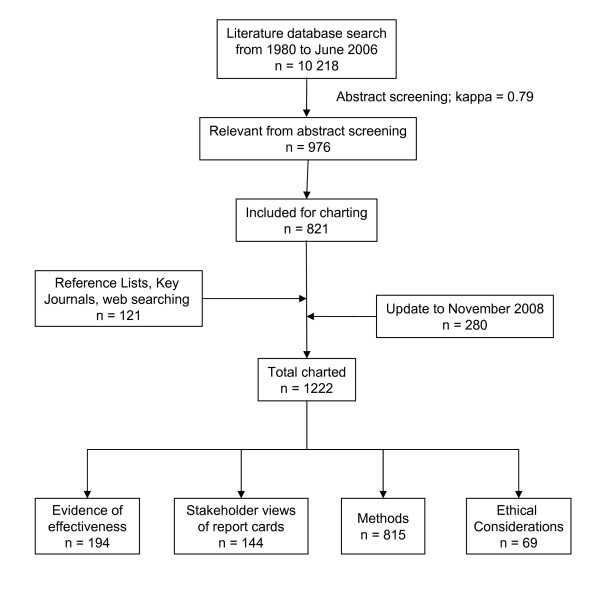
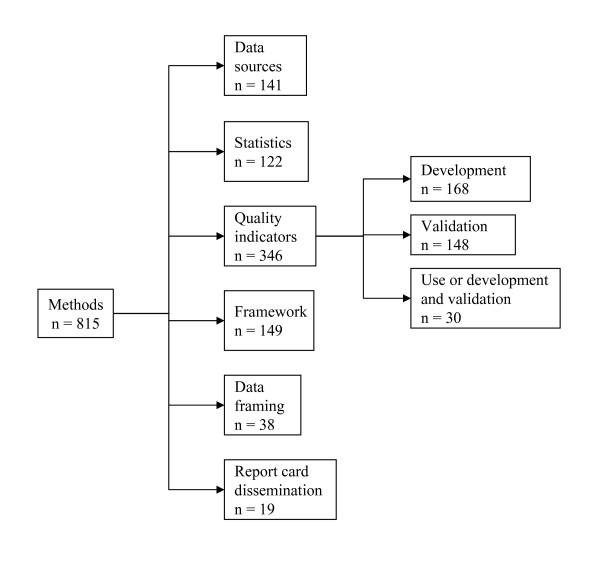
A total of 10,102 articles were identified from searching the literature databases, 821 were deemed relevant to our scoping review. An additional 401 were identified from updates, website searching, references lists, key journals, and stakeholder suggestions for a total of 1,222 included articles. These were categorized and catalogued according to the inclusion criteria, and further subcategories were identified through the charting process. Topic areas represented by this review included the effectiveness of health system report cards (n = 194 articles), methodological issues in their development (n = 815 articles), stakeholder views on report cards (n = 144 articles), and ethical considerations around their development (n = 69 articles).
The scoping review methodology has permitted us to characterize and catalogue the extensive body of literature pertaining to health system report cards. The resulting literature repository that our review has created can be of use to researchers and health system stakeholders interested in the topic of health system quality measurement and reporting.
关于卫生系统质量报告的文献很多,但尚未对其进行特征描述。范围界定是一种系统评估特定研究领域文献广度的新方法。我们的目的是展示范围界定综述方法在卫生系统质量报告综述中的应用,并报告该领域文献的广泛程度。
采用英国约克大学 Arksey 和 O'Malley 制定的约克方法进行范围界定综述。我们在 14 个同行评审和灰色文献数据库中进行了搜索,限定了检索范围为 1980 年至 2006 年 6 月发表的英文和附有英文摘要的非英文文献,并于 2008 年 11 月进行了更新。我们还搜索了特定网站、参考文献和主要期刊以获取相关资料,并征求了主要利益攸关方的意见。采用纳入/排除标准选择相关资料,并从选定文献中提取定性信息。
从文献数据库搜索共确定了 10102 篇文章,其中 821 篇被认为与我们的范围界定综述相关。通过更新、网站搜索、参考文献列表、主要期刊和利益攸关方建议,又确定了 401 篇,共计纳入 1222 篇文章。这些文章根据纳入标准进行了分类和编目,并通过图表制作过程进一步确定了子类别。本综述涉及的主题领域包括卫生系统记分卡的效果(194 篇文章)、其制定的方法学问题(815 篇文章)、利益攸关方对记分卡的看法(144 篇文章)以及其制定过程中的伦理问题(69 篇文章)。
范围界定综述方法使我们能够对与卫生系统记分卡相关的大量文献进行特征描述和编目。我们的综述创建的文献库可以为对卫生系统质量测量和报告感兴趣的研究人员和卫生系统利益攸关方提供帮助。