Department of Internal Medicine, University Hospital Basel, Basel, Switzerland.
BMC Pulm Med. 2010 Mar 11;10:12. doi: 10.1186/1471-2466-10-12.
Despite recommendations for outpatient management, low risk patients with lower respiratory tract infections (LRTIs) are often hospitalized. This survey analyzed perceptions of physicians, nurses, patients and relatives about feasibility of outpatient management and required duration of hospital stay.
We performed a prospective, observational questionnaire survey in hospitalized patients with LRTI as part of a multicenter trial. Treating physicians and nurses, patients and their relatives were asked on admission and before discharge about feasibility of outpatient treatment over 5 dimensions (medical, nursing, organizational factors, and patients' and relatives' preferences) using continuous scales.
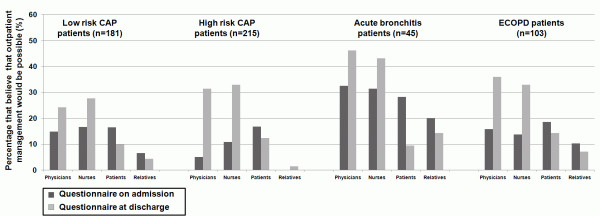
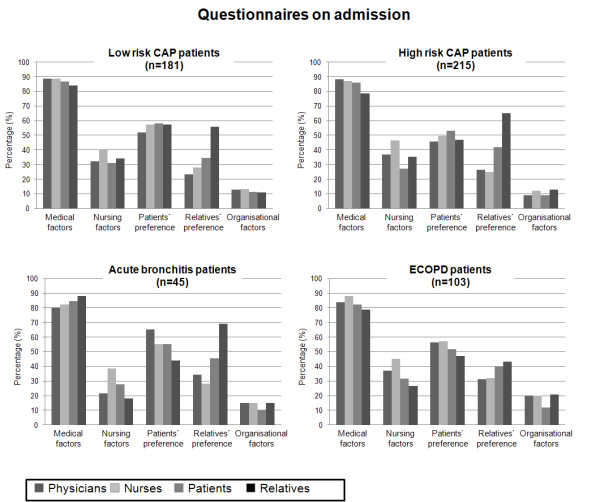
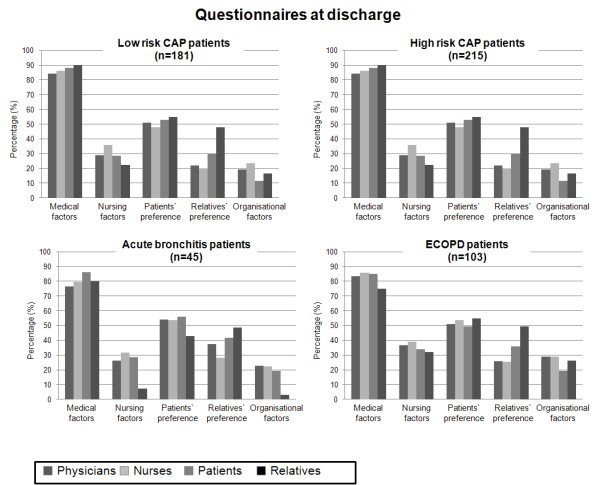
On admission, 12.6% of physicians, 15.1% of nurses, 18.0% of patients and 5.2% of relatives believed that outpatient treatment would be possible. Before hospital discharge, 31.1% of physicians, 32.2% of nurses, 11.6% of patients and 4.1% of relatives thought that earlier discharge would have been feasible. Medical factors were the most frequently perceived motives for inpatient management. These perceptions were similar in all LRTI subgroups and independent of disease severity and associated expected mortality risks as assessed by the Pneumonia Severity Index (PSI).
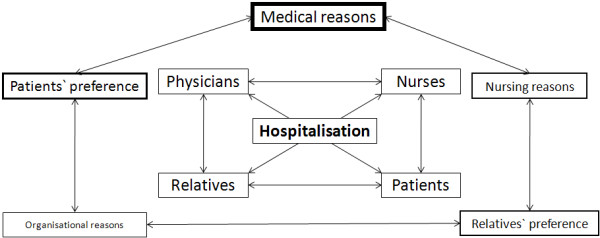
Independent of type and severity of respiratory tract infection, the misperceived high severity and expected mortality and morbidity were the predominant reasons why treating physicians, nurses, patients and their relatives unanimously believed that inpatient management was necessary. Better assessment and communication about true expected medical risks might contribute to a pathway to shorten in-hospital days and to introduce a more risk-targeted and individually tailored allocation of health-care resources.
NCT00350987.
尽管有建议进行门诊管理,但患有下呼吸道感染(LRTI)的低危患者通常仍住院治疗。本调查分析了医生、护士、患者和家属对门诊管理可行性和所需住院时间的看法。
我们在一项多中心试验中对住院的 LRTI 患者进行了前瞻性、观察性问卷调查。入院时和出院前,主治医生和护士、患者及其家属分别就 5 个方面(医疗、护理、组织因素以及患者和家属的偏好)的门诊治疗可行性采用连续量表进行评估。
入院时,12.6%的医生、15.1%的护士、18.0%的患者和 5.2%的家属认为门诊治疗可行。出院前,31.1%的医生、32.2%的护士、11.6%的患者和 4.1%的家属认为更早出院是可行的。医疗因素是最常被认为是住院治疗的动机。这些看法在所有 LRTI 亚组中相似,且与肺炎严重指数(PSI)评估的疾病严重程度和相关预期死亡率无关。
无论呼吸道感染的类型和严重程度如何,治疗医生、护士、患者及其家属一致认为住院管理是必要的,主要原因是他们错误地认为病情严重且存在预期的死亡和发病风险。更好地评估和沟通真实的预期医疗风险,可能有助于缩短住院时间,并引入更具风险针对性和个体化的医疗资源分配方式。
NCT00350987。