Exercise and Health Laboratory, Faculty of Human Movement-Technical University of Lisbon, Portugal.
Nutr Metab (Lond). 2010 Mar 22;7:22. doi: 10.1186/1743-7075-7-22.
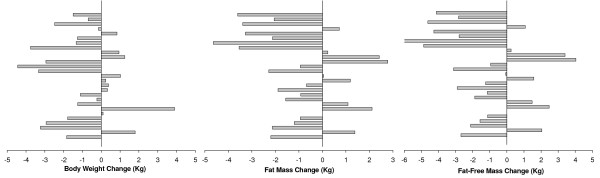
Dual-energy x-ray absorptiometry (DXA) provides an affordable and practical assessment of multiple whole body and regional body composition. However, little information is available on the assessment of changes in body composition in top-level athletes using DXA. The present study aimed to assess the accuracy of DXA in tracking body composition changes (relative fat mass [%FM], absolute fat mass [FM], and fat-free mass [FFM]) of elite male judo athletes from a period of weight stability to prior to a competition, compared to a four compartment model (4C model), as the criterion method.
A total of 27 elite male judo athletes (age, 22.2 +/- 2.8 yrs) athletes were evaluated. Measures of body volume by air displacement plethysmography, bone mineral content assessed by DXA, and total-body water assessed by deuterium dilution were used in a 4C model. Statistical analyses included examination of the coefficient of determinant (r2), standard error of estimation (SEE), slope, intercept, and agreement between models.
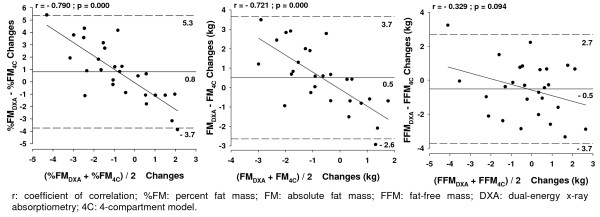
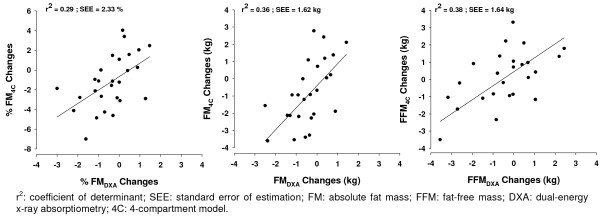
At a group level analysis, changes in %FM, FM, and FFM estimates by DXA were not significantly different from those by the 4C model. Though the regression between DXA and the 4C model did not differ from the line of identity DXA %FM, FM, and FFM changes only explained 29%, 36%, and 38% of the 4C reference values, respectively. Individual results showed that the 95% limits of agreement were -3.7 to 5.3 for %FM, -2.6 to 3.7 for FM, and -3.7 to 2.7 for FFM. The relation between the difference and the mean of the methods indicated a significant trend for %FM and FM changes with DXA overestimating at the lower ends and underestimating at the upper ends of FM changes.
Our data indicate that both at group and individual levels DXA did not present an expected accuracy in tracking changes in adiposity in elite male judo athletes.
双能 X 射线吸收法(DXA)可提供经济实惠且实用的全身和身体各部位的身体成分评估。然而,关于使用 DXA 评估顶级运动员身体成分变化的信息很少。本研究旨在评估 DXA 在跟踪精英男性柔道运动员在体重稳定期到比赛前的身体成分变化(相对脂肪量[FM],绝对脂肪量[FM]和无脂肪量[FFM])方面的准确性,与作为标准方法的四室模型(4C 模型)进行比较。
共评估了 27 名精英男性柔道运动员(年龄 22.2 +/- 2.8 岁)。使用空气置换体描记法测量体容积,DXA 评估骨矿物质含量,氘稀释法评估全身水。4C 模型用于评估各模型之间的决定系数(r2),估计标准误差(SEE),斜率,截距和一致性。
在组水平分析中,DXA 对 FM,FM 和 FFM 估计值的变化与 4C 模型无显著差异。尽管 DXA 与 4C 模型的回归关系与身份线无差异,但 DXA 的 FM,FM 和 FFM 变化仅分别解释了 4C 参考值的 29%,36%和 38%。个体结果表明,FM 的 95%一致性限为 -3.7 至 5.3,FM 为 -2.6 至 3.7,FFM 为 -3.7 至 2.7。方法之间的差异与平均值之间的关系表明,在 FM 变化的低端,DXA 对 FM 变化的估计值过高,而在 FM 变化的高端,DXA 对 FM 变化的估计值过低,这种趋势具有统计学意义。
我们的数据表明,无论是在组水平还是个体水平,DXA 都没有在跟踪精英男性柔道运动员脂肪量变化方面表现出预期的准确性。