Way Kimberley L, Thomas Hannah J, Parker Lewan, Maiorana Andrew, Keske Michelle A, Scott David, Reed Jennifer L, Tieng Jessica, Hackett Daniel, Hawkins Tess, Latella Christopher, Cordina Rachael, Tran Derek L
Institute for Physical Activity and Nutrition, School of Exercise and Nutrition Sciences, Deakin University, Geelong, VIC, 3125, Australia.
Exercise Physiology and Cardiovascular Health Lab, Division of Cardiac Prevention and Rehabilitation, University of Ottawa Heart Institute, Ottawa, ON, Canada.
Sports Med Open. 2023 Sep 19;9(1):86. doi: 10.1186/s40798-023-00634-z.
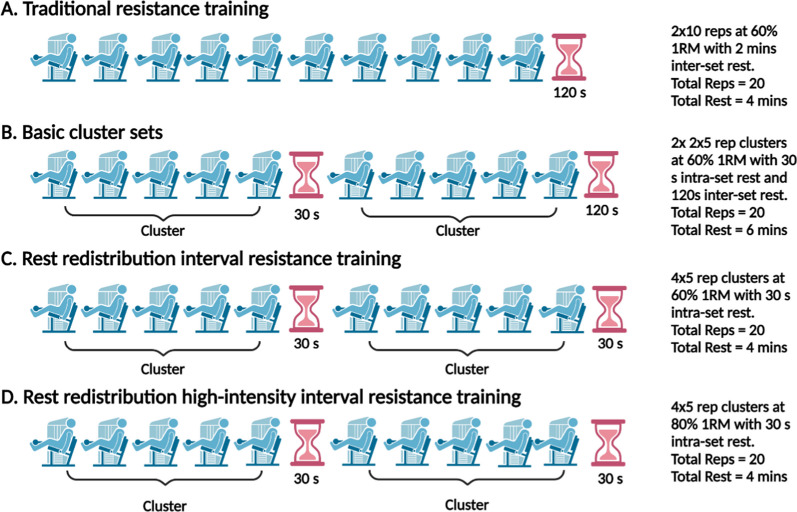
The integration of resistance training for cardiac patients leads to important health outcomes that are not optimally obtained with aerobic exercise; these include an increase in muscle mass, maintenance of bone mineral density, and improvements in muscular fitness parameters. Despite the proliferation of evidence supporting resistance exercise in recent decades, the implementation of resistance training is underutilised, and prescription is often sub-optimal in cardiac patients. This is frequently associated with safety concerns and inadequate methods of practical exercise prescription. This review discusses the potential application of cluster sets to prescribe interval resistance training in cardiac populations. The addition of planned, regular passive intra-set rest periods (cluster sets) in resistance training (i.e., interval resistance training) may be a practical solution for reducing the magnitude of haemodynamic responses observed with traditional resistance training. This interval resistance training approach may be a more suitable option for cardiac patients. Additionally, many cardiac patients present with impaired exercise tolerance; this model of interval resistance training may be a more suitable option to reduce fatigue, increase patient tolerance and enhance performance to these workloads. Practical strategies to implement interval resistance training for cardiac patients are also discussed. Preliminary evidence suggests that interval resistance training may lead to safer acute haemodynamic responses in cardiac patients. Future research is needed to determine the efficacy and feasibility of interval resistance training for health outcomes in this population.
对心脏病患者进行抗阻训练能带来重要的健康益处,而有氧运动无法最佳地实现这些益处;这些益处包括肌肉量增加、骨矿物质密度维持以及肌肉适能参数改善。尽管近几十年来支持抗阻运动的证据不断增加,但抗阻训练的实施未得到充分利用,且在心脏病患者中,运动处方往往不够理想。这通常与安全担忧和不充分的实际运动处方方法有关。本综述讨论了分组训练在为心脏病患者制定间歇抗阻训练处方中的潜在应用。在抗阻训练(即间歇抗阻训练)中增加有计划、规律的组内被动休息期(分组训练)可能是一种切实可行的解决方案,可降低传统抗阻训练中观察到的血液动力学反应幅度。这种间歇抗阻训练方法可能对心脏病患者更合适。此外,许多心脏病患者存在运动耐力受损的情况;这种间歇抗阻训练模式可能是减轻疲劳、提高患者耐受性并增强对这些负荷的表现的更合适选择。还讨论了为心脏病患者实施间歇抗阻训练的实际策略。初步证据表明,间歇抗阻训练可能会使心脏病患者产生更安全的急性血液动力学反应。未来需要开展研究以确定间歇抗阻训练对该人群健康结局的有效性和可行性。