Unité de Recherche sur les Maladies Infectieuses et Tropicales Emergentes, UMR CNRS-6236, IRD 189, IFR 48 Faculté de Médecine, Université de la Méditerranée, Marseille France.
BMC Microbiol. 2010 Apr 1;10:99. doi: 10.1186/1471-2180-10-99.
Most of environmental mycobacteria have been previously demonstrated to resist free-living amoeba with subsequent increased virulence and resistance to antibiotics and biocides. The Mycobacterium avium complex (MAC) comprises of environmental organisms that inhabit a wide variety of ecological niches and exhibit a significant degree of genetic variability. We herein studied the intra-ameobal location of all members of the MAC as model organisms for environmental mycobacteria.
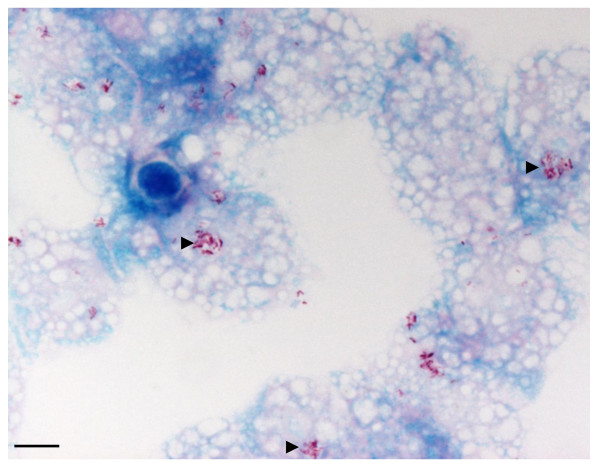
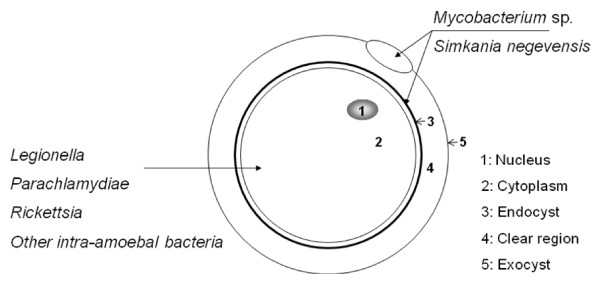
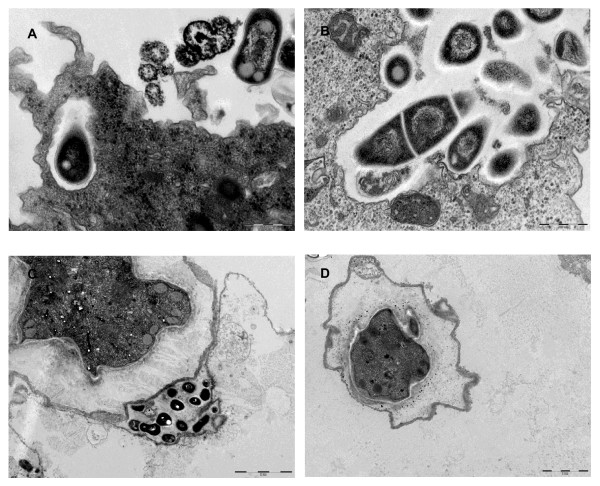
Type strains for M. avium, Mycobacterium intracellulare, Mycobacterium chimaera, Mycobacterium colombiense, Mycobacterium arosiense, Mycobacterium marseillense, Mycobacterium timonense and Mycobacterium bouchedurhonense were co-cultivated with the free-living amoeba Acanthamoeba polyphaga strain Linc-AP1. Microscopic analyses demonstrated the engulfment and replication of mycobacteria into vacuoles of A. polyphaga trophozoites. Mycobacteria were further entrapped within amoebal cysts, and survived encystment as demonstrated by subculturing. Electron microscopy observations show that, three days after entrapment into A. polyphaga cysts, all MAC members typically resided within the exocyst.
Combined with published data, these observations indicate that mycobacteria are unique among amoeba-resistant bacteria, in residing within the exocyst.
大多数环境分枝杆菌已被证明能够抵抗自由生活的阿米巴虫,随后表现出更强的毒力和对抗生素和杀生剂的抗性。鸟分枝杆菌复合体(MAC)由栖息在广泛生态位的环境生物体组成,表现出显著的遗传变异性。我们在此研究了 MAC 的所有成员在阿米巴虫内的定位,作为环境分枝杆菌的模型生物。
用自由生活的阿米巴虫棘阿米巴属多形虫株 Linc-AP1 共同培养 MAC 的模式菌株,包括鸟分枝杆菌、胞内分枝杆菌、奇美拉分枝杆菌、哥伦比亚分枝杆菌、阿罗分枝杆菌、马赛分枝杆菌、蒂姆诺分枝杆菌和布凯东分枝杆菌。显微镜分析表明,分枝杆菌被阿米巴虫滋养体吞噬并在其空泡内复制。分枝杆菌进一步被包入阿米巴虫包囊内,并通过继代培养证明其能在包囊形成中存活。电子显微镜观察显示,在被包入棘阿米巴虫包囊三天后,所有 MAC 成员通常都位于外囊内。
结合已发表的数据,这些观察结果表明,分枝杆菌在驻留在外囊内方面是阿米巴虫抗性细菌中独特的。