Deng Li, Gwiazda Jane, Thorn Frank
Department of Vision Science, New England College of Optometry, Boston, Massachusetts 02115, USA.
Optom Vis Sci. 2010 Jun;87(6):406-13. doi: 10.1097/OPX.0b013e3181da8a85.
To investigate the association of children's refractive errors with their visual activities assessed by questionnaire in the school year and summer break (June, July, and August).
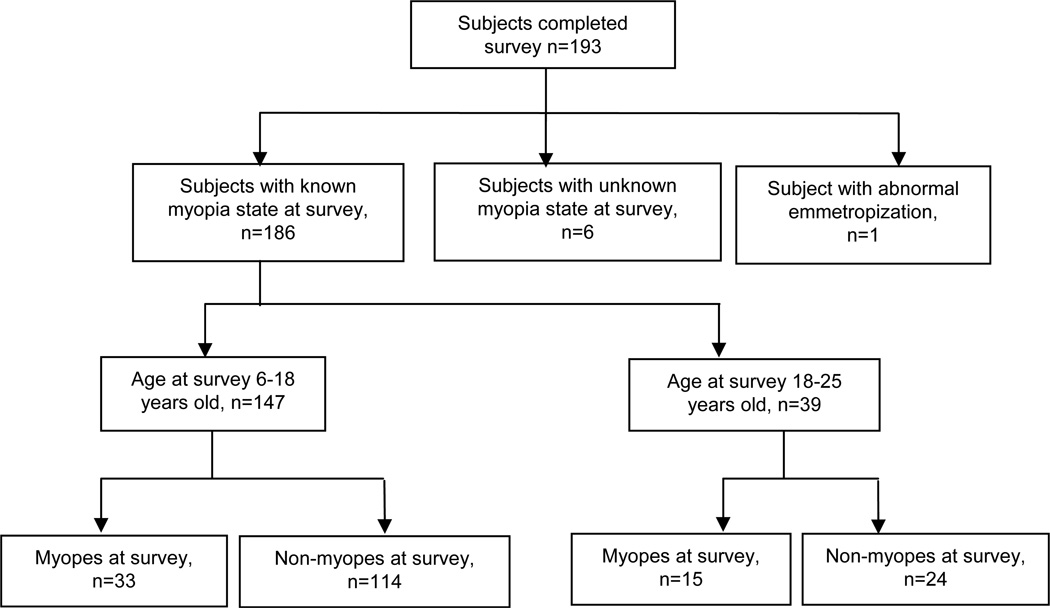
The parents of 147 children aged 6 to 18 years participating in a longitudinal study of refraction and visual function filled out a questionnaire in 1999 listing the number of weekly hours outside of school that the children read for pleasure, studied, watched TV, used the computer/played video games, and engaged in sports/outdoor activities. They also provided hours for these activities during the summer break. Refractions were measured annually by non-cycloplegic distance retinoscopy. Myopes refer to subjects who were myopic (spherical equivalent < -0.5 diopter) at the time of the survey and non-myopes (spherical equivalent refraction > or = -0.5 diopter) were emmetropic or in a few cases hyperopic at survey time.
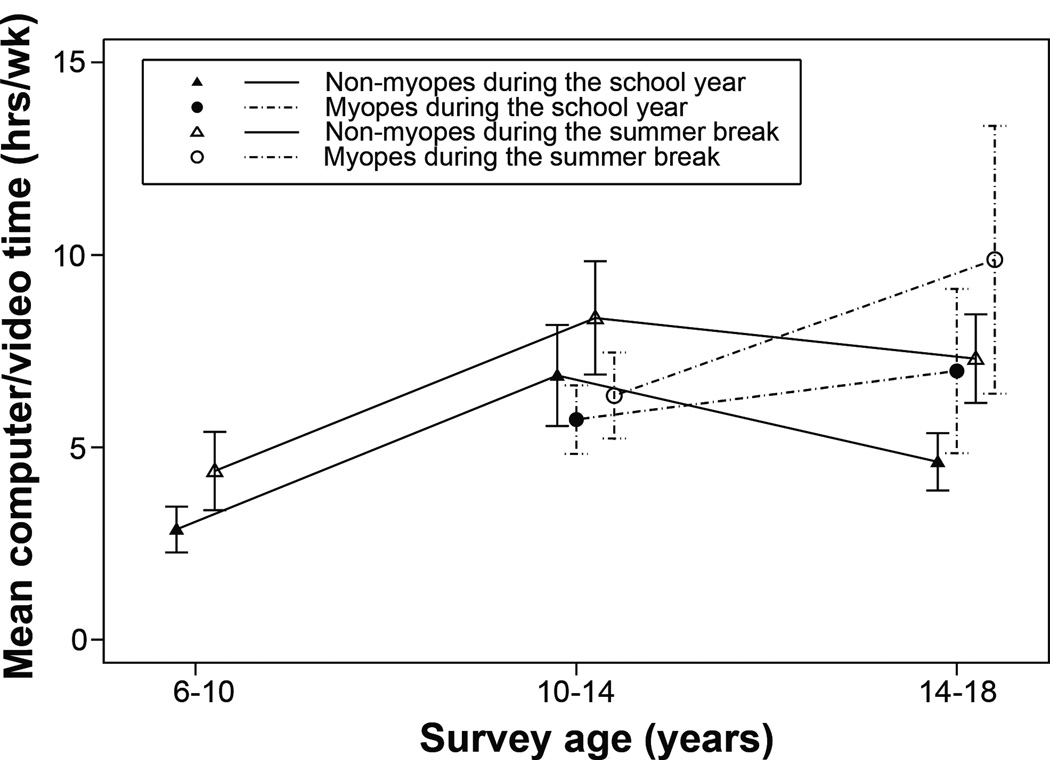
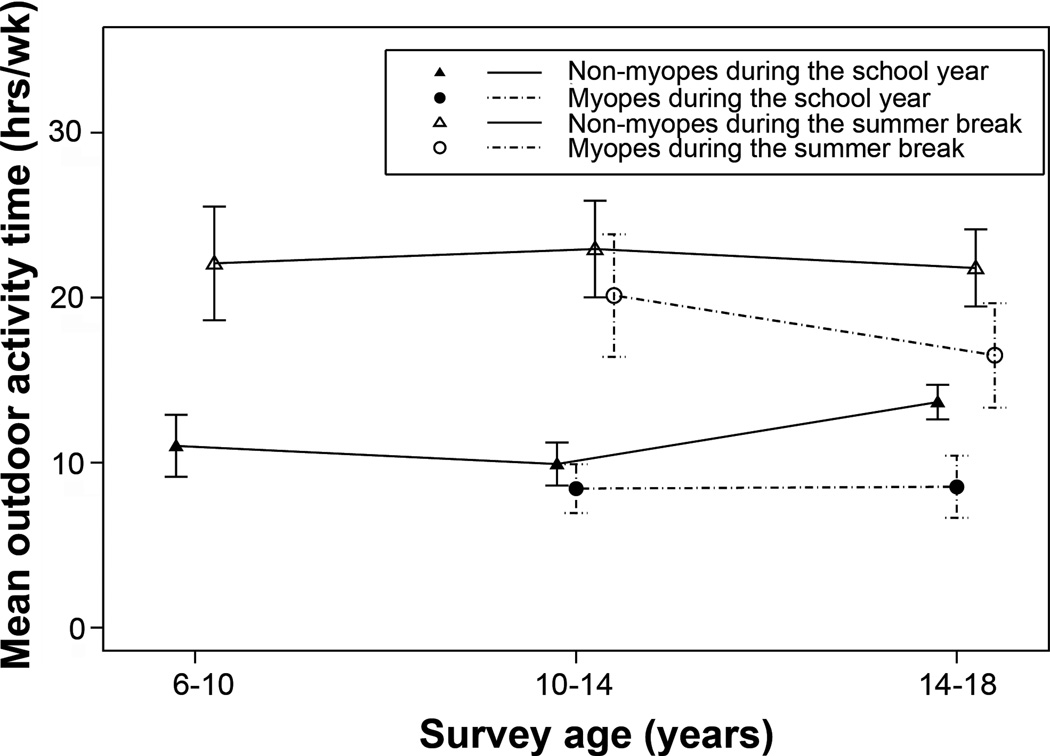
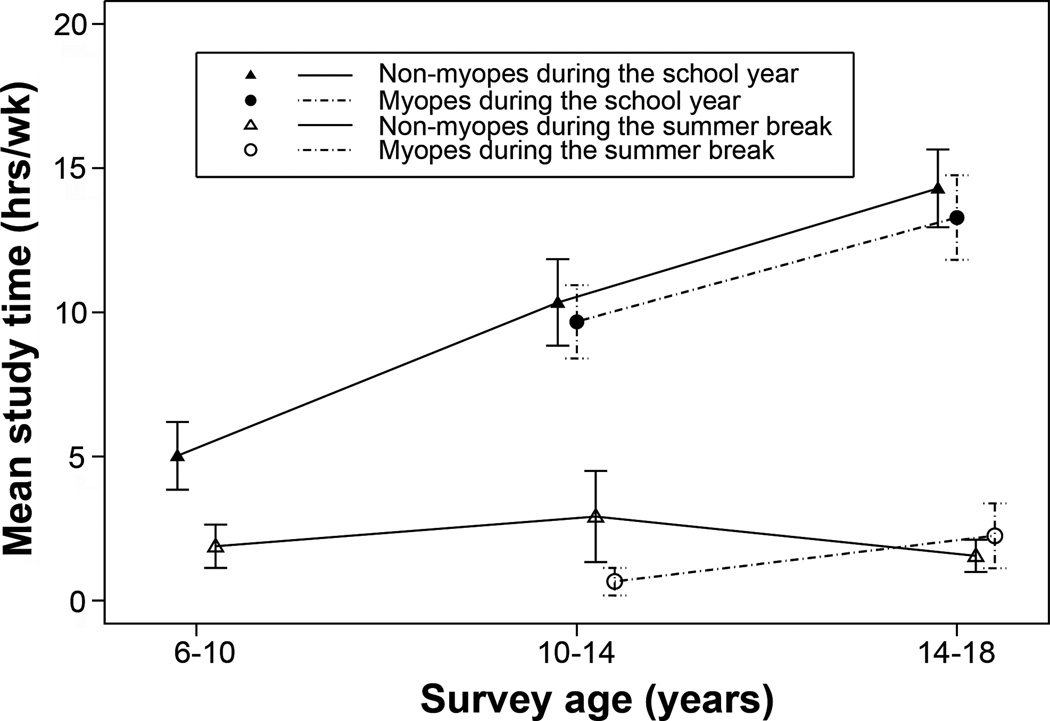
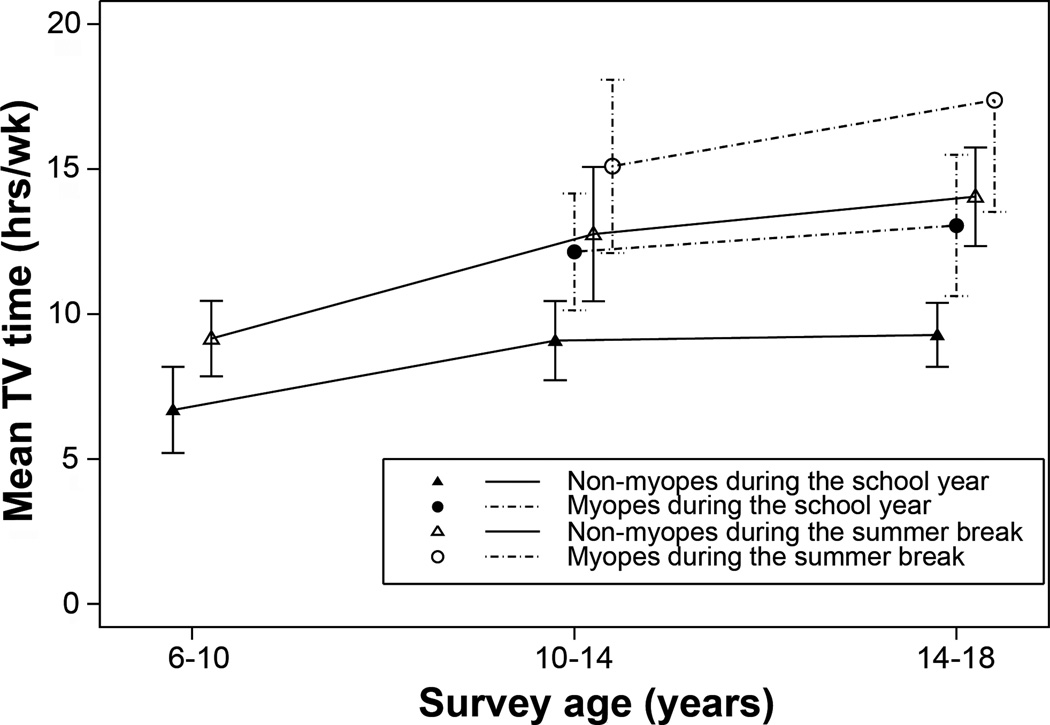
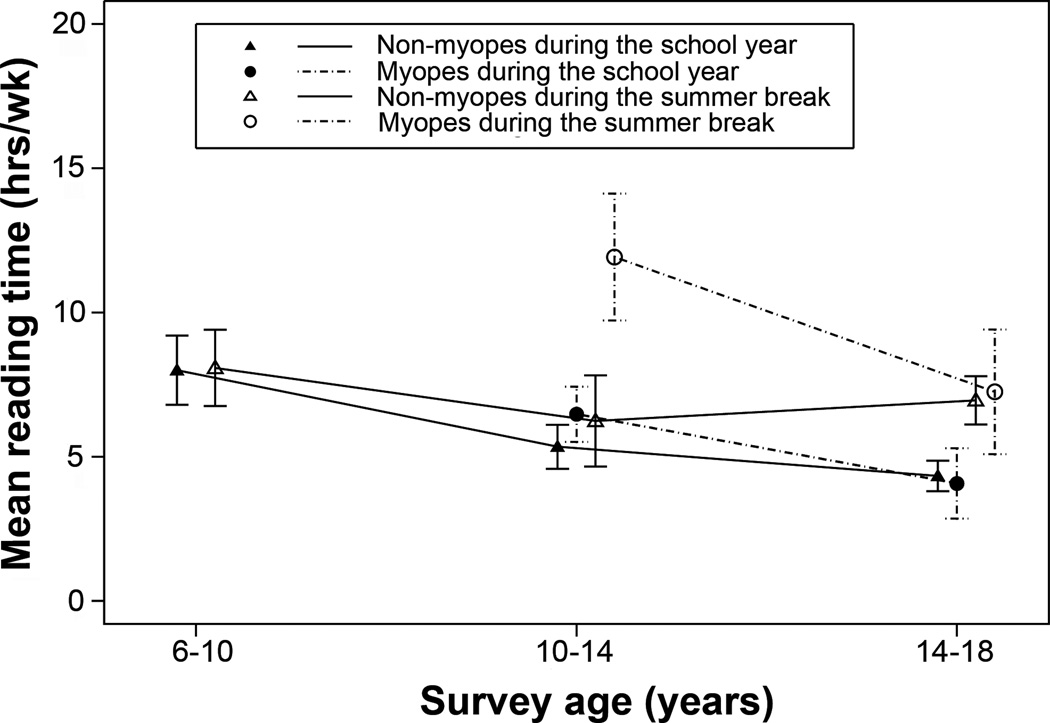
During the school year, myopes spent significantly fewer hours (8.25 +/- 6.24 h/week) than non-myopes (10.95 +/- 5.95 h/week) in sports/outdoor activity (p < 0.05). In addition, myopes (12.78 +/- 9.28 h/week) watched more television than non-myopes (8.91 +/- 5.95 h/week) (p = 0.02). No significant refractive group differences were found for other activities. During the summer break, no significant differences were found between refractive groups in any visual activity times. No significant correlations between sports/outdoor activity and TV time were found. Overall, the biggest differences between summer and school activity times were found in outdoor activity (21.76 +/- 13.80 vs.10.34 +/- 6.10 h/week; p < 0.001) and studying (1.69 +/- 3.71 vs. 9.51 +/- 6.96 h/week; p < 0.001).
In agreement with other studies, the non-myopes had more hours of sports/outdoor activity during the school year, which may protect against myopia development. A new finding is the high number of sports/outdoor activity hours for both myopes and non-myopes during the summer break, which may contribute to slowed eye growth in all children during these 3 months.
通过问卷调查,研究学年期间和暑假(6月、7月和8月)儿童屈光不正与视觉活动之间的关联。
147名6至18岁参与屈光和视觉功能纵向研究的儿童的家长于1999年填写了一份问卷,列出孩子们在课外每周用于阅读消遣、学习、看电视、使用电脑/玩电子游戏以及进行体育/户外活动的小时数。他们还提供了暑假期间这些活动的时长。每年通过非散瞳验光测量屈光度数。近视者是指在调查时近视(等效球镜度数<-0.5屈光度)的受试者,非近视者(等效球镜度数≥-0.5屈光度)在调查时为正视,少数情况下为远视。
在学年期间,近视者进行体育/户外活动的时间(8.25±6.24小时/周)显著少于非近视者(10.95±5.95小时/周)(p<0.05)。此外,近视者(12.78±9.28小时/周)看电视的时间比非近视者(8.91±5.95小时/周)更多(p = 0.02)。在其他活动方面,屈光组之间未发现显著差异。在暑假期间,屈光组在任何视觉活动时间上均未发现显著差异。体育/户外活动时间与看电视时间之间未发现显著相关性。总体而言,暑假和学年活动时间的最大差异在于户外活动(21.76±13.80 vs.10.34±6.10小时/周;p<0.001)和学习(1.69±3.71 vs. 9.51±6.96小时/周;p<0.001)。
与其他研究一致,非近视者在学年期间进行体育/户外活动的时间更多,这可能有助于预防近视的发生。一项新发现是,近视者和非近视者在暑假期间进行体育/户外活动的时间都很多,这可能有助于在这3个月内减缓所有儿童眼睛的生长。