National Swedish Prevention of Mental Ill-Health and Suicide (NASP), Karolinska Institutet, Stockholm, Sweden.
BMC Public Health. 2010 Apr 13;10:192. doi: 10.1186/1471-2458-10-192.
There have been only a few reports illustrating the moderate effectiveness of suicide-preventive interventions in reducing suicidal behavior, and, in most of those studies, the target populations were primarily adults, whereas few focused on adolescents. Essentially, there have been no randomized controlled studies comparing the efficacy, cost-effectiveness and cultural adaptability of suicide-prevention strategies in schools. There is also a lack of information on whether suicide-preventive interventions can, in addition to preventing suicide, reduce risk behaviors and promote healthier ones as well as improve young people's mental health.The aim of the SEYLE project, which is funded by the European Union under the Seventh Framework Health Program, is to address these issues by collecting baseline and follow-up data on health and well-being among European adolescents and compiling an epidemiological database; testing, in a randomized controlled trial, three different suicide-preventive interventions; evaluating the outcome of each intervention in comparison with a control group from a multidisciplinary perspective; as well as recommending culturally adjusted models for promoting mental health and preventing suicidal behaviors.
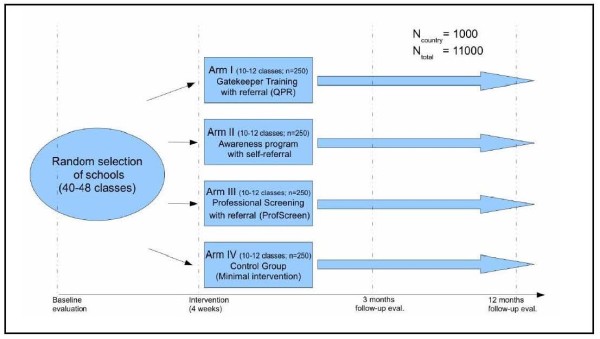
The study comprises 11,000 adolescents emitted from randomized schools in 11 European countries: Austria, Estonia, France, Germany, Hungary, Ireland, Israel, Italy, Romania, Slovenia and Spain, with Sweden serving as the scientific coordinating center. Each country performs three active interventions and one minimal intervention as a control group. The active interventions include gatekeeper training (QPR), awareness training on mental health promotion for adolescents, and screening for at-risk adolescents by health professionals. Structured questionnaires are utilized at baseline, 3- and 12-month follow-ups in order to assess changes.
Although it has been reported that suicide-preventive interventions can be effective in decreasing suicidal behavior, well-documented and randomized studies are lacking. The effects of such interventions in terms of combating unhealthy lifestyles in young people, which often characterize suicidal individuals, have never been reported. We know that unhealthy and risk-taking behaviors are detrimental to individuals' current and future health. It is, therefore, crucial to test well-designed, longitudinal mental health-promoting and suicide-preventive interventions by evaluating the implications of such activities for reducing unhealthy and risk behaviors while concurrently promoting healthy ones.
The German Clinical Trials Register, DRKS00000214.
仅有少数报告表明,预防自杀干预在减少自杀行为方面具有中等效果,而且在大多数这些研究中,目标人群主要是成年人,而很少关注青少年。实际上,没有随机对照研究比较学校预防自杀策略的疗效、成本效益和文化适应性。也缺乏关于预防自杀干预是否除了预防自杀之外,还可以减少风险行为、促进更健康的行为以及改善年轻人心理健康的信息。SEYLE 项目由欧盟在第七框架健康计划下资助,旨在通过收集欧洲青少年健康和幸福感的基线和随访数据来解决这些问题,并编制一个流行病学数据库;在一项随机对照试验中测试三种不同的预防自杀干预措施;从多学科角度评估每种干预措施的结果,并与对照组进行比较;以及推荐促进心理健康和预防自杀行为的文化适应性模型。
该研究包括来自 11 个欧洲国家(奥地利、爱沙尼亚、法国、德国、匈牙利、爱尔兰、以色列、意大利、罗马尼亚、斯洛文尼亚和西班牙)的 11000 名随机学校的青少年:瑞典作为科学协调中心。每个国家进行三种积极干预和一种作为对照组的最小干预。积极干预措施包括守门员培训(QPR)、青少年心理健康促进意识培训、以及卫生专业人员对高危青少年的筛查。在基线、3 个月和 12 个月的随访中使用结构化问卷来评估变化。
虽然已经报道预防自杀干预可以有效减少自杀行为,但缺乏有充分记录和随机的研究。这些干预措施在对抗年轻人不健康生活方式方面的效果,而这些不健康的生活方式往往是自杀个体的特征,从未有过报道。我们知道,不健康和冒险行为对个人的当前和未来健康都是有害的。因此,通过评估这些活动对减少不健康和风险行为同时促进健康行为的影响,测试精心设计的、纵向的促进心理健康和预防自杀的干预措施至关重要。
德国临床试验注册处,DRKS00000214。