Primary Care Research Institute IDIAP Jordi Gol, Catalan Institute of Health, Lleida, Spain.
BMC Public Health. 2010 May 17;10:255. doi: 10.1186/1471-2458-10-255.
Health professionals and organizations in developed countries adapt slowly to the increase of ethnically diverse populations attending health care centres. Several studies report that attention to immigrant mental health comes up with barriers in access, diagnosis and therapeutics, threatening equity. This study analyzes differences in exposure to antidepressant drugs between the immigrant and the native population of a Spanish health region.
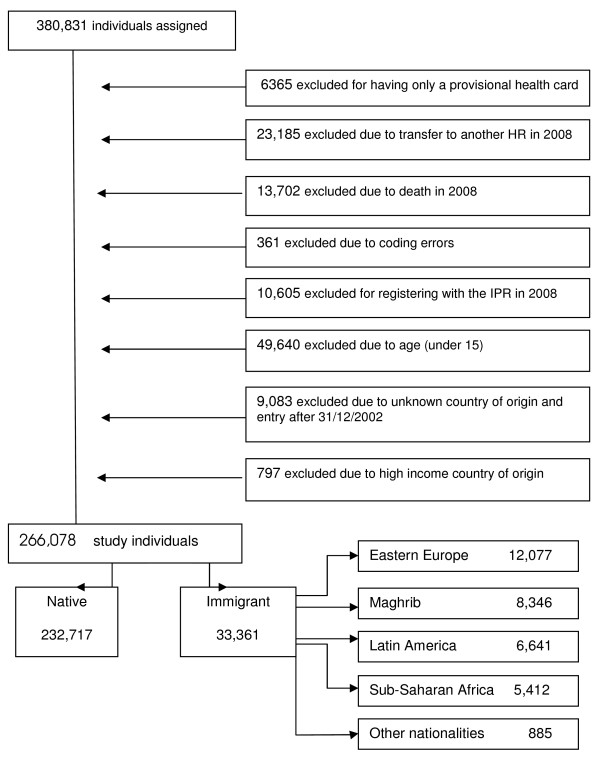
Cross-sectional study of the dispensation of antidepressant drugs to the population aged 15 years or older attending the public primary health centres of a health region, 232,717 autochthonous and 33,361 immigrants, during 2008. Data were obtained from computerized medical records and pharmaceutical records of medications dispensed in pharmacies. Age, sex, country of origin, visits, date of entry in the regional health system, generic drugs and active ingredients were considered. Statistical analysis expressed the percentage of persons exposed to antidepressants stratified by age, gender, and country of origin and prevalence ratios of antidepressant exposition were calculated.
Antidepressants were dispensed to 11% of native population and 2.6% of immigrants. Depending on age, native women were prescribed antidepressants between 1.9 and 2.7 times more than immigrant women, and native men 2.5 and 3.1 times more than their immigrant counterparts. Among immigrant females, the highest rate was found in the Latin Americans (6.6%) and the lowest in the sub-Saharans (1.4%). Among males, the highest use was also found in the Latin Americans (1.6%) and the lowest in the sub-Saharans (0.7%). The percentage of immigrants prescribed antidepressants increased significantly in relation to the number of years registered with the local health system. Significant differences were found for the new antidepressants, prescribed 8% more in the native population than in immigrants, both in men and in women.
All the immigrants, regardless of the country of origin, had lower antidepressant consumption than the native population of the same age and sex. Latin American women presented the highest levels of consumption, and the sub-Saharan men the lowest. The prescription profiles also differed, since immigrants consumed more generics and fewer recently commercialized active ingredients.
在发达国家,医疗专业人员和机构对越来越多的不同族裔人群到医疗中心就诊的适应速度较慢。多项研究报告称,关注移民的心理健康会在获取服务、诊断和治疗方面存在障碍,从而威胁公平性。本研究分析了西班牙某一卫生区域移民和本地人群接受抗抑郁药物治疗的差异。
对 2008 年在该卫生区域的公立初级保健中心就诊的 15 岁及以上人群(232717 名本地人和 33361 名移民)使用抗抑郁药物的情况进行了横断面研究。数据来源于计算机化的医疗记录和药店配药记录。考虑了年龄、性别、原籍国、就诊次数、进入区域卫生系统的日期、非专利药物和活性成分。统计分析以年龄、性别和原籍国分层表示暴露于抗抑郁药物的人数,并计算了抗抑郁药物暴露的患病率比。
11%的本地人和 2.6%的移民使用了抗抑郁药物。按年龄划分,本地女性比移民女性开出抗抑郁药物的比例高 1.9 至 2.7 倍,本地男性比移民男性开出抗抑郁药物的比例高 2.5 至 3.1 倍。在移民女性中,拉丁美洲人最高(6.6%),撒哈拉以南非洲人最低(1.4%)。在男性中,拉丁美洲人最高(1.6%),撒哈拉以南非洲人最低(0.7%)。随着在当地卫生系统登记年限的增加,开出抗抑郁药物的移民人数显著增加。与移民相比,新的抗抑郁药物在本地人群中的使用率高出 8%,无论男女均如此。
所有移民无论原籍国如何,使用抗抑郁药物的比例均低于同年龄和性别的本地人群。拉丁美洲女性的使用率最高,撒哈拉以南非洲男性的使用率最低。处方模式也存在差异,因为移民使用的非专利药物更多,最近商业化的活性成分更少。