San Diego Supercomputer Center, University of California San Diego, 9500 Gilman Drive, La Jolla, CA 92093, USA.
Nucleic Acids Res. 2010 Jul;38(Web Server issue):W441-4. doi: 10.1093/nar/gkq400. Epub 2010 May 19.
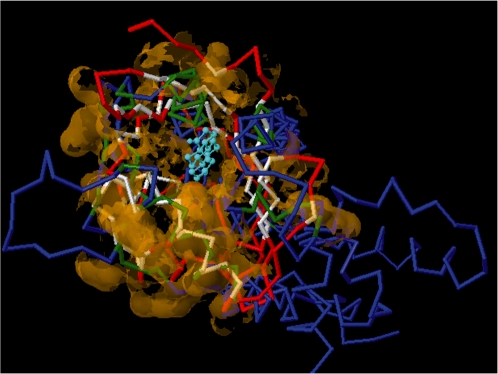
The proteome-wide characterization and analysis of protein ligand-binding sites and their interactions with ligands can provide pivotal information in understanding the structure, function and evolution of proteins and for designing safe and efficient therapeutics. The SMAP web service (SMAP-WS) meets this need through parallel computations designed for 3D ligand-binding site comparison and similarity searching on a structural proteome scale. SMAP-WS implements a shape descriptor (the Geometric Potential) that characterizes both local and global topological properties of the protein structure and which can be used to predict the likely ligand-binding pocket [Xie,L. and Bourne,P.E. (2007) A robust and efficient algorithm for the shape description of protein structures and its application in predicting ligand-binding sites. BMC bioinformatics, 8 (Suppl. 4.), S9.]. Subsequently a sequence order independent profile-profile alignment (SOIPPA) algorithm is used to detect and align similar pockets thereby finding protein functional and evolutionary relationships across fold space [Xie, L. and Bourne, P.E. (2008) Detecting evolutionary relationships across existing fold space, using sequence order-independent profile-profile alignments. Proc. Natl Acad. Sci. USA, 105, 5441-5446]. An extreme value distribution model estimates the statistical significance of the match [Xie, L., Xie, L. and Bourne, P.E. (2009) A unified statistical model to support local sequence order independent similarity searching for ligand-binding sites and its application to genome-based drug discovery. Bioinformatics, 25, i305-i312.]. These algorithms have been extensively benchmarked and shown to outperform most existing algorithms. Moreover, several predictions resulting from SMAP-WS have been validated experimentally. Thus far SMAP-WS has been applied to predict drug side effects, and to repurpose existing drugs for new indications. SMAP-WS provides both a user-friendly web interface and programming API for scientists to address a wide range of compute intense questions in biology and drug discovery. SMAP-WS is available from the URL http://smap.nbcr.net.
蛋白质组范围内对蛋白质配体结合位点及其与配体相互作用的特征化和分析,可以为理解蛋白质的结构、功能和进化以及设计安全有效的治疗方法提供关键信息。SMAP 网络服务(SMAP-WS)通过并行计算来满足这一需求,这些计算旨在对结构蛋白质组进行 3D 配体结合位点比较和相似性搜索。SMAP-WS 实现了一种形状描述符(几何势能),该描述符可以描述蛋白质结构的局部和全局拓扑性质,并可用于预测可能的配体结合口袋 [Xie,L. 和 Bourne,P.E. (2007) 一种用于蛋白质结构形状描述的稳健而高效的算法及其在预测配体结合位点中的应用。BMC 生物信息学,8(增刊 4),S9。]。随后,使用序列独立的轮廓-轮廓比对(SOIPPA)算法来检测和对齐相似口袋,从而在折叠空间中发现蛋白质的功能和进化关系 [Xie, L. 和 Bourne, P.E. (2008) 使用序列独立的轮廓-轮廓比对检测现有折叠空间中的进化关系。Proc. Natl Acad. Sci. USA, 105, 5441-5446]。极值分布模型估计匹配的统计显著性 [Xie, L., Xie, L. 和 Bourne, P.E. (2009) 一种支持配体结合位点局部序列独立相似搜索的统一统计模型及其在基于基因组的药物发现中的应用。生物信息学,25,i305-i312]。这些算法已经经过广泛的基准测试,并且表现优于大多数现有的算法。此外,SMAP-WS 的一些预测已经通过实验得到验证。到目前为止,SMAP-WS 已经被用于预测药物的副作用,并重新利用现有的药物用于新的适应症。SMAP-WS 为科学家提供了一个用户友好的网络界面和编程 API,以解决生物学和药物发现中广泛的计算密集型问题。SMAP-WS 可从 URL http://smap.nbcr.net 获得。