Biology Department, The University of Texas at San Antonio, San Antonio, Texas, United States of America.
PLoS Comput Biol. 2010 May 13;6(5):e1000780. doi: 10.1371/journal.pcbi.1000780.
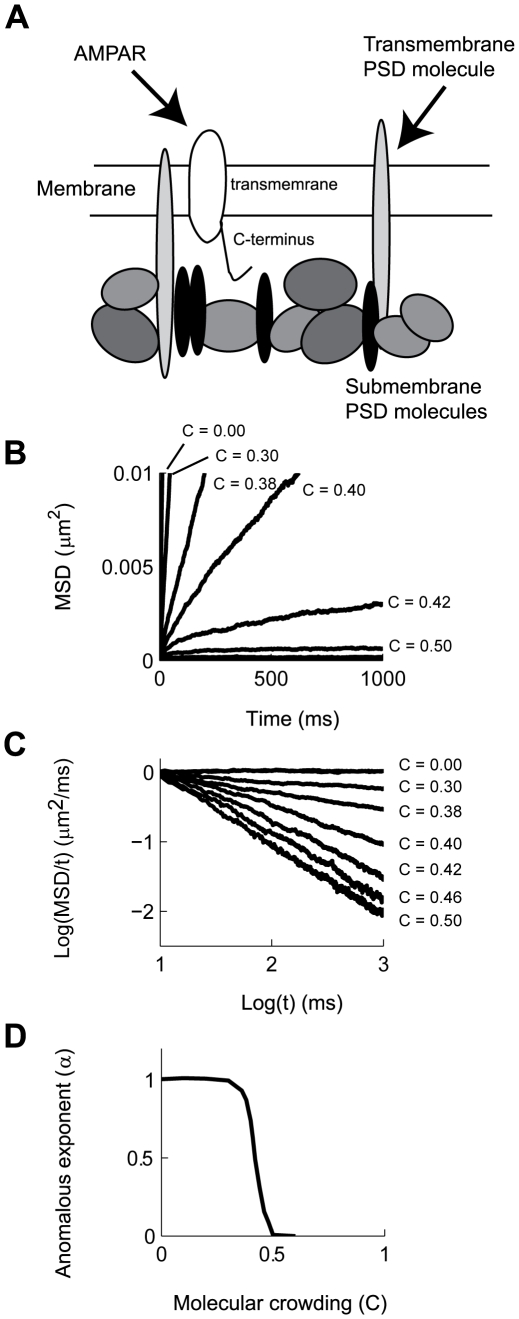
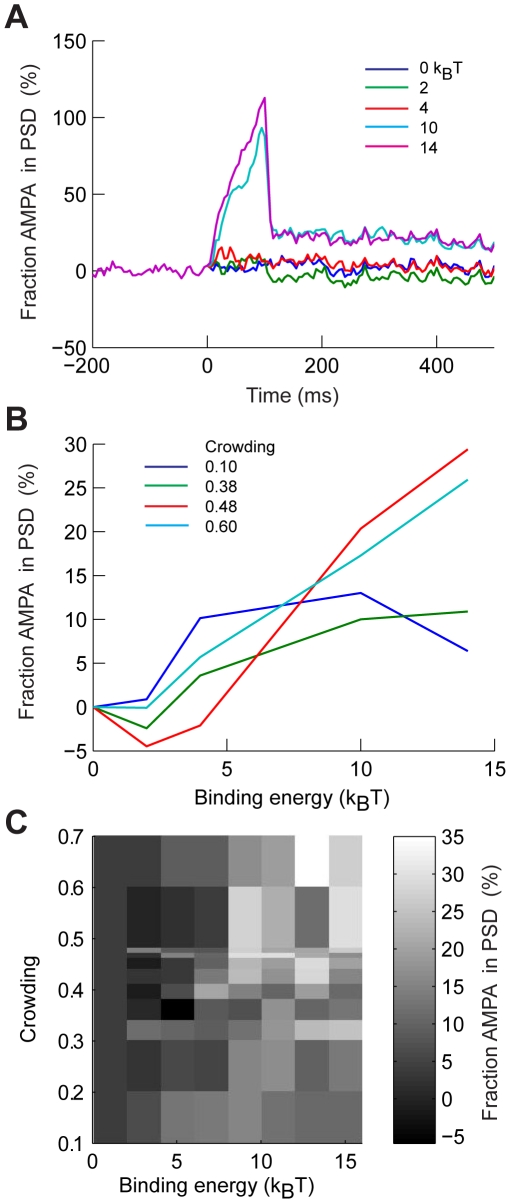
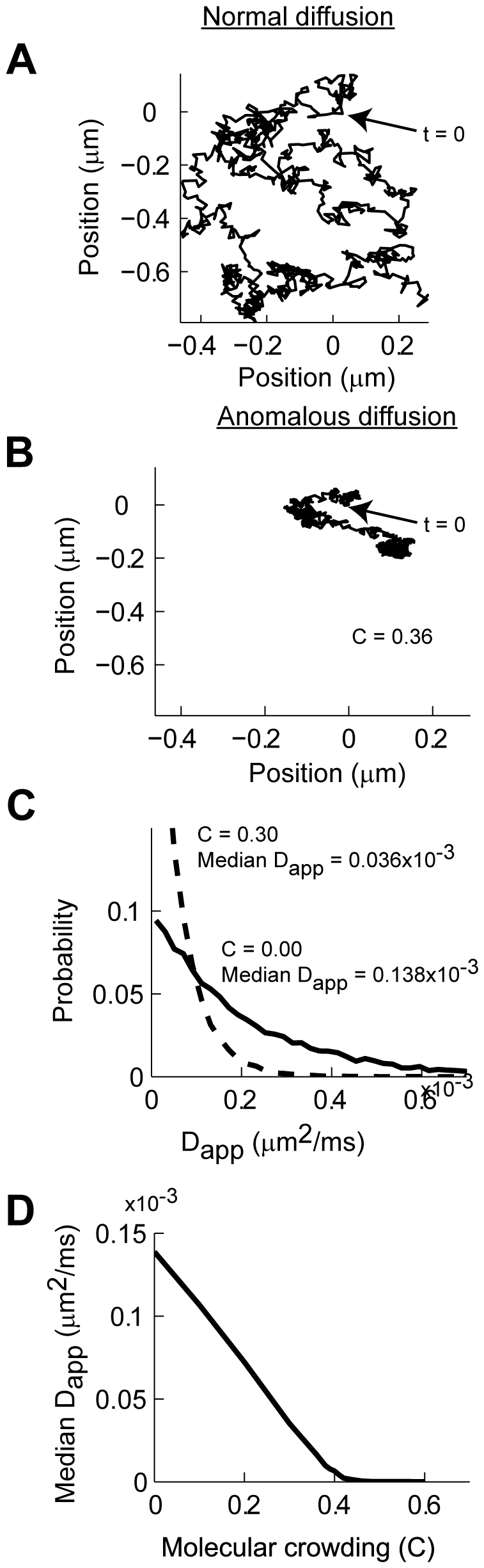
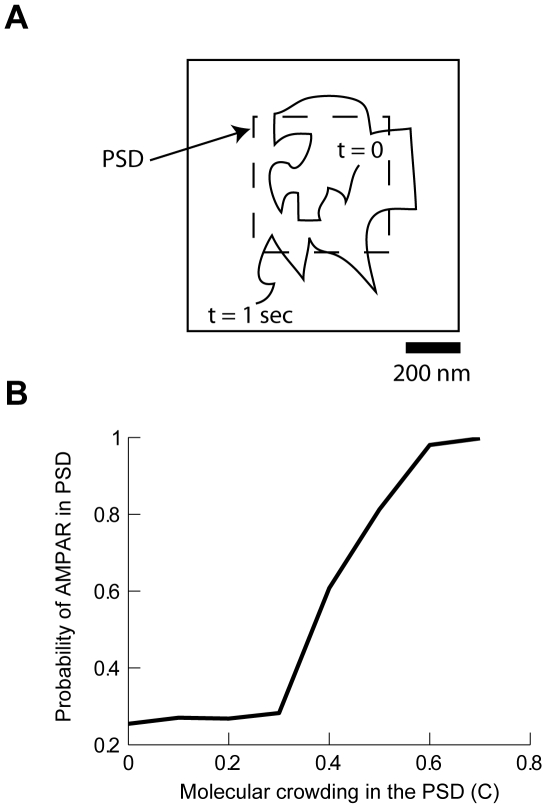
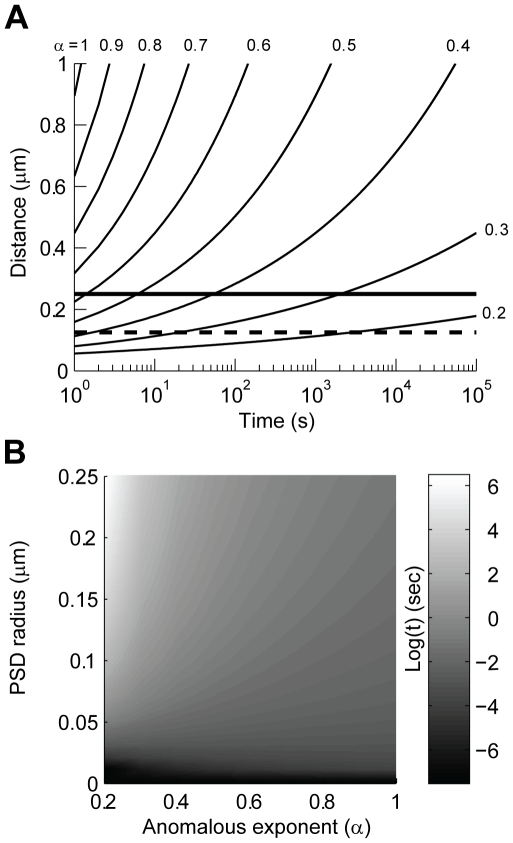
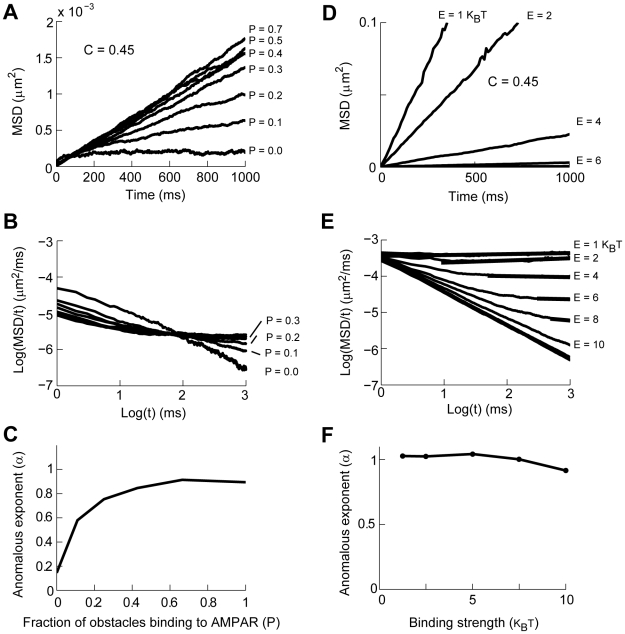
One mechanism of information storage in neurons is believed to be determined by the strength of synaptic contacts. The strength of an excitatory synapse is partially due to the concentration of a particular type of ionotropic glutamate receptor (AMPAR) in the post-synaptic density (PSD). AMPAR concentration in the PSD has to be plastic, to allow the storage of new memories; but it also has to be stable to preserve important information. Although much is known about the molecular identity of synapses, the biophysical mechanisms by which AMPAR can enter, leave and remain in the synapse are unclear. We used Monte Carlo simulations to determine the influence of PSD structure and activity in maintaining homeostatic concentrations of AMPARs in the synapse. We found that, the high concentration and excluded volume caused by PSD molecules result in molecular crowding. Diffusion of AMPAR in the PSD under such conditions is anomalous. Anomalous diffusion of AMPAR results in retention of these receptors inside the PSD for periods ranging from minutes to several hours in the absence of strong binding of receptors to PSD molecules. Trapping of receptors in the PSD by crowding effects was very sensitive to the concentration of PSD molecules, showing a switch-like behavior for retention of receptors. Non-covalent binding of AMPAR to anchored PSD molecules allowed the synapse to become well-mixed, resulting in normal diffusion of AMPAR. Binding also allowed the exchange of receptors in and out of the PSD. We propose that molecular crowding is an important biophysical mechanism to maintain homeostatic synaptic concentrations of AMPARs in the PSD without the need of energetically expensive biochemical reactions. In this context, binding of AMPAR with PSD molecules could collaborate with crowding to maintain synaptic homeostasis but could also allow synaptic plasticity by increasing the exchange of these receptors with the surrounding extra-synaptic membrane.
神经元中信息存储的一种机制被认为取决于突触接触的强度。兴奋性突触的强度部分取决于在后突触密度 (PSD) 中特定类型的离子型谷氨酸受体 (AMPA 受体) 的浓度。PSD 中的 AMPA 受体浓度必须具有可塑性,以允许新记忆的存储;但它也必须稳定以保存重要信息。尽管人们对突触的分子特性了解很多,但 AMPA 进入、离开和留在突触的生物物理机制尚不清楚。我们使用蒙特卡罗模拟来确定 PSD 结构和活动对维持突触中 AMPA 受体的稳态浓度的影响。我们发现,PSD 分子导致的高浓度和排除体积导致分子拥挤。在这种情况下,AMPA 受体在 PSD 中的扩散是异常的。AMPA 受体的异常扩散导致这些受体在没有受体与 PSD 分子强烈结合的情况下,在几分钟到几个小时的时间内保留在 PSD 内。受体在 PSD 中的捕获受拥挤效应的影响非常敏感,对 PSD 分子浓度表现出类似开关的行为,保留受体。AMPA 受体与锚定的 PSD 分子的非共价结合允许突触变得充分混合,从而导致 AMPA 受体的正常扩散。结合还允许受体在 PSD 内外交换。我们提出,分子拥挤是一种重要的生物物理机制,可以在不需要能量昂贵的生化反应的情况下维持 PSD 中 AMPA 受体的稳态突触浓度。在这种情况下,AMPA 受体与 PSD 分子的结合可以与拥挤合作来维持突触稳态,但也可以通过增加这些受体与周围突触外膜的交换来允许突触可塑性。