Vårdalinstitutet, The Swedish Institute for Health Sciences, Universities of Gothenburg and Lund, Sweden.
BMC Geriatr. 2010 May 26;10:27. doi: 10.1186/1471-2318-10-27.
The very old (80+) are often described as a "frail" group that is particularly exposed to diseases and functional disability. They are at great risk of losing the ability to manage their activities of daily living independently. A health-promoting intervention programme might prevent or delay dependence in activities of daily life and the development of functional decline. Studies have shown that those who benefit most from a health-promoting and disease-preventive programme are persons with no, or discrete, activity restrictions. The three-armed study "Elderly in the risk zone" is designed to evaluate if multi-dimensional and multi-professional educational senior meetings are more effective than preventive home visits, and if it is possible to prevent or delay deterioration if an intervention is made when the persons are not so frail. In this paper the study design, the intervention and the outcome measures as well as the baseline characteristics of the study participants are presented.
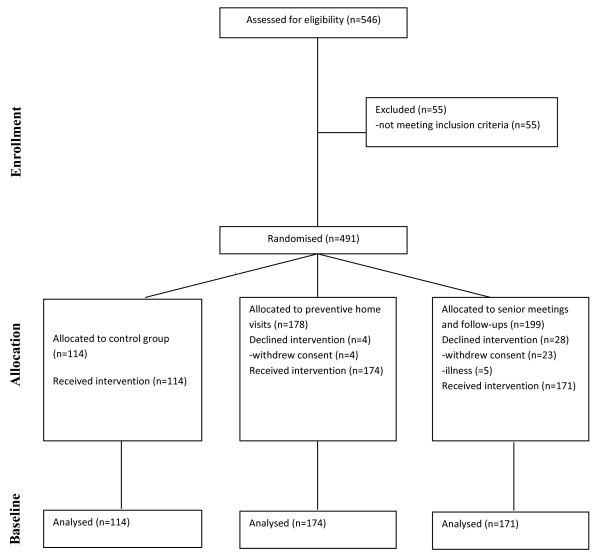
METHODS/DESIGN: The study is a randomised three-armed single-blind controlled trial with follow-ups 3 months, 1 and 2 years. The study group should comprise a representative sample of pre-frail 80-year old persons still living at home in two municipalities of Gothenburg. To allow for drop-outs, it was estimated that a total of about 450 persons would need to be included in the study. The participants should live in their ordinary housing and not be dependent on the municipal home help service or care. Further, they should be independent of help from another person in activities of daily living and be cognitively intact, having a score of 25 or higher as assessed with the Mini Mental State Examination (MMSE).
We believe that the design of the study, the randomisation procedure, outcome measurements and the study protocol meetings should ensure the quality of the study. Furthermore, the multi-dimensionality of the intervention, the involvement of both the professionals and the senior citizens in the planning of the intervention should have the potential to effectively target the heterogeneous needs of the elderly.
通常情况下,非常高龄的老年人(80 岁以上)被描述为一个“脆弱”的群体,他们特别容易受到疾病和功能障碍的影响。他们有很大的风险失去独立管理日常生活活动的能力。健康促进干预计划可能会预防或延迟日常生活活动的依赖和功能下降的发展。研究表明,那些从健康促进和疾病预防计划中受益最大的人是没有或离散的活动限制的人。“处于危险中的老年人”三臂研究旨在评估多维和多专业教育老年人会议是否比预防性家访更有效,如果在干预时个人没有那么脆弱,是否有可能预防或延迟恶化。本文介绍了研究设计、干预措施和结果测量以及研究参与者的基线特征。
方法/设计:该研究是一项随机、三臂、单盲对照试验,随访时间为 3 个月、1 年和 2 年。研究组应包括居住在哥德堡两个市的仍在家中生活的脆弱 80 岁老年人的代表性样本。为了允许出现脱落情况,估计总共需要大约 450 人参加研究。参与者应居住在普通住房中,不依赖于市家庭帮助服务或护理。此外,他们应在日常生活活动中独立于他人的帮助,认知完整,用简易精神状态检查(MMSE)评估得分为 25 或更高。
我们相信研究设计、随机化程序、结果测量和研究方案会议应确保研究的质量。此外,干预措施的多维性、专业人员和老年人参与干预计划的规划,应该有潜力有效地针对老年人的异质需求。