Management, Policy, and Community Health Division, University of Texas School of Public Health, 1200 Pressler Drive, Houston, TX 77030, USA.
BMC Public Health. 2010 Jun 1;10:296. doi: 10.1186/1471-2458-10-296.
Among European countries, Italy is one of the countries where regional health disparities contribute substantially to socioeconomic health disparities. In this paper, we report on regional differences in self-reported poor health and explore possible determinants at the individual and regional levels in Italy.
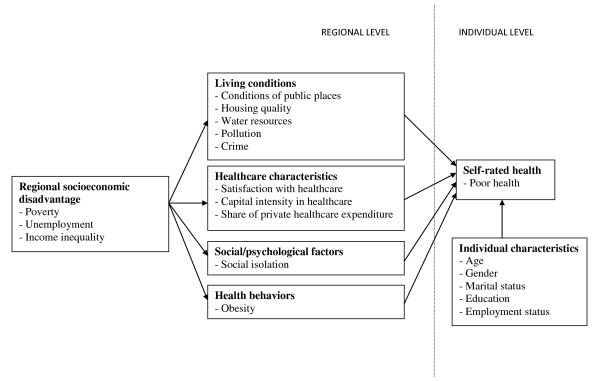
We use data from the "Indagine Multiscopo sulle Famiglie", a survey of aspects of everyday life in the Italian population, to estimate multilevel logistic regressions that model poor self-reported health as a function of individual and regional socioeconomic factors. Next we use the causal step approach to test if living conditions, healthcare characteristics, social isolation, and health behaviors at the regional level mediate the relationship between regional socioeconomic factors and self-rated health.
We find that residents living in regions with more poverty, more unemployment, and more income inequality are more likely to report poor health and that poor living conditions and private share of healthcare expenditures at the regional level mediate socioeconomic disparities in self-rated health among Italian regions.
The implications are that regional contexts matter and that regional policies in Italy have the potential to reduce health disparities by implementing interventions aimed at improving living conditions and access to quality healthcare.
在欧洲国家中,意大利是导致区域健康差异对社会经济健康差异影响较大的国家之一。本文报告了意大利自我报告的健康状况的区域差异,并探讨了个体和区域层面的可能决定因素。
我们使用来自“意大利多主题家庭调查”的数据,该调查是对意大利人口日常生活各个方面的调查,以估计多水平逻辑回归模型,该模型将自我报告的健康状况不佳作为个体和区域社会经济因素的函数。接下来,我们使用因果步骤方法来检验区域生活条件、医疗保健特征、社会隔离和健康行为是否在区域社会经济因素与自我评估健康之间的关系中起中介作用。
我们发现,生活在贫困、失业和收入不平等程度较高的地区的居民更有可能报告健康状况不佳,而区域层面的较差生活条件和私人医疗保健支出份额则在意大利各地区自我评估健康的社会经济差异中起中介作用。
这意味着区域背景很重要,意大利的区域政策有可能通过实施旨在改善生活条件和获得高质量医疗保健的干预措施来减少健康差异。