Naghavi Mohsen
Lancet Public Health. 2025 Apr;10(4):e309-e320. doi: 10.1016/S2468-2667(25)00045-3.
Over the past two decades, the Italian National Health Service has been gradually decentralised, with Italy's 21 regional governments now responsible for managing their health services. This change, coupled with austerity measures and a steadily ageing population, has adversely affected universal health coverage and equity, exacerbating inequalities and regional disparities. This study aimed to analyse time trends and subnational differences in the burden of disease from 2000 to 2019, and from 2019 to 2021 to capture the effects of the COVID-19 pandemic.
This study uses estimates for Italy from the Global Burden of Diseases, Injuries, and Risk Factors Study 2021. We analyse trends and geographical differences in disease burden from 2000 to 2021. Metrics include life expectancy, health-adjusted life expectancy (HALE), years lived with disability (YLDs), years of life lost (YLLs), and disability-adjusted life-years (DALYs) observed at national, macroregional, and subnational levels. Percent changes in rates, with both all-age and age-standardised rates, and 95% uncertainty intervals (95% UIs) are reported.
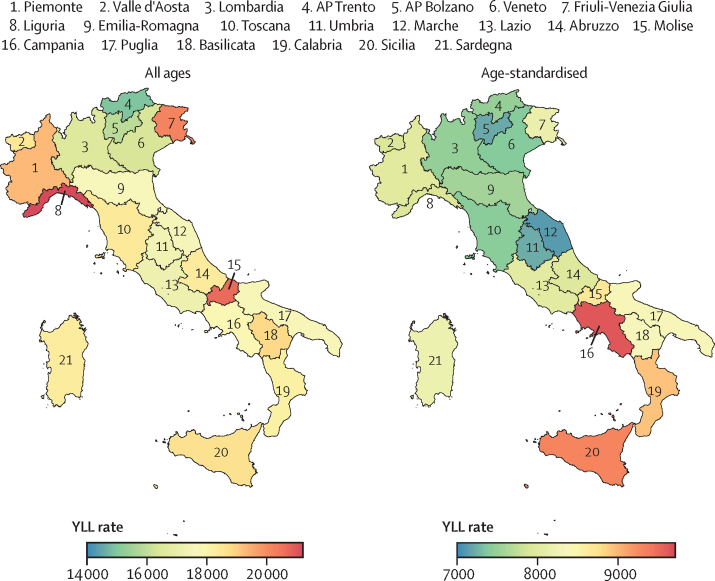
Life expectancy at birth in Italy increased from 79·6 years in 2000 to 83·4 years in 2019, dropped to 82·2 years in 2020 due to COVID-19, and recovered slightly to 82·7 years in 2021. HALE was 70·9 years (95% UI 67·4-73·8) in 2021. Substantial regional disparities were observed: in general, despite higher YLD rates, northern regions had better health outcomes, with higher life expectancy and HALE and lower YLL rates compared with southern regions. Overall, the top causes of YLDs were low back pain (1556·5 [1098·5-2080·2]), falls (926·2 [638·8-1253·8]), and headache disorders (858·0 [173·7-1808·2]). Anxiety and depressive disorders both had substantial increases in the period from 2019 to 2021 (19·8% and 17·3%, respectively). YLDs for Alzheimer's disease and diabetes increased substantially from 2000 to 2019 and 2019 to 2021 (70·6% and 3·0% for Alzheimer's disease and 46·8% and 7·9%, respectively for each timepoint). YLL rates declined for ischaemic heart disease from 2000 (-29·9% in 2019), but increased for Alzheimer's disease and other dementias (54·5%). DALY rates decreased overall from 2000 to 2019, but rose again in 2021 due to the COVID-19 pandemic.
The study highlights considerable regional disparities in Italy's health outcomes, driven by demography, heterogeneous health service quality, and economic inequalities. Addressing the increasing burden of Alzheimer's disease, diabetes, and mental health disorders, as well as regional disparities, requires strengthened preventive measures, equitable health service access, and socioeconomic policies, both at the national and regional levels.
Bill & Melinda Gates Foundation.
在过去二十年中,意大利国家医疗服务体系逐渐去中心化,如今由意大利的21个地区政府负责管理其医疗服务。这一变化,再加上紧缩措施和人口持续老龄化,对全民健康覆盖和公平性产生了不利影响,加剧了不平等和地区差异。本研究旨在分析2000年至2019年以及2019年至2021年疾病负担的时间趋势和国家以下层面的差异,以了解新冠疫情的影响。
本研究采用了《2021年全球疾病、伤害及风险因素负担研究》对意大利的估计数据。我们分析了2000年至2021年疾病负担的趋势和地理差异。指标包括预期寿命、健康调整生命 expectancy(HALE)、带病生存年数(YLDs)、寿命损失年数(YLLs)以及在国家、大区和国家以下层面观察到的伤残调整生命年(DALYs)。报告了全年龄率和年龄标准化率的百分比变化以及95%不确定性区间(95%UIs)。
意大利的出生预期寿命从2000年的79.6岁增至2019年的83.4岁,由于新冠疫情,2020年降至82.2岁,2021年略有回升至82.7岁。2021年的健康调整生命 expectancy为70.9岁(95%UI 67.4 - 73.8)。观察到显著的地区差异:总体而言,尽管带病生存年数率较高,但北部地区的健康状况更好,与南部地区相比,预期寿命和健康调整生命 expectancy更高,寿命损失年数率更低。总体而言,带病生存年数的主要原因是腰痛(1556.5[1098.5 - 2080.2])、跌倒(926.2[638.8 - 1253.8])和头痛障碍(858.0[173.7 - 1808.2])。2019年至2021年期间,焦虑症和抑郁症均大幅增加(分别为19.8%和17.3%)。2000年至2019年以及2019年至2021年,阿尔茨海默病和糖尿病的带病生存年数大幅增加(阿尔茨海默病在两个时间点分别为70.6%和3.0%,糖尿病分别为46.8%和7.9%)。2000年至2019年,缺血性心脏病的寿命损失年数率下降(2019年下降29.9%),但阿尔茨海默病和其他痴呆症的寿命损失年数率上升(54.5%)。2000年至2019年期间,伤残调整生命年率总体下降,但由于新冠疫情,2021年再次上升。
该研究突出了意大利健康状况存在显著的地区差异,这是由人口结构变化、医疗服务质量参差不齐以及经济不平等所导致的。应对阿尔茨海默病、糖尿病和精神健康障碍日益加重的负担以及地区差异,需要在国家和地区层面加强预防措施、实现公平的医疗服务可及性以及制定社会经济政策。
比尔及梅琳达·盖茨基金会。