Janelia Farm Research Campus, Howard Hughes Medical Institute, Ashburn, VA 20147, USA.
Bioinformatics. 2010 Jun 15;26(12):i38-46. doi: 10.1093/bioinformatics/btq212.
Digital reconstruction of 3D neuron structures is an important step toward reverse engineering the wiring and functions of a brain. However, despite a number of existing studies, this task is still challenging, especially when a 3D microscopic image has low single-to-noise ratio and discontinued segments of neurite patterns.
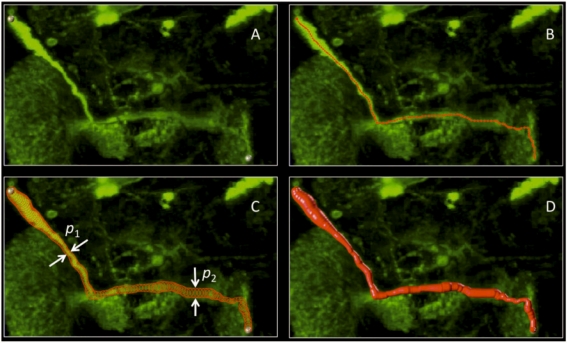
We developed a graph-augmented deformable model (GD) to reconstruct (trace) the 3D structure of a neuron when it has a broken structure and/or fuzzy boundary. We formulated a variational problem using the geodesic shortest path, which is defined as a combination of Euclidean distance, exponent of inverse intensity of pixels along the path and closeness to local centers of image intensity distribution. We solved it in two steps. We first used a shortest path graph algorithm to guarantee that we find the global optimal solution of this step. Then we optimized a discrete deformable curve model to achieve visually more satisfactory reconstructions. Within our framework, it is also easy to define an optional prior curve that reflects the domain knowledge of a user. We investigated the performance of our method using a number of challenging 3D neuronal image datasets of different model organisms including fruit fly, Caenorhabditis elegans, and mouse. In our experiments, the GD method outperformed several comparison methods in reconstruction accuracy, consistency, robustness and speed. We further used GD in two real applications, namely cataloging neurite morphology of fruit fly to build a 3D 'standard' digital neurite atlas, and estimating the synaptic bouton density along the axons for a mouse brain.
The software is provided as part of the V3D-Neuron 1.0 package freely available at http://penglab.janelia.org/proj/v3d.
对 3D 神经元结构进行数字重建是对大脑进行逆向工程的重要步骤。然而,尽管有许多现有的研究,这个任务仍然具有挑战性,特别是当一个 3D 微观图像具有低单比-无噪声比和断续的神经突模式段时。
我们开发了一种基于图增强的可变形模型(GD),用于在神经元结构断裂和/或边界模糊时重建(追踪)神经元的 3D 结构。我们使用测地线最短路径定义了一个变分问题,它是欧几里得距离、沿路径的像素强度倒数的指数以及与图像强度分布局部中心的接近度的组合。我们分两步解决了这个问题。我们首先使用最短路径图算法来保证我们找到这个步骤的全局最优解。然后,我们优化了一个离散可变形曲线模型,以实现更令人满意的视觉重建。在我们的框架中,也很容易定义一个可选的先验曲线,反映用户的领域知识。我们使用来自不同模式生物的多个具有挑战性的 3D 神经元图像数据集研究了我们的方法的性能,包括果蝇、秀丽隐杆线虫和老鼠。在我们的实验中,GD 方法在重建准确性、一致性、鲁棒性和速度方面优于几个比较方法。我们进一步在两个实际应用中使用了 GD,即对果蝇的神经突形态进行编目,以建立一个 3D“标准”数字神经突图谱,以及估计老鼠大脑中轴突上的突触小球密度。
该软件作为 V3D-Neuron 1.0 软件包的一部分提供,可在 http://penglab.janelia.org/proj/v3d 上免费获得。