Laboratory of Infectious Diseases, National Institute of Allergy and Infectious Diseases, National Institutes of Health, Bethesda, MD 20892, USA.
Virology. 2010 Sep 15;405(1):243-52. doi: 10.1016/j.virol.2010.06.014. Epub 2010 Jul 1.
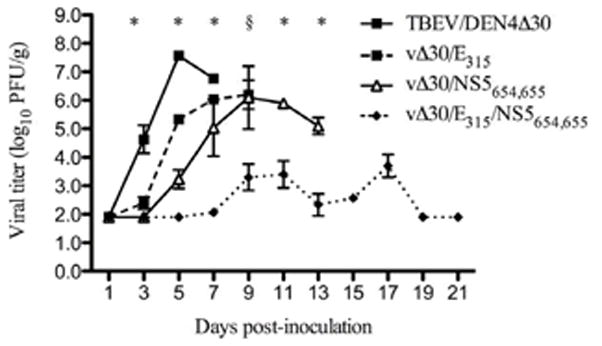
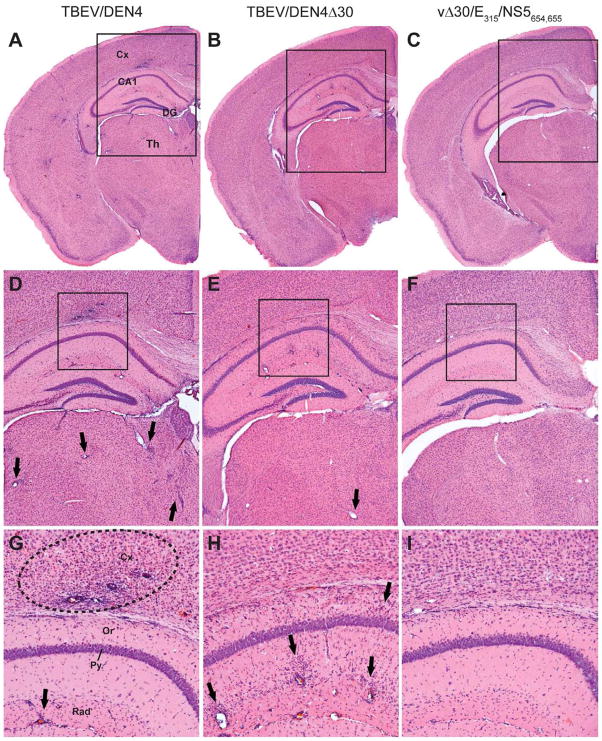
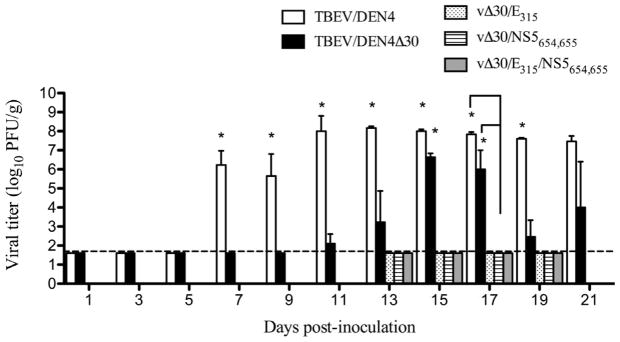
Tick-borne encephalitis (TBE) is a severe disease affecting thousands of people throughout Eurasia. Despite the use of formalin-inactivated vaccines in endemic areas, an increasing incidence of TBE emphasizes the need for an alternative vaccine that will induce a more durable immunity against TBE virus (TBEV). The chimeric attenuated virus vaccine candidate containing the structural protein genes of TBEV on a dengue virus genetic background (TBEV/DEN4) retains a high level of neurovirulence in both mice and monkeys. Therefore, attenuating mutations were introduced into the envelope (E(315)) and NS5 (NS5(654,655)) proteins, and into the 3' non-coding region (Delta30) of TBEV/DEN4. The variant that contained all three mutations (vDelta30/E(315)/NS5(654,655)) was significantly attenuated for neuroinvasiveness and neurovirulence and displayed a reduced level of replication and virus-induced histopathology in the brains of mice. The high level of safety in the central nervous system indicates that vDelta30/E(315)/NS5(654,655) should be further evaluated as a TBEV vaccine.
蜱传脑炎(TBE)是一种严重的疾病,影响着整个欧亚大陆的数千人。尽管在流行地区使用了甲醛灭活疫苗,但 TBE 发病率的上升强调了需要一种替代疫苗,以诱导对 TBE 病毒(TBEV)更持久的免疫力。含有 TBEV 结构蛋白基因的嵌合减毒病毒疫苗候选物(TBEV/DEN4)在小鼠和猴子中保留了高水平的神经毒力。因此,对 TBEV/DEN4 的包膜(E(315))和 NS5(NS5(654,655))蛋白以及 3'非编码区(Delta30)引入了减毒突变。包含所有三个突变的变体(vDelta30/E(315)/NS5(654,655))在神经侵袭性和神经毒力方面显著减弱,并且在小鼠大脑中显示出较低水平的复制和病毒诱导的组织病理学。在中枢神经系统中的高安全性表明,vDelta30/E(315)/NS5(654,655) 应作为 TBEV 疫苗进一步评估。