
阻塞性睡眠呼吸暂停患者循环内皮微颗粒增加与颈动脉粥样硬化。
Increased circulating endothelial microparticles and carotid atherosclerosis in obstructive sleep apnea.
机构信息
Department of Neurology, Inha University College of Medicine, Incheon, Korea.
出版信息
J Clin Neurol. 2010 Jun;6(2):89-98. doi: 10.3988/jcn.2010.6.2.89. Epub 2010 Jun 30.
BACKGROUND AND PURPOSE
Endothelial impairment is a linking mechanism between obstructive sleep apnea (OSA) and cardiovascular diseases. Profiles of endothelial microparticles (EMPs) and endothelial progenitor cells (EPCs) reflect the degree of endothelial impairment. The aims of this study were to measure the levels of EMPs and progenitor cells in OSA, determine the correlations between these factors and OSA severity and the degree of atherosclerosis, and document any changes in these factors after therapy.
METHODS
Subjects with (n=82) and without (n=22) OSA were recruited prospectively. We measured the number of colony-forming units (CFU) in cell culture as the endothelial progenitor cell index, and the number of EMPs using flow cytometry with CD31 [platelet endothelial cell adhesion molecule (PECAM)], CD42 (platelet glycoprotein), annexin V, and CD62E (E-selectin) antibodies at baseline and after 4-6 weeks of continuous positive airway pressure (CPAP) therapy. Carotid intima-media thickness (IMT) was regarded as a marker of atherosclerosis.
RESULTS
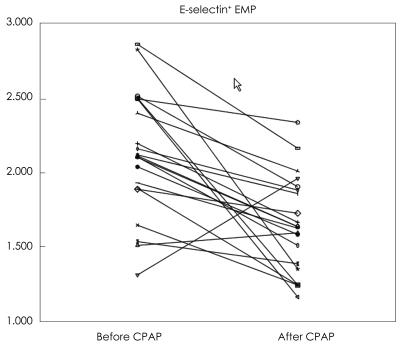
The levels of PECAM(+)CD42(-) (p<0.001), PECAM(+)annexin V(+) (p<0.001), and E-selectin(+) microparticles (p=0.001) were higher in OSA subjects than in non-OSA subjects. The number of CFU did not differ between the two groups. OSA severity independently predicted the levels of PECAM(+)CD42(-) (p=0.02) and PECAM(+)annexin V(+) (p=0.004). Carotid IMT was correlated with OSA severity (p<0.001), PECAM(+)CD42(-) (p=0.03), and PECAM(+)annexin V(+) (p=0.01). Neither OSA severity nor carotid IMT was correlated with either the number of CFU or E-selectin(+). CPAP therapy decreased the occurrence of E-selectin(+) (p<0.001) in 21 of the OSA subjects, but had no effect on the other microparticles of the number of CFU.
CONCLUSIONS
OSA led to the overproduction of EMPs, which moderately correlated with OSA severity and the degree of atherosclerosis, and partly responded to therapy. The endothelial impairment might contribute to future cardiovascular events.
背景与目的
血管内皮功能障碍是阻塞性睡眠呼吸暂停(OSA)与心血管疾病之间的联系机制。内皮细胞微颗粒(EMP)和内皮祖细胞(EPC)的特征反映了内皮损伤的程度。本研究的目的是测量 OSA 患者的 EMP 和祖细胞水平,确定这些因素与 OSA 严重程度和动脉粥样硬化程度之间的相关性,并记录治疗后这些因素的任何变化。
方法
前瞻性招募了患有(n=82)和不患有(n=22)OSA 的受试者。我们使用细胞培养中的集落形成单位(CFU)数量作为内皮祖细胞指数进行测量,并使用流式细胞术测量 EMP 数量,使用 CD31[血小板内皮细胞黏附分子(PECAM)]、CD42(血小板糖蛋白)、膜联蛋白 V 和 CD62E(E-选择素)抗体。在基线和 4-6 周持续气道正压通气(CPAP)治疗后。颈动脉内膜中层厚度(IMT)被视为动脉粥样硬化的标志物。
结果
与非 OSA 受试者相比,OSA 受试者的 PECAM(+)CD42(-)(p<0.001)、PECAM(+)膜联蛋白 V(+)(p<0.001)和 E-选择素(+)微颗粒(p=0.001)水平更高。两组 CFU 数量无差异。OSA 严重程度独立预测 PECAM(+)CD42(-)(p=0.02)和 PECAM(+)膜联蛋白 V(+)(p=0.004)水平。颈动脉 IMT 与 OSA 严重程度(p<0.001)、PECAM(+)CD42(-)(p=0.03)和 PECAM(+)膜联蛋白 V(+)(p=0.01)相关。OSA 严重程度和颈动脉 IMT 均与 CFU 数量或 E-选择素(+)无关。CPAP 治疗降低了 21 例 OSA 患者中 E-选择素(+)的发生(p<0.001),但对 CFU 数量的其他微颗粒没有影响。
结论
OSA 导致 EMP 过度产生,与 OSA 严重程度和动脉粥样硬化程度中度相关,并部分对治疗有反应。内皮损伤可能导致未来发生心血管事件。


 Zotero 插件