Broad Institute of MIT and Harvard, Cambridge, Massachusetts, United States of America.
PLoS Biol. 2010 Jul 6;8(7):e1000414. doi: 10.1371/journal.pbio.1000414.
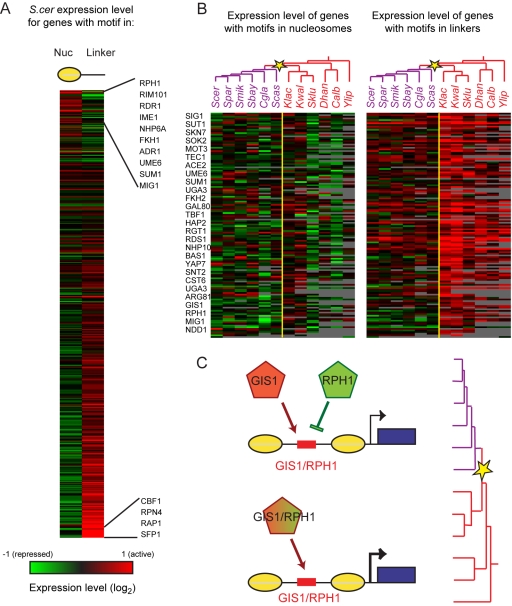
Chromatin organization plays a major role in gene regulation and can affect the function and evolution of new transcriptional programs. However, it can be difficult to decipher the basis of changes in chromatin organization and their functional effect on gene expression. Here, we present a large-scale comparative genomic analysis of the relationship between chromatin organization and gene expression, by measuring mRNA abundance and nucleosome positions genome-wide in 12 Hemiascomycota yeast species. We found substantial conservation of global and functional chromatin organization in all species, including prominent nucleosome-free regions (NFRs) at gene promoters, and distinct chromatin architecture in growth and stress genes. Chromatin organization has also substantially diverged in both global quantitative features, such as spacing between adjacent nucleosomes, and in functional groups of genes. Expression levels, intrinsic anti-nucleosomal sequences, and trans-acting chromatin modifiers all play important, complementary, and evolvable roles in determining NFRs. We identify five mechanisms that couple chromatin organization to evolution of gene regulation and have contributed to the evolution of respiro-fermentation and other key systems, including (1) compensatory evolution of alternative modifiers associated with conserved chromatin organization, (2) a gradual transition from constitutive to trans-regulated NFRs, (3) a loss of intrinsic anti-nucleosomal sequences accompanying changes in chromatin organization and gene expression, (4) re-positioning of motifs from NFRs to nucleosome-occluded regions, and (5) the expanded use of NFRs by paralogous activator-repressor pairs. Our study sheds light on the molecular basis of chromatin organization, and on the role of chromatin organization in the evolution of gene regulation.
染色质组织在基因调控中起着重要作用,并能影响新转录程序的功能和进化。然而,要推断染色质组织变化的基础及其对基因表达的功能影响可能具有挑战性。在这里,我们通过在 12 种半子囊菌酵母物种中测量全基因组 mRNA 丰度和核小体位置,进行了大规模的比较基因组学分析,以研究染色质组织与基因表达之间的关系。我们发现,在所有物种中,整体和功能染色质组织都有很大的保守性,包括基因启动子上明显的无核小体区域 (NFR),以及在生长和应激基因中独特的染色质结构。染色质组织在全局定量特征(如相邻核小体之间的间隔)和功能基因群中也有很大的差异。表达水平、固有抗核小体序列和转录激活的染色质修饰物在确定 NFR 方面都起着重要的、互补的和可进化的作用。我们确定了五种将染色质组织与基因调控进化联系起来的机制,并为呼吸发酵和其他关键系统的进化做出了贡献,包括:(1) 与保守染色质组织相关的替代修饰物的补偿性进化;(2) 从组成型到转录调节 NFR 的逐渐转变;(3) 伴随染色质组织和基因表达变化而丧失固有抗核小体序列;(4) 将基序从 NFR 重新定位到核小体封闭区域;(5) 同源激活剂-抑制剂对通过 NFR 的扩展使用。我们的研究揭示了染色质组织的分子基础,以及染色质组织在基因调控进化中的作用。