Geisbert T W, Rhoderick J B, Jahrling P B
Disease Assessment Division, US Army Medical Research Institute of Infectious Diseases, Fort Detrick, Frederick, Maryland 21702-5011.
J Clin Pathol. 1991 Jun;44(6):521-2. doi: 10.1136/jcp.44.6.521.
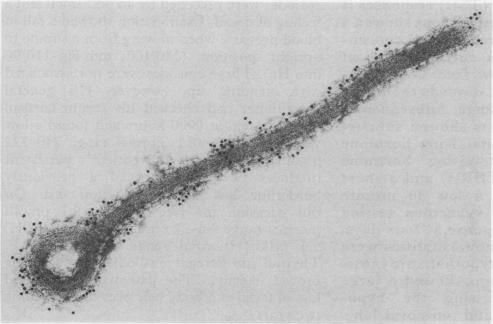
Recent filoviral outbreaks in animal primates have raised public awareness of the potential for filoviruses to become a public health concern; methods that efficiently identify these viruses are therefore of high priority. An indirect immunoelectron microscopy method, which uses homologous guinea pig polyclonal antiserum, successfully identified Ebola-related (Reston) virus particles in serum and tissue culture fluid specimens with infectivity titres of 300 plaque forming units (pfu) per ml or more. The sensitivity of this procedure is sufficient to show virus in most acute phase sera, and is equal to that of the antigen capture enzyme linked immunosorbent assay (ELISA). The immunoelectron microscopy fluid technique can differentiate among antigenically distinct filoviruses in less than three hours. It should be valuable in the rapid diagnosis of potential filoviral infections.
近期在灵长类动物中爆发的丝状病毒疫情提高了公众对丝状病毒可能成为公共卫生问题的认识;因此,高效识别这些病毒的方法具有高度优先性。一种间接免疫电子显微镜方法,使用同源豚鼠多克隆抗血清,成功在血清和组织培养液标本中识别出感染滴度为每毫升300个空斑形成单位(pfu)或更高的埃博拉相关(莱斯顿)病毒颗粒。该程序的灵敏度足以在大多数急性期血清中显示病毒,且与抗原捕获酶联免疫吸附测定(ELISA)相当。免疫电子显微镜流体技术可在不到三小时内区分抗原性不同的丝状病毒。它在潜在丝状病毒感染的快速诊断中应具有重要价值。