Division of Community Health and Human Development, University of California at Berkeley School of Public Health, Berkeley, CA 94720-7360, USA.
Am J Community Psychol. 2010 Sep;46(1-2):152-66. doi: 10.1007/s10464-010-9335-8.
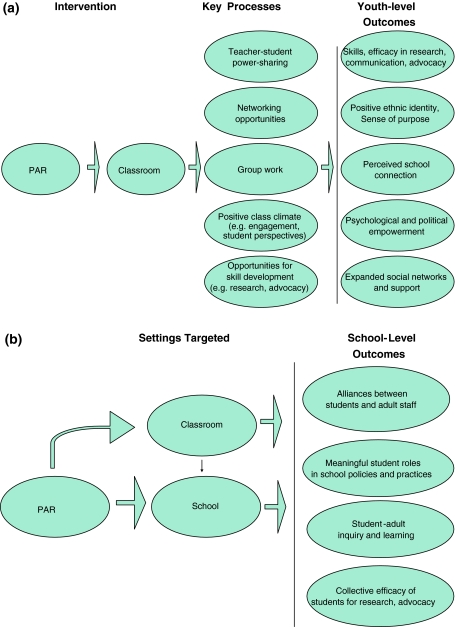
Late childhood and early adolescence represent a critical transition in the developmental and academic trajectory of youth, a time in which there is an upsurge in academic disengagement and psychopathology. PAR projects that can promote youth's sense of meaningful engagement in school and a sense of efficacy and mattering can be particularly powerful given the challenges of this developmental stage. In the present study, we draw on data from our own collaborative implementation of PAR projects in secondary schools to consider two central questions: (1) How do features of middle school settings and the developmental characteristics of the youth promote or inhibit the processes, outcomes, and sustainability of the PAR endeavor? and (2) How can the broad principles and concepts of PAR be effectively translated into specific intervention activities in schools, both within and outside of the classroom? In particular, we discuss a participatory research project conducted with 6th and 7th graders at an urban middle school as a means of highlighting the opportunities, constraints, and lessons learned in our efforts to contribute to the high-quality implementation and evaluation of PAR in diverse urban public schools.
儿童晚期和青少年早期是青少年发展和学业轨迹的一个关键转折点,也是学业脱离和心理病理学急剧增加的时期。鉴于这一发展阶段的挑战,如果有项目可以促进青年在学校有意义地参与感以及效能感和重要感,那么这些项目可能会特别有力。在本研究中,我们借鉴了我们在中学合作实施参与式行动研究项目的数据,来考虑两个核心问题:(1)中学环境的特点和青年的发展特征如何促进或阻碍参与式行动研究的过程、结果和可持续性?(2)如何将参与式行动研究的广泛原则和概念有效地转化为学校内课堂内外的具体干预活动?特别是,我们讨论了一个与城市中学的 6 年级和 7 年级学生一起进行的参与式研究项目,以此强调我们努力为高质量实施和评估不同城市公立学校的参与式行动研究做出贡献时所面临的机会、限制和经验教训。