Instituto Leloir, Av. Patricias Argentinas 435, C1405 BWE Buenos Aires, Argentina; CONICET, Buenos Aires, Argentina.
Cell Signal. 2011 Feb;23(2):324-34. doi: 10.1016/j.cellsig.2010.08.011. Epub 2010 Sep 8.
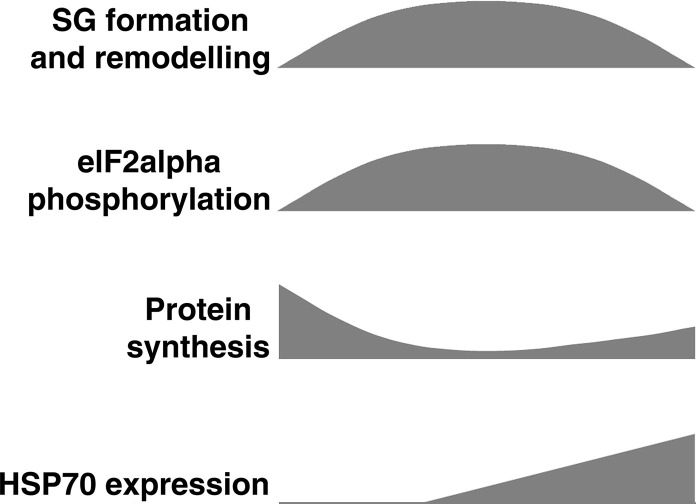
Processing bodies (PBs) and Stress Granules (SGs) are the founding members of a new class of RNA granules, known as mRNA silencing foci, as they harbour transcripts circumstantially excluded from the translationally active pool. PBs and SGs are able to release mRNAs thus allowing their translation. PBs are constitutive, but respond to stimuli that affect mRNA translation and decay, whereas SGs are specifically induced upon cellular stress, which triggers a global translational silencing by several pathways, including phosphorylation of the key translation initiation factor eIF2alpha, and tRNA cleavage among others. PBs and SGs with different compositions may coexist in a single cell. These macromolecular aggregates are highly conserved through evolution, from unicellular organisms to vertebrate neurons. Their dynamics is regulated by several signaling pathways, and depends on microfilaments and microtubules, and the cognate molecular motors myosin, dynein, and kinesin. SGs share features with aggresomes and related aggregates of unfolded proteins frequently present in neurodegenerative diseases, and may play a role in the pathology. Virus infections may induce or impair SG formation. Besides being important for mRNA regulation upon stress, SGs modulate the signaling balancing apoptosis and cell survival. Finally, the formation of Nuclear Stress Bodies (nSBs), which share components with SGs, and the assembly of additional cytosolic aggregates containing RNA -the UV granules and the Ire1 foci-, all of them induced by specific cell damage factors, contribute to cell survival.
处理体 (PBs) 和应激颗粒 (SGs) 是一类新的 RNA 颗粒的创始成员,称为 mRNA 沉默焦点,因为它们包含偶然从翻译活性池中排除的转录本。PBs 和 SGs 能够释放 mRNAs,从而允许它们翻译。PBs 是组成型的,但对影响 mRNA 翻译和降解的刺激有反应,而 SGs 则在细胞应激时特异性诱导,这通过几种途径触发全局翻译沉默,包括关键翻译起始因子 eIF2alpha 的磷酸化和 tRNA 切割等。具有不同组成的 PBs 和 SGs 可能在单个细胞中共存。这些大分子聚集体在从单细胞生物到脊椎动物神经元的进化过程中高度保守。它们的动力学受几种信号通路的调节,取决于微丝和微管,以及同源分子马达肌球蛋白、动力蛋白和驱动蛋白。SGs 与聚集物和相关的未折叠蛋白聚集体具有共同的特征,这些聚集体在神经退行性疾病中经常出现,并且可能在病理学中发挥作用。病毒感染可能诱导或损害 SG 的形成。除了在应激时对 mRNA 调节很重要外,SGs 还调节信号平衡细胞凋亡和细胞存活。最后,核应激体 (nSBs) 的形成,与 SGs 共享成分,以及包含 RNA 的额外细胞质聚集体的组装 - UV 颗粒和 Ire1 焦点 - 所有这些都是由特定的细胞损伤因素诱导的,有助于细胞存活。