Krawczyk Daniel C, Hanten Gerri, Wilde Elisabeth A, Li Xiaoqi, Schnelle Kathleen P, Merkley Tricia L, Vasquez Ana C, Cook Lori G, McClelland Michelle, Chapman Sandra B, Levin Harvey S
Center for Brain Health, School of Behavioral and Brain Sciences, The University of Texas at Dallas TX, USA.
Front Hum Neurosci. 2010 Aug 19;4. doi: 10.3389/fnhum.2010.00062. eCollection 2010.
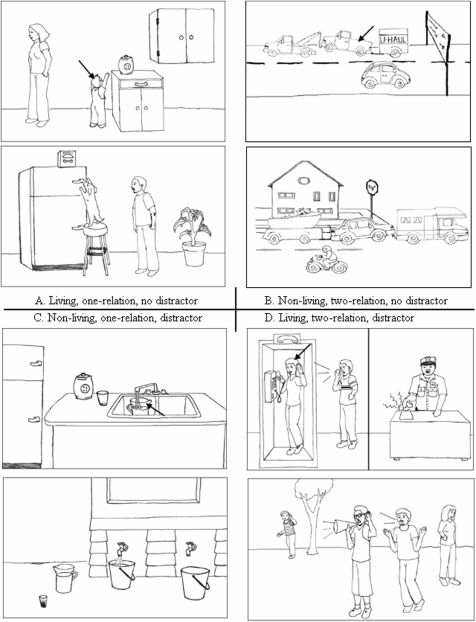
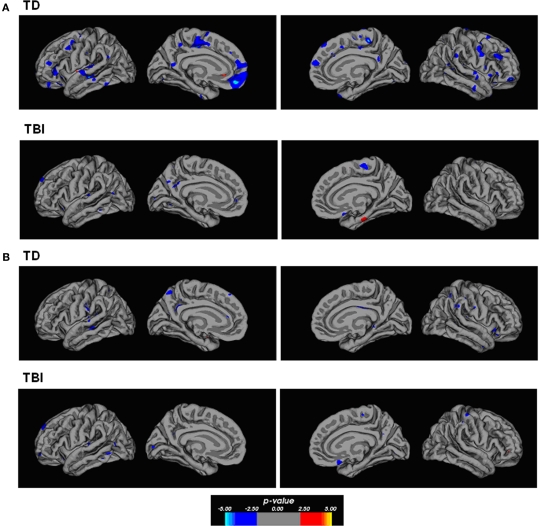
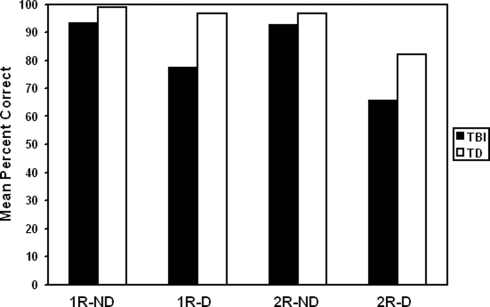
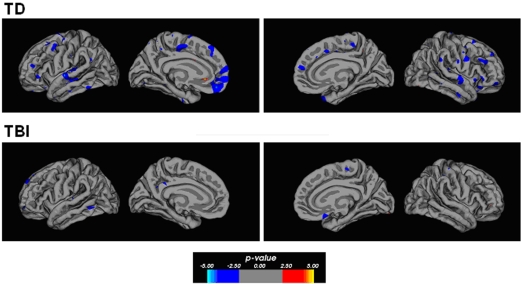
Individuals with traumatic brain injury (TBI) exhibit deficits in executive control, which may impact their reasoning abilities. Analogical reasoning requires working memory and inhibitory abilities. In this study, we tested adolescents with moderate to severe TBI and typically developing (TD) controls on a set of picture analogy problems. Three factors were varied: complexity (number of relations in the problems), distraction (distractor item present or absent), and animacy (living or non-living items in the problems). We found that TD adolescents performed significantly better overall than TBI adolescents. There was also an age effect present in the TBI group where older participants performed better than younger ones. This age effect was not observed in the TD group. Performance was affected by complexity and distraction. Further, TBI participants exhibited lower performance with distractors present than TD participants. The reasoning deficits exhibited by the TBI participants were correlated with measures of executive function that required working memory updating, attention, and attentional screening. Using MRI-derived measures of cortical thickness, correlations were carried out between task accuracy and cortical thickness. The TD adolescents showed negative correlations between thickness and task accuracy in frontal and temporal regions consistent with cortical maturation in these regions. This study demonstrates that adolescent TBI results in impairments in analogical reasoning ability. Further, TBI youth have difficulty effectively screening out distraction, which may lead to failures in comprehension of the relations among items in visual scenes. Lastly, TBI youth fail to show robust cortical-behavior correlations as observed in TD individuals.
创伤性脑损伤(TBI)患者表现出执行控制方面的缺陷,这可能会影响他们的推理能力。类比推理需要工作记忆和抑制能力。在本研究中,我们让中度至重度TBI青少年和发育正常(TD)的对照组完成一组图片类比问题测试。我们改变了三个因素:复杂性(问题中关系的数量)、干扰因素(有无干扰项)和生动性(问题中的生物或非生物项目)。我们发现,总体而言,TD青少年的表现明显优于TBI青少年。TBI组还存在年龄效应,年龄较大的参与者表现优于年龄较小的参与者。TD组未观察到这种年龄效应。表现受复杂性和干扰因素的影响。此外,有干扰项时,TBI参与者的表现低于TD参与者。TBI参与者表现出的推理缺陷与需要工作记忆更新、注意力和注意力筛选的执行功能指标相关。使用MRI得出的皮质厚度测量值,对任务准确性和皮质厚度进行了相关性分析。TD青少年在额叶和颞叶区域的厚度与任务准确性之间呈负相关,这与这些区域的皮质成熟情况一致。本研究表明,青少年TBI会导致类比推理能力受损。此外,TBI青少年难以有效排除干扰,这可能导致他们无法理解视觉场景中项目之间的关系。最后,TBI青少年没有像TD个体那样表现出强大的皮质-行为相关性。