Department of Experimental Evolutionary Biology, University of Bologna, Via Irnerio 42, I-40126 Bologna Italy.
J Exp Bot. 2011 Jan;62(2):545-55. doi: 10.1093/jxb/erq288. Epub 2010 Sep 27.
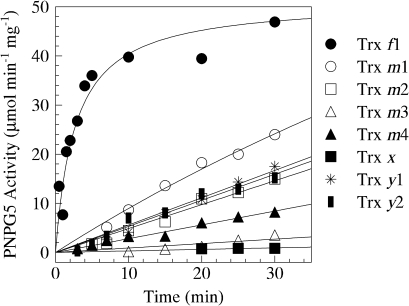
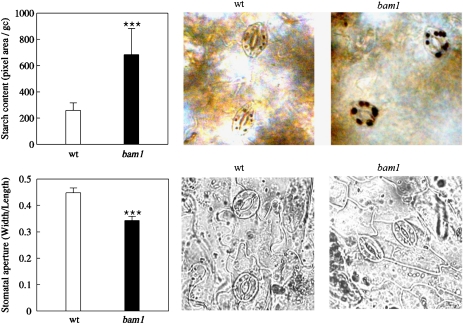
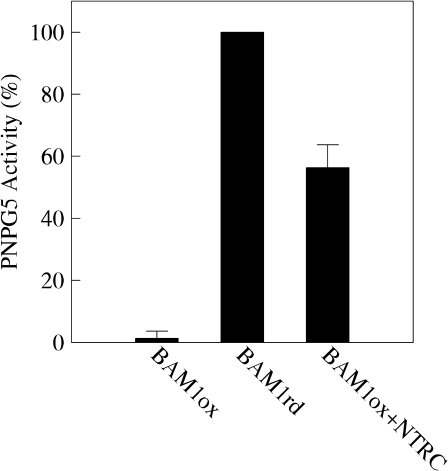
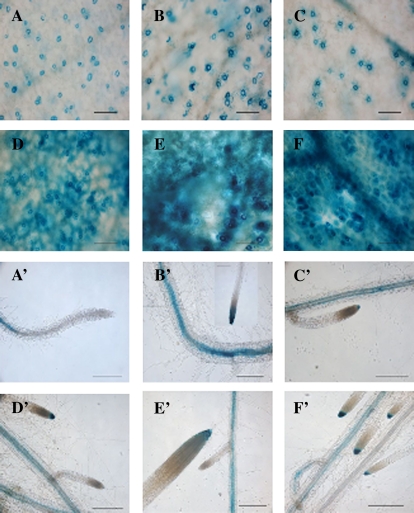
BAM1 is a plastid-targeted β-amylase of Arabidopsis thaliana specifically activated by reducing conditions. Among eight different chloroplast thioredoxin isoforms, thioredoxin f1 was the most efficient redox mediator, followed by thioredoxins m1, m2, y1, y2, and m4. Plastid-localized NADPH-thioredoxin reductase (NTRC) was also able partially to restore the activity of oxidized BAM1. Promoter activity of BAM1 was studied by reporter gene expression (GUS and YFP) in Arabidopsis transgenic plants. In young (non-flowering) plants, BAM1 was expressed both in leaves and roots, but expression in leaves was mainly restricted to guard cells. Compared with wild-type plants, bam1 knockout mutants were characterized by having more starch in illuminated guard cells and reduced stomata opening, suggesting that thioredoxin-regulated BAM1 plays a role in diurnal starch degradation which sustains stomata opening. Besides guard cells, BAM1 appears in mesophyll cells of young plants as a result of a strongly induced gene expression under osmotic stress, which is paralleled by an increase in total β-amylase activity together with its redox-sensitive fraction. Osmotic stress impairs the rate of diurnal starch accumulation in leaves of wild-type plants, but has no effect on starch accumulation in bam1 mutants. It is proposed that thioredoxin-regulated BAM1 activates a starch degradation pathway in illuminated mesophyll cells upon osmotic stress, similar to the diurnal pathway of starch degradation in guard cells that is also dependent on thioredoxin-regulated BAM1.
BAM1 是拟南芥质体靶向的β-淀粉酶,特异性地被还原条件激活。在 8 种不同的叶绿体硫氧还蛋白同工型中,硫氧还蛋白 f1 是最有效的氧化还原介体,其次是硫氧还蛋白 m1、m2、y1、y2 和 m4。质体定位的 NADPH-硫氧还蛋白还原酶(NTRC)也能够部分恢复氧化 BAM1 的活性。通过在拟南芥转基因植物中用报告基因表达(GUS 和 YFP)研究 BAM1 的启动子活性。在年轻(非开花)的植物中,BAM1 在叶片和根部都有表达,但在叶片中的表达主要局限于保卫细胞。与野生型植物相比,bam1 敲除突变体的特征是在照光的保卫细胞中有更多的淀粉,并且气孔开度降低,这表明硫氧还蛋白调节的 BAM1 在维持气孔开度的昼夜淀粉降解中起作用。除了保卫细胞外,BAM1 还出现在年轻植物的叶肉细胞中,这是由于在渗透胁迫下强烈诱导基因表达的结果,这与总β-淀粉酶活性及其氧化还原敏感部分的增加相平行。渗透胁迫会损害野生型植物叶片中昼夜淀粉积累的速度,但对 bam1 突变体中的淀粉积累没有影响。据推测,在渗透胁迫下,硫氧还蛋白调节的 BAM1 会在照光的叶肉细胞中激活淀粉降解途径,类似于依赖硫氧还蛋白调节的 BAM1 的保卫细胞中昼夜淀粉降解途径。