Department of Comparative Genetics and Refinement, Biomedical Primate Research Centre, Lange Kleiweg 161, 2288, Rijswijk, The Netherlands.
Immunogenetics. 2011 Feb;63(2):73-83. doi: 10.1007/s00251-010-0486-4. Epub 2010 Oct 15.
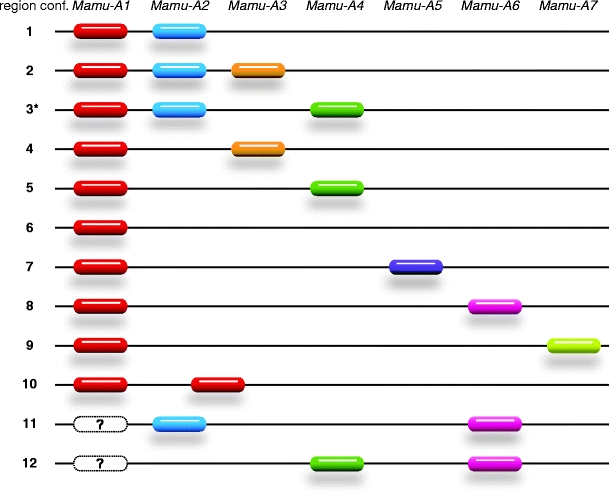
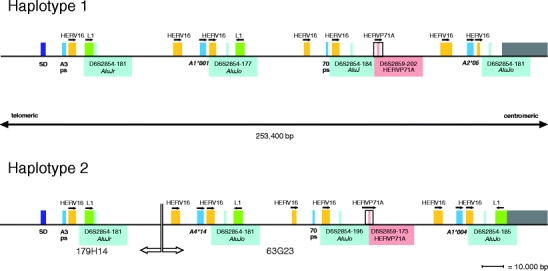
The Mamu-A genes of the rhesus macaque show different degrees of polymorphism, transcription level variation, and differential haplotype distribution. Per haplotype, usually one "major" transcribed gene is present, A1 (A7), in various combinations with "minor" genes, A2 to A6. In silico analysis of the physical map of a heterozygous animal revealed the presence of similar Mamu-A regions consisting of four duplication units, but with dissimilar positions of the A1 genes on both haplotypes, and in combination with different minor genes. Two microsatellites, D6S2854 and D6S2859, have been selected as potential tools to characterize this complex region. Subsequent analysis of a large breeding colony resulted in the description of highly discriminative patterns, displaying copy number variation in concert with microsatellite repeat length differences. Sequencing and segregation analyses revealed that these patterns are unique for each Mamu-A haplotype. In animals of Indian, Burmese, and Chinese origin, 19, 15, or 9 haplotypes, respectively, could be defined, illustrating the occurrence of differential block duplications and subsequent rearrangements by recombination. The haplotypes can be assigned to 12 unique combinations of genes (region configurations). Although most configurations harbor two transcribed A genes, one or three genes per haplotype are also present. Additionally, haplotypes lacking an A1 gene or with an A1 duplication appear to exist. The presence of different transcribed A genes/alleles in monkeys from various origins may have an impact on differential disease susceptibilities. The high-throughput microsatellite technique will be a valuable tool in animal selection for diverse biomedical research projects.
恒河猴的 Mamu-A 基因表现出不同程度的多态性、转录水平变化和不同单倍型的分布。在每种单倍型中,通常存在一个“主要”转录基因 A1(A7),与“次要”基因 A2 至 A6 以各种组合存在。对杂合动物的物理图谱进行的计算机分析揭示了存在类似的 Mamu-A 区域,这些区域由四个重复单元组成,但两个单倍型上的 A1 基因位置不同,并且与不同的次要基因组合。选择了两个微卫星 D6S2854 和 D6S2859 作为表征该复杂区域的潜在工具。随后对一个大型繁殖群体的分析导致了高度可区分模式的描述,显示出与微卫星重复长度差异协同的拷贝数变化。测序和分离分析表明,这些模式对于每个 Mamu-A 单倍型都是独特的。在来自印度、缅甸和中国的动物中,分别可以定义 19、15 或 9 种单倍型,这表明存在差异的块重复和随后的重组重排。这些单倍型可以分配给 12 种独特的基因组合(区域构型)。尽管大多数构型携带两个转录的 A 基因,但每个单倍型也存在一个或三个基因。此外,似乎还存在缺乏 A1 基因或具有 A1 重复的单倍型。来自不同起源的猴子中存在不同的转录 A 基因/等位基因可能会影响疾病易感性的差异。高通量微卫星技术将成为各种生物医学研究项目中动物选择的有价值工具。