Instituto de Cardiologia do Rio Grande do Sul/Fundação Universitária de Cardiologia, Rio Grande do Sul, Brasil.
Cardiovasc Diabetol. 2010 Oct 28;9:67. doi: 10.1186/1475-2840-9-67.
Although exercise training has well-known cardiorespiratory and metabolic benefits, low compliance with exercise training programs is a fact, and the harmful effects of physical detraining regarding these adaptations usually go unnoticed. We investigated the effects of exercise detraining on blood pressure, insulin sensitivity, and GLUT4 expression in spontaneously hypertensive rats (SHR) and normotensive Wistar Kyoto rats (WKY).
Studied animals were randomized into sedentary, trained (treadmill running/5 days a week, 60 min/day for 10 weeks), 1 week of detraining, and 2 weeks of detraining. Blood pressure (tail-cuff system), insulin sensitivity (kITT), and GLUT4 (Western blot) in heart, gastrocnemius and white fat tissue were measured.
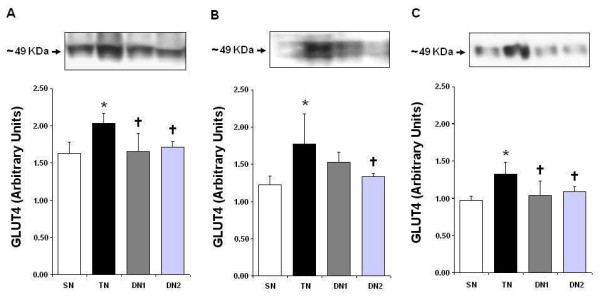
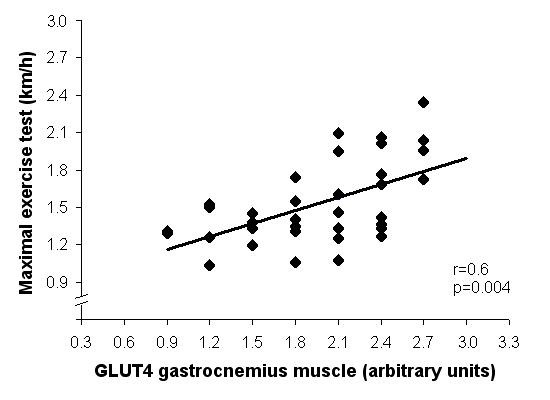
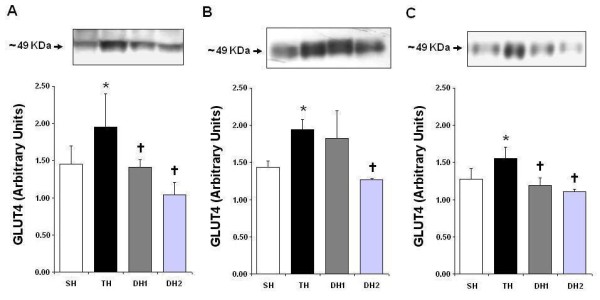
Exercise training reduced blood pressure (19%), improved insulin sensitivity (24%), and increased GLUT4 in the heart (+34%); gastrocnemius (+36%) and fat (+22%) in SHR. In WKY no change in either blood pressure or insulin sensitivity were observed, but there was an increase in GLUT4 in the heart (+25%), gastrocnemius (+45%) and fat (+36%) induced by training. Both periods of detraining did not induce any change in neither blood pressure nor insulin sensitivity in SHR and WKY. One-week detraining reduced GLUT4 in SHR (heart: -28%; fat: -23%) and WKY (heart: -19%; fat: -22%); GLUT4 in the gastrocnemius was reduced after a 2-week detraining (SHR: -35%; WKY: -25%). There was a positive correlation between GLUT4 (gastrocnemius) and the maximal velocity in the exercise test (r = 0.60, p = 0.004).
The study findings show that in detraining, despite reversion of the enhanced GLUT4 expression, cardiorespiratory and metabolic beneficial effects of exercise are preserved.
尽管运动训练对心肺功能和代谢有显著的益处,但运动训练计划的低依从性是一个事实,而身体失训对这些适应性的有害影响通常被忽视。我们研究了运动失训对自发性高血压大鼠(SHR)和正常血压 Wistar 京都大鼠(WKY)的血压、胰岛素敏感性和 GLUT4 表达的影响。
研究动物随机分为安静组、训练组(跑步机跑步/每周 5 天,每天 60 分钟,共 10 周)、1 周失训组和 2 周失训组。通过尾套系统测量血压、胰岛素敏感性(kITT)和心脏、比目鱼肌和白色脂肪组织中的 GLUT4(Western blot)。
运动训练降低了 SHR 的血压(19%),提高了胰岛素敏感性(24%),并增加了心脏(+34%)、比目鱼肌(+36%)和白色脂肪组织(+22%)的 GLUT4;在 WKY 中,血压或胰岛素敏感性均未发生变化,但训练增加了心脏(+25%)、比目鱼肌(+45%)和白色脂肪组织(+36%)中的 GLUT4。失训 1 周和 2 周均未引起 SHR 和 WKY 的血压或胰岛素敏感性发生变化。1 周失训降低了 SHR(心脏:-28%;脂肪:-23%)和 WKY(心脏:-19%;脂肪:-22%)的 GLUT4;2 周失训降低了比目鱼肌中的 GLUT4(SHR:-35%;WKY:-25%)。运动测试中最大速度与比目鱼肌 GLUT4 呈正相关(r = 0.60,p = 0.004)。
研究结果表明,在失训中,尽管 GLUT4 表达增强的情况有所逆转,但运动的心肺和代谢有益作用得以保留。