Menzies School of Health Research, Charles Darwin University, Darwin, Australia.
Cardiovasc Diabetol. 2010 Oct 29;9:69. doi: 10.1186/1475-2840-9-69.
Epidemiological evidence suggests that fibrinogen and CRP are associated with coronary heart disease risk. High CRP in Indigenous Australians has been reported in previous studies including our 'Diabetes and Related diseases in Urban Indigenous population in Darwin region' (DRUID) Study. We studied levels of fibrinogen and its cross-sectional relationship with traditional and non-traditional cardiovascular risk factors in an urban Indigenous Australian cohort.
Fibrinogen data were available from 287 males and 628 females (aged ≥ 15 years) from the DRUID study. Analysis was performed for associations with the following risk factors: diabetes, HbA1c, age, BMI, waist circumference, waist-hip ratio, total cholesterol, triglyceride, HDL cholesterol, C-reactive protein, homocysteine, blood pressure, heart rate, urine ACR, smoking status, alcohol abstinence.
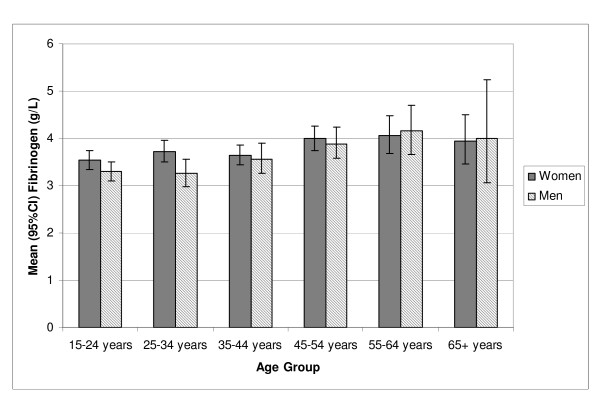
Fibrinogen generally increased with age in both genders; levels by age group were higher than those previously reported in other populations, including Native Americans. Fibrinogen was higher in those with than without diabetes (4.24 vs 3.56 g/L, p < 0.001). After adjusting for age and sex, the following were significantly associated with fibrinogen: BMI, waist, waist-hip ratio, systolic blood pressure, heart rate, fasting triglycerides, HDL cholesterol, HbA1c, CRP, ACR and alcohol abstinence. On multivariate regression (age and sex-adjusted) CRP and HbA1c were significant independent predictors of fibrinogen, explaining 27% of its variance; CRP alone explained 25% of fibrinogen variance. On factor analysis, both CRP and fibrinogen clustered with obesity in women (this factor explained 20% of variance); but in men, CRP clustered with obesity (factor explained 18% of variance) whilst fibrinogen clustered with HbA1c and urine ACR (factor explained 13% of variance).
Fibrinogen is associated with traditional and non-traditional cardiovascular risk factors in this urban Indigenous cohort and may be a useful biomarker of CVD in this high-risk population. The apparent different associations of fibrinogen with cardiovascular disease risk markers in men and women should be explored further.
流行病学证据表明纤维蛋白原和 C 反应蛋白与冠心病风险相关。先前的研究包括我们的“达尔文地区城市土着人口的糖尿病及相关疾病”(DRUID)研究报告称,澳大利亚土着人群的 CRP 较高。我们研究了纤维蛋白原的水平及其与传统和非传统心血管危险因素的横断面关系,研究对象为城市土着澳大利亚人群。
DRUID 研究中,287 名男性和 628 名女性(年龄≥15 岁)的纤维蛋白原数据可用。分析与以下危险因素的相关性:糖尿病、HbA1c、年龄、BMI、腰围、腰臀比、总胆固醇、甘油三酯、HDL 胆固醇、C 反应蛋白、同型半胱氨酸、血压、心率、尿 ACR、吸烟状态、酒精戒断。
纤维蛋白原在两性中均随年龄增长而升高;各年龄组的水平均高于其他人群(包括美国原住民)的报道。有糖尿病者的纤维蛋白原高于无糖尿病者(4.24 比 3.56g/L,p<0.001)。在调整年龄和性别后,以下因素与纤维蛋白原显著相关:BMI、腰围、腰臀比、收缩压、心率、空腹甘油三酯、HDL 胆固醇、HbA1c、CRP、ACR 和酒精戒断。多元回归(年龄和性别调整)显示 CRP 和 HbA1c 是纤维蛋白原的独立显著预测因子,解释了其 27%的方差;CRP 单独解释了纤维蛋白原方差的 25%。在因子分析中,CRP 和纤维蛋白原在女性中与肥胖相关(该因子解释了 20%的方差);但在男性中,CRP 与肥胖相关(该因子解释了 18%的方差),而纤维蛋白原与 HbA1c 和尿 ACR 相关(该因子解释了 13%的方差)。
在这个城市土着人群中,纤维蛋白原与传统和非传统心血管危险因素相关,可能是这个高危人群心血管疾病的有用生物标志物。应进一步探讨纤维蛋白原与男性和女性心血管疾病风险标志物的不同关联。