Centre for Nutrition and Bowel Disease, Department of Medical Gastroenterology, Aarhus University Hospital, Aalborg, Denmark.
Clin Epidemiol. 2010 Oct 21;2:209-16. doi: 10.2147/CLEP.S11265.
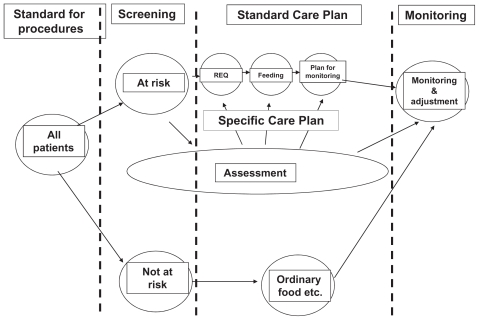
About 20%-50% of patients in hospitals are undernourished. The number varies depending on the screening tool amended and clinical setting. A large number of these patients are undernourished when admitted to the hospital, and in most of these patients, undernutrition develops further during hospital stay. The nutrition course of the patient starts by nutritional screening and is linked to the prescription of a nutrition plan and monitoring. The purpose of nutritional screening is to predict the probability of a better or worse outcome due to nutritional factors and whether nutritional treatment is likely to influence this. Most screening tools address four basic questions: recent weight loss, recent food intake, current body mass index, and disease severity. Some screening tools, moreover, include other measurements for predicting the risk of malnutrition. The usefulness of screening methods recommended is based on the aspects of predictive validity, content validity, reliability, and practicability. Various tools are recommended depending on the setting, ie, in the community, in the hospital, and among elderly in institutions. The Nutrition Risk Screening (NRS) 2002 seems to be the best validated screening tool, in terms of predictive validity ie, the clinical outcome improves when patients identified to be at risk are treated. For adult patients in hospital, thus, the NRS 2002 is recommended.
约 20%-50%的住院患者存在营养不良。具体比例取决于所采用的筛查工具和临床环境。大量住院患者入院时即存在营养不良,其中多数患者在住院期间会进一步出现营养不足。患者的营养治疗始于营养筛查,随后会开具营养计划并进行监测。营养筛查的目的是预测因营养因素导致的转归好坏的可能性,以及营养治疗是否可能对此产生影响。多数筛查工具都涉及以下四个基本问题:近期体重下降、近期食物摄入、当前体重指数和疾病严重程度。此外,部分筛查工具还包括其他用于预测营养不良风险的指标。推荐使用的筛查方法的有效性基于预测准确性、内容有效性、可靠性和实用性等方面。不同工具的推荐依据是具体环境,如社区、医院和机构中的老年人。从预测准确性(即对存在风险的患者进行治疗后可改善临床结局)方面来看,NRS 2002 似乎是最有效的筛查工具。因此,推荐在医院对成年患者使用 NRS 2002。