Department of Medical Research, Tzu Chi General Hospital and Department of Pediatrics, Tzu Chi University, Hualien 970, Taiwan.
PPAR Res. 2010;2010:345098. doi: 10.1155/2010/345098. Epub 2010 Nov 8.
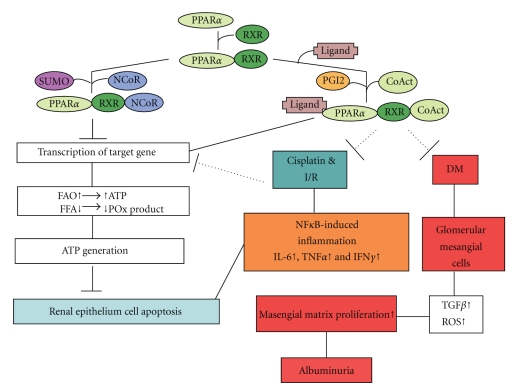
Peroxisome proliferator-activated receptor (PPAR)-α, a member of a large nuclear receptor superfamily, plays a major role in the regulation of lipid metabolism. Recently, PPARα activation has been shown to confer additional benefits on endothelial function, kidney function, and anti-inflammation, suggesting that PPARα agonists may be good candidates for treating acute renal failure. In clinical application, PPAR-α activators, such as hypolipidemic drugs in fibric acid class, were proven to have therapeutic effects on metabolic syndrome and cardiovascular disease. This paper focuses on signaling pathways, ligand selectivity, and physio-pathological roles of PPARα in kidney diseases and the therapeutic utility of PPARα modulators in the treatment of diabetes and inflammation-induced nephropathy. Implication of new and more potent PPAR-α activators could provide important insights into the overall benefits of activating PPAR-α clinically for the treatment of dyslipidemia and the prevention of diabetic or inflammation-induced nephropathy in the future.
过氧化物酶体增殖物激活受体 (PPAR)-α 是核受体超家族的一个成员,在调节脂质代谢中起着重要作用。最近的研究表明,PPARα 的激活对内皮功能、肾功能和抗炎具有额外的益处,这表明 PPARα 激动剂可能是治疗急性肾衰竭的理想候选药物。在临床应用中,PPAR-α 激动剂,如纤维酸类降脂药物,已被证明对代谢综合征和心血管疾病具有治疗作用。本文重点介绍了 PPARα 在肾脏疾病中的信号通路、配体选择性、生理病理学作用,以及 PPARα 调节剂在治疗糖尿病和炎症性肾病中的应用。新型、更有效的 PPAR-α 激动剂的应用可能为临床上激活 PPAR-α 治疗血脂异常以及预防糖尿病或炎症性肾病提供重要的见解。