School of Engineering Systems, Queensland University of Technology, Brisbane, Australia.
PLoS Comput Biol. 2010 Nov 11;6(11):e1000995. doi: 10.1371/journal.pcbi.1000995.
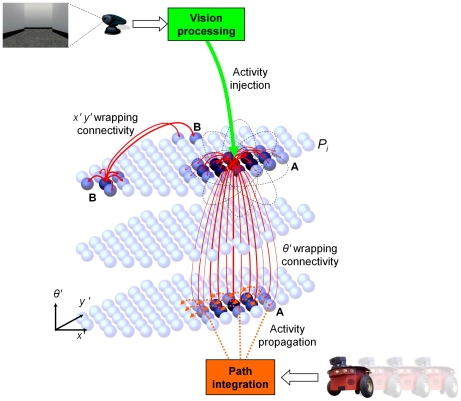
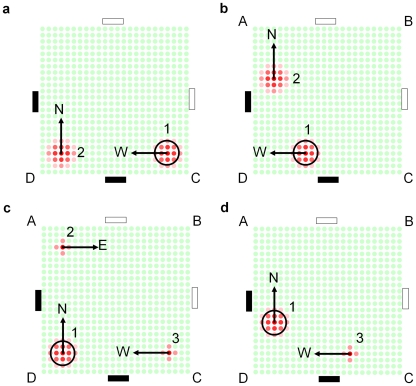
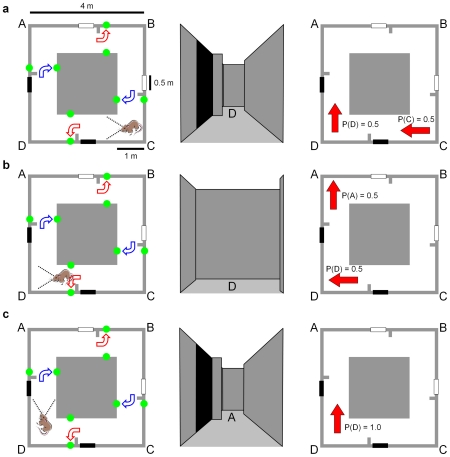
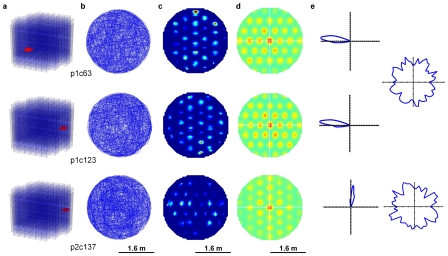
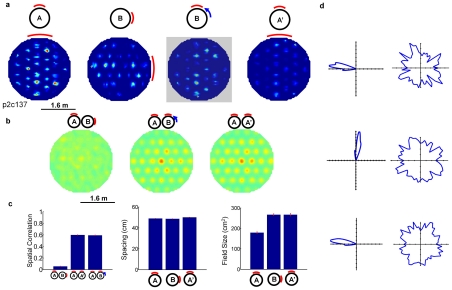
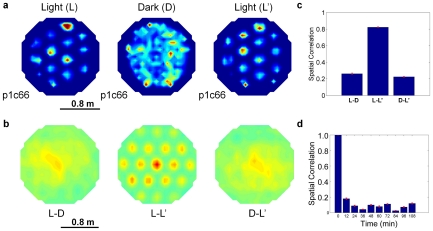
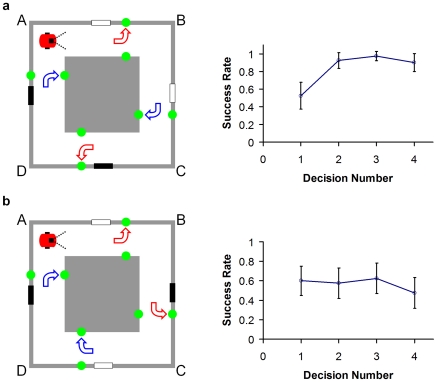
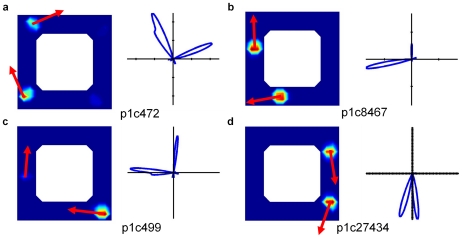
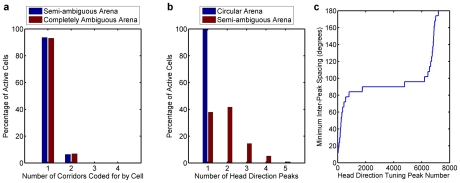
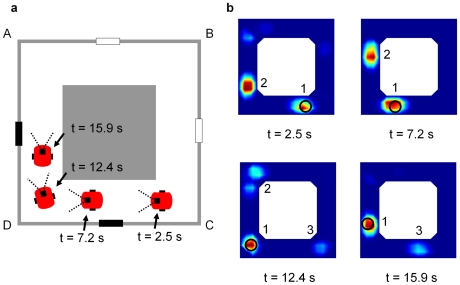
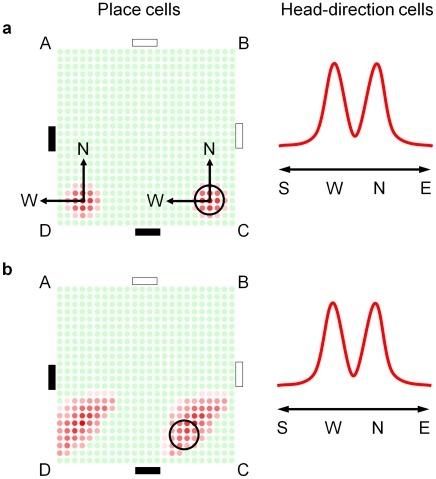
To successfully navigate their habitats, many mammals use a combination of two mechanisms, path integration and calibration using landmarks, which together enable them to estimate their location and orientation, or pose. In large natural environments, both these mechanisms are characterized by uncertainty: the path integration process is subject to the accumulation of error, while landmark calibration is limited by perceptual ambiguity. It remains unclear how animals form coherent spatial representations in the presence of such uncertainty. Navigation research using robots has determined that uncertainty can be effectively addressed by maintaining multiple probabilistic estimates of a robot's pose. Here we show how conjunctive grid cells in dorsocaudal medial entorhinal cortex (dMEC) may maintain multiple estimates of pose using a brain-based robot navigation system known as RatSLAM. Based both on rodent spatially-responsive cells and functional engineering principles, the cells at the core of the RatSLAM computational model have similar characteristics to rodent grid cells, which we demonstrate by replicating the seminal Moser experiments. We apply the RatSLAM model to a new experimental paradigm designed to examine the responses of a robot or animal in the presence of perceptual ambiguity. Our computational approach enables us to observe short-term population coding of multiple location hypotheses, a phenomenon which would not be easily observable in rodent recordings. We present behavioral and neural evidence demonstrating that the conjunctive grid cells maintain and propagate multiple estimates of pose, enabling the correct pose estimate to be resolved over time even without uniquely identifying cues. While recent research has focused on the grid-like firing characteristics, accuracy and representational capacity of grid cells, our results identify a possible critical and unique role for conjunctive grid cells in filtering sensory uncertainty. We anticipate our study to be a starting point for animal experiments that test navigation in perceptually ambiguous environments.
为了成功地在其栖息地中导航,许多哺乳动物结合使用两种机制,即路径整合和地标校准,这两种机制共同使它们能够估计其位置和方向,即姿势。在大型自然环境中,这两种机制都具有不确定性:路径整合过程受到误差积累的影响,而地标校准则受到感知歧义的限制。目前尚不清楚动物在存在这种不确定性的情况下如何形成连贯的空间表示。使用机器人进行的导航研究已经确定,通过维持机器人姿势的多个概率估计,可以有效地解决不确定性问题。在这里,我们展示了背侧尾侧内侧内嗅皮层 (dMEC) 中的联合栅格细胞如何使用称为 RatSLAM 的基于大脑的机器人导航系统来维持多个姿势估计。基于啮齿动物空间响应细胞和功能工程原理,RatSLAM 计算模型核心的细胞具有类似于啮齿动物栅格细胞的特征,我们通过复制 Moser 开创性实验来证明这一点。我们将 RatSLAM 模型应用于新的实验范式,旨在研究机器人或动物在感知歧义存在时的反应。我们的计算方法使我们能够观察到多个位置假设的短期群体编码,这是在啮齿动物记录中不易观察到的现象。我们提出了行为和神经证据,证明联合栅格细胞维持和传播多个姿势估计,从而即使没有唯一识别线索,也能随着时间的推移正确解决姿势估计。虽然最近的研究集中在网格状放电特性、网格细胞的准确性和表示能力上,但我们的结果确定了联合栅格细胞在过滤感觉不确定性方面可能具有关键而独特的作用。我们预计我们的研究将成为测试感知模糊环境中导航的动物实验的起点。