Department of Psychiatry, Washington University School of Medicine, St. Louis, MO 63110, USA.
J Am Acad Child Adolesc Psychiatry. 2010 Dec;49(12):1202-14. doi: 10.1016/j.jaac.2010.09.004. Epub 2010 Oct 20.
To provide an overview of the genetic epidemiology of substance use and misuse in adolescents.
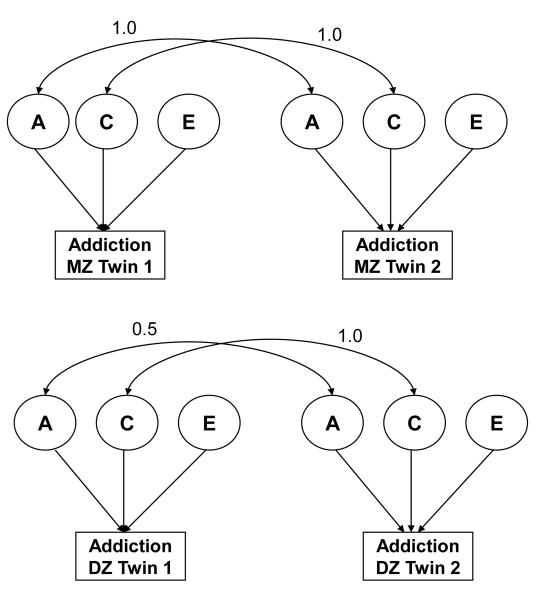
A selective review of genetically informative research strategies, their limitations, and key findings examining issues related to the heritability of substance use and substance use disorders in children and adolescents is presented.
Adoption, twin, and extended-family designs have established there is a strong heritable component to liability to nicotine, alcohol, and illicit drug dependence in adults. However, shared environmental influences are relatively stronger in youth samples and at earlier stages of substance involvement (e.g., use). There is considerable overlap in the genetic influences associated with the abuse/dependence across drug classes, and shared genetic influences contribute to the commonly observed associations between substance-use disorders and externalizing and, to a lesser extent, internalizing psychopathology. Rapid technologic advances have made the identification of specific gene variants that influence risks for substance-use disorders feasible, and linkage and association (including genomewide association studies) have identified promising candidate genes implicated in the development of substance-use disorders.
Studies using genetically informative research designs, including those that examine aggregate genetic factors and those examining specific gene variants, individually and in interaction with environmental influences, offer promising avenues not only for delineating genetic effects on substance-use disorders but also for understanding the unfolding of risk across development and the interaction between environmental and genetic factors in the etiology of these disorders.
概述青少年物质使用和滥用的遗传流行病学。
对遗传信息研究策略、其局限性以及关键发现进行了选择性回顾,这些研究策略涉及与儿童和青少年物质使用和物质使用障碍的遗传性、易感性相关的问题。
收养、双胞胎和大家庭设计已经证实,成年人对尼古丁、酒精和非法药物依赖具有很强的遗传易感性。然而,在青少年样本和物质使用的早期阶段(例如,使用),共享环境影响相对更强。滥用/依赖相关的遗传影响在不同药物类别之间存在很大重叠,共享遗传影响导致物质使用障碍与外向和内向精神病理学之间常见的关联。快速的技术进步使得鉴定影响物质使用障碍风险的特定基因变异成为可能,连锁和关联(包括全基因组关联研究)已经确定了一些有前途的候选基因,这些基因与物质使用障碍的发展有关。
使用遗传信息研究设计的研究,包括那些检查总体遗传因素以及那些检查特定基因变异的研究,单独或与环境影响相互作用,不仅为确定物质使用障碍的遗传效应提供了有希望的途径,而且为理解风险在整个发展过程中的展开以及这些障碍的病因学中环境和遗传因素之间的相互作用提供了途径。