Yale Child Study Center, Yale University School of Medicine, New Haven, CT 06520, USA.
Cereb Cortex. 2011 Jul;21(7):1498-506. doi: 10.1093/cercor/bhq186. Epub 2010 Nov 19.
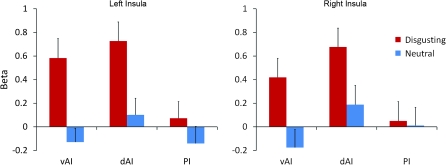
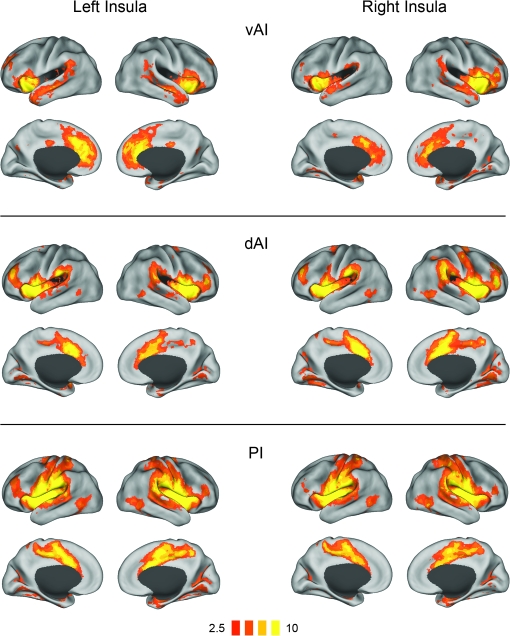
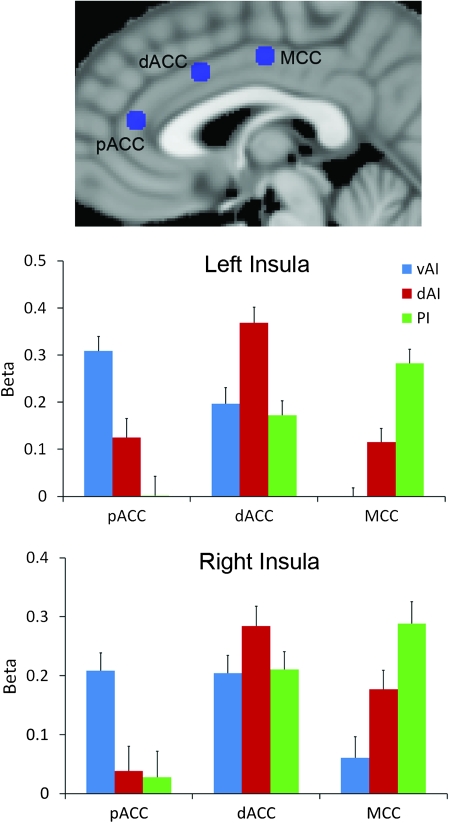
Despite much research on the function of the insular cortex, few studies have investigated functional subdivisions of the insula in humans. The present study used resting-state functional connectivity magnetic resonance imaging (MRI) to parcellate the human insular lobe based on clustering of functional connectivity patterns. Connectivity maps were computed for each voxel in the insula based on resting-state functional MRI (fMRI) data and segregated using cluster analysis. We identified 3 insular subregions with distinct patterns of connectivity: a posterior region, functionally connected with primary and secondary somatomotor cortices; a dorsal anterior to middle region, connected with dorsal anterior cingulate cortex, along with other regions of a previously described control network; and a ventral anterior region, primarily connected with pregenual anterior cingulate cortex. Applying these regions to a separate task data set, we found that dorsal and ventral anterior insula responded selectively to disgusting images, while posterior insula did not. These results demonstrate that clustering of connectivity patterns can be used to subdivide cerebral cortex into anatomically and functionally meaningful subregions; the insular regions identified here should be useful in future investigations on the function of the insula.
尽管人们对脑岛皮层的功能进行了大量研究,但很少有研究调查人类脑岛的功能细分。本研究使用静息态功能连接磁共振成像 (MRI) 根据功能连接模式的聚类来对人脑岛叶进行分区。基于静息态功能 MRI (fMRI) 数据计算了脑岛每个体素的连接图,并使用聚类分析进行了分离。我们确定了 3 个具有不同连接模式的脑岛亚区:后区与初级和次级躯体感觉皮层功能连接;背侧前到中部区域与背侧前扣带皮层连接,并与之前描述的控制网络的其他区域连接;腹侧前区域主要与前扣带皮质的吻侧区域连接。将这些区域应用于另一个任务数据集,我们发现背侧和腹侧前脑岛对令人恶心的图像有选择性反应,而后脑岛则没有。这些结果表明,连接模式的聚类可以用于将大脑皮层分为具有解剖学和功能意义的亚区;这里确定的脑岛区域应该对未来脑岛功能的研究有用。