Krebs Ruth M, Schoenfeld Mircea A, Boehler Carsten N, Song Allen W, Woldorff Marty G
Center for Cognitive Neuroscience, Duke University Durham, NC, USA.
Front Hum Neurosci. 2010 Nov 1;4:193. doi: 10.3389/fnhum.2010.00193. eCollection 2010.
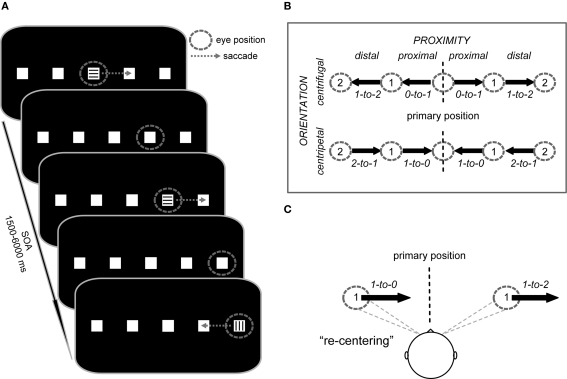
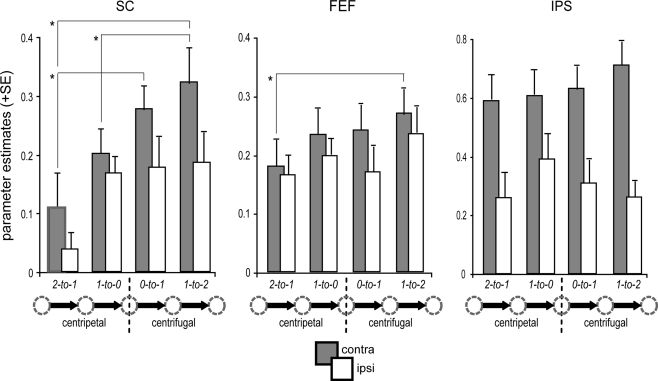
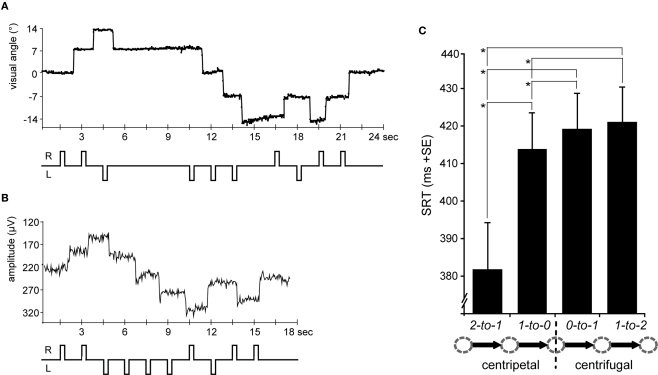
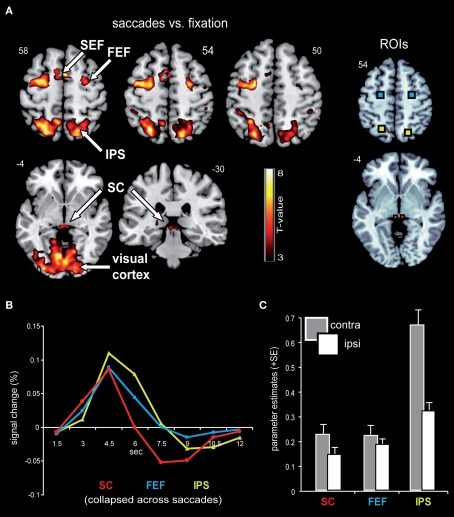
Being able to effectively explore our visual world is of fundamental importance, and it has been suggested that the straight-ahead gaze (primary position) might play a special role in this context. We employed fMRI in humans to investigate how neural activity might be modulated for saccades relative to this putative default position. Using an endogenous cueing paradigm, saccade direction and orbital starting position were systematically manipulated, resulting in saccades toward primary position (centripetal) and away from primary position (centrifugal) that were matched in amplitude, directional predictability, as well as orbital starting position. In accord with earlier research, we found that fMRI activity in the superior colliculus (SC), as well as in the frontal eye fields and the intraparietal sulcus, was enhanced contralateral to saccade direction across all saccade conditions. Furthermore, the SC exhibited a relative activity decrease during re-centering relative to centrifugal saccades, a pattern that was paralleled by faster saccadic reaction times. In contrast, activity within the cortical eye fields was not significantly modulated during re-centering saccades as compared to other saccade types, suggesting that the re-centering bias is predominantly implemented at a subcortical rather than cortical processing stage. Such a modulation might reflect a special coding bias facilitating the return of gaze to a default position in the gaze space in which retinotopic and egocentric reference frames are aligned and from which the visual world can be effectively explored.
能够有效地探索我们的视觉世界至关重要,并且有人提出,直视凝视(初始位置)在这种情况下可能发挥特殊作用。我们利用功能磁共振成像(fMRI)对人类进行研究,以探究相对于这个假定的默认位置,扫视过程中的神经活动是如何被调节的。使用内源性线索范式,系统地操纵扫视方向和眼眶起始位置,从而产生朝向初始位置(向心)和远离初始位置(离心)的扫视,这些扫视在幅度、方向可预测性以及眼眶起始位置方面相互匹配。与早期研究一致,我们发现,在所有扫视条件下,上丘(SC)以及额叶眼区和顶内沟的功能磁共振成像活动在扫视方向的对侧增强。此外,与离心扫视相比,SC在重新定位期间表现出相对的活动减少,这种模式与更快的扫视反应时间并行。相比之下,与其他扫视类型相比,在重新定位扫视期间,皮质眼区内的活动没有受到显著调节,这表明重新定位偏差主要是在皮层下而非皮层处理阶段实现的。这种调节可能反映了一种特殊的编码偏差,有助于将目光返回到注视空间中的默认位置,在这个位置,视网膜定位和自我中心参考框架对齐,并且可以从这个位置有效地探索视觉世界。