Faculty of Natural Sciences and Mathematics, University of Maribor, Slovenia.
PLoS One. 2010 Dec 6;5(12):e15117. doi: 10.1371/journal.pone.0015117.
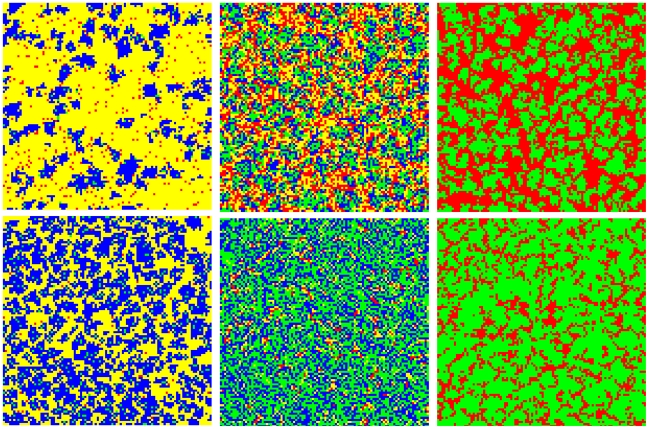
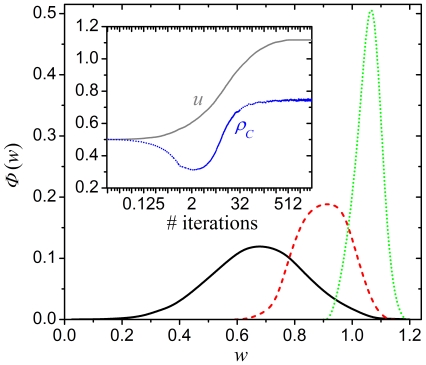
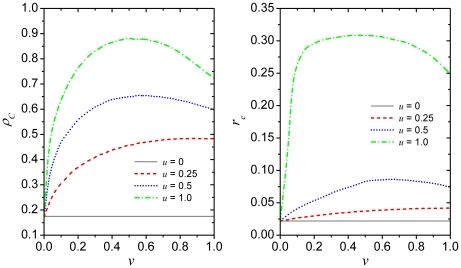
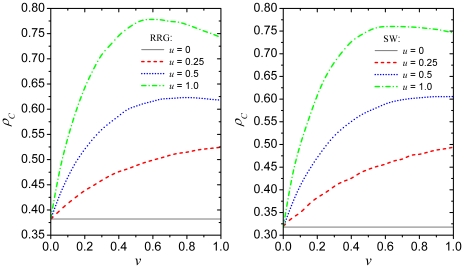
To be the fittest is central to proliferation in evolutionary games. Individuals thus adopt the strategies of better performing players in the hope of successful reproduction. In structured populations the array of those that are eligible to act as strategy sources is bounded to the immediate neighbors of each individual. But which one of these strategy sources should potentially be copied? Previous research dealt with this question either by selecting the fittest or by selecting one player uniformly at random. Here we introduce a parameter u that interpolates between these two extreme options. Setting u equal to zero returns the random selection of the opponent, while positive u favor the fitter players. In addition, we divide the population into two groups. Players from group A select their opponents as dictated by the parameter u, while players from group B do so randomly irrespective of u. We denote the fraction of players contained in groups A and B by v and 1 - v, respectively. The two parameters u and v allow us to analyze in detail how aspirations in the context of the prisoner’s dilemma game influence the evolution of cooperation. We find that for sufficiently positive values of u there exist a robust intermediate v ≈ 0.5 for which cooperation thrives best. The robustness of this observation is tested against different levels of uncertainty in the strategy adoption process K and for different interaction networks. We also provide complete phase diagrams depicting the dependence of the impact of u and v for different values of K, and contrast the validity of our conclusions by means of an alternative model where individual aspiration levels are subject to evolution as well. Our study indicates that heterogeneity in aspirations may be key for the sustainability of cooperation in structured populations.
最适应者在进化博弈中得以增殖。因此,个体采用表现更好的玩家的策略,以期成功繁殖。在结构化群体中,有资格充当策略源的个体数量仅限于每个个体的直接邻居。但是,应该复制哪些策略源呢?以前的研究要么通过选择最适应者,要么通过随机选择一个玩家来解决这个问题。在这里,我们引入一个参数 u,它在这两个极端选项之间进行插值。将 u 设置为零会返回对手的随机选择,而正值 u 则有利于更适应的玩家。此外,我们将群体分为两组。组 A 的玩家根据参数 u 选择他们的对手,而组 B 的玩家则不管 u 如何随机选择。我们用 v 和 1 - v 分别表示组 A 和组 B 中包含的玩家的分数。参数 u 和 v 使我们能够详细分析囚徒困境游戏中目标对合作进化的影响。我们发现,对于足够正的 u 值,存在一个稳健的中间值 v ≈ 0.5,在这个值下合作表现最好。我们通过不同的策略采用过程 K 水平和不同的相互作用网络对这一观察结果的稳健性进行了测试。我们还提供了完整的相图,描绘了不同 K 值下 u 和 v 的影响的依赖性,并通过一种替代模型来对比我们结论的有效性,在该模型中,个体的期望水平也会进化。我们的研究表明,期望的异质性可能是结构化群体中合作可持续性的关键。