Juyal Ratish, Verma Rajesh, Garg Ravindra Kumar, Shukla Rakesh, Agarwal Atul, Singh Maneesh Kumar
Department of Neurology, Chhatrapati Shahuji Maharaj Medical University, Uttar Pradesh, Lucknow, India.
Ann Indian Acad Neurol. 2010 Oct;13(4):276-83. doi: 10.4103/0972-2327.74201.
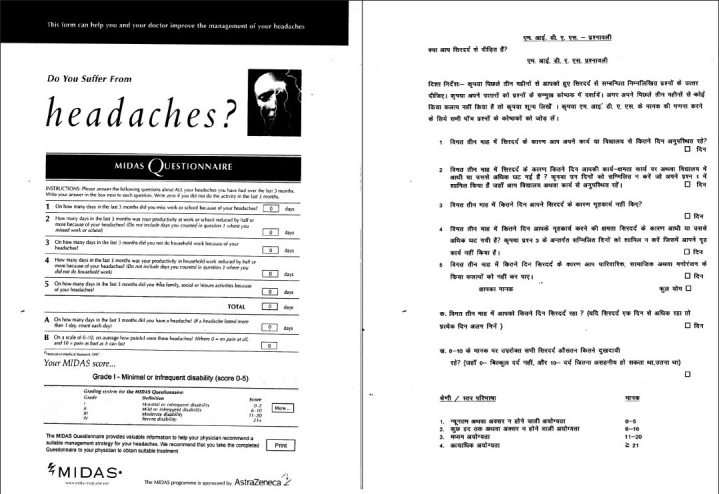
The objective of the study was to assess the reliability and validity of the Hindi translation of the Migraine Disability Assessment (MIDAS) and Headache Impact Test-6 (HIT-6) questionnaires.
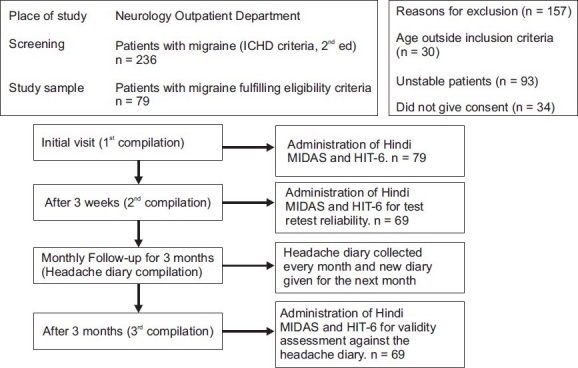
The study was conducted on the migraine patients. For test-retest reliability, the respondents filled the MIDAS and HIT-6 questionnaires twice, at an interval of three weeks. For validity, the same population of patients filled the headache diary for three months. After three months they filled the MIDAS and HIT-6 questionnaires again. The patients were subgrouped according to their occupation and level of education. The test-retest reliability and validity were calculated by the Pearson correlation coefficient. Internal consistency was calculated using the Cronbach alpha.
A total of 236 migraine patients were screened. Seventy-nine patients fulfilled the inclusion criteria. A total of 69 patients completed the study. The HIT-6 questionnaire was applicable to all the subgroups of patients and had better comprehensibility than the MIDAS. Housewives missed out on the first two questions of the MIDAS and had lower mean MIDAS scores than HIT-6. The test-retest correlation coefficients for the total MIDAS and HIT-6 scores were 0.94 and 0.81, respectively. The correlation coefficients between the total score in the headache diary equivalent and the MIDAS and HIT-6 total score were 0.91 and 0.77, respectively. Cronbach alpha, a measure of internal consistency for the MIDAS questionnaire was > 0.90 at all the compilations. For the HIT-6 questionnaire, it ranged from 0.67 to 0.79.
The Hindi versions of MIDAS and HIT-6 questionnaires were reliable and valid, but could not be interchanged. HIT-6 had better comprehensibility.
本研究旨在评估偏头痛残疾评估量表(MIDAS)和头痛影响测试-6(HIT-6)问卷印地语翻译版的信度和效度。
本研究以偏头痛患者为对象。为进行重测信度研究,受访者间隔三周两次填写MIDAS和HIT-6问卷。为评估效度,同一批患者填写三个月的头痛日记。三个月后再次填写MIDAS和HIT-6问卷。患者按职业和教育程度进行分组。重测信度和效度通过Pearson相关系数计算。内部一致性采用Cronbach α系数计算。
共筛查236例偏头痛患者。79例患者符合纳入标准。共有69例患者完成研究。HIT-6问卷适用于所有患者亚组,且比MIDAS具有更好的可理解性。家庭主妇未能回答MIDAS的前两个问题,其MIDAS平均得分低于HIT-6。MIDAS和HIT-6总分的重测相关系数分别为0.94和0.81。头痛日记等效总分与MIDAS和HIT-6总分的相关系数分别为0.91和0.77。MIDAS问卷各版本的内部一致性指标Cronbach α均>0.90。HIT-6问卷的该指标范围为0.67至0.79。
MIDAS和HIT-6问卷的印地语版本可靠且有效,但不可相互替代。HIT-6具有更好的可理解性。