Immunoregulation Section, Autoimmunity Branch, National Institute of Arthritis and Musculoskeletal and Skin Diseases, National Institutesof Health, Bethesda, MD 20892, USA.
J Exp Med. 2011 Mar 14;208(3):519-33. doi: 10.1084/jem.20102049. Epub 2011 Jan 31.
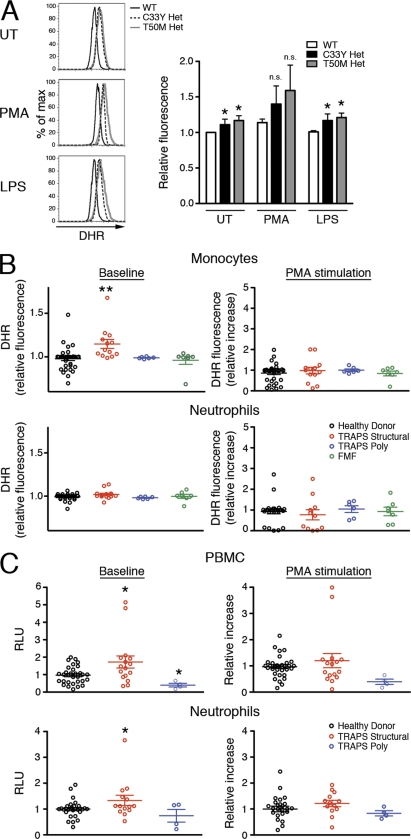
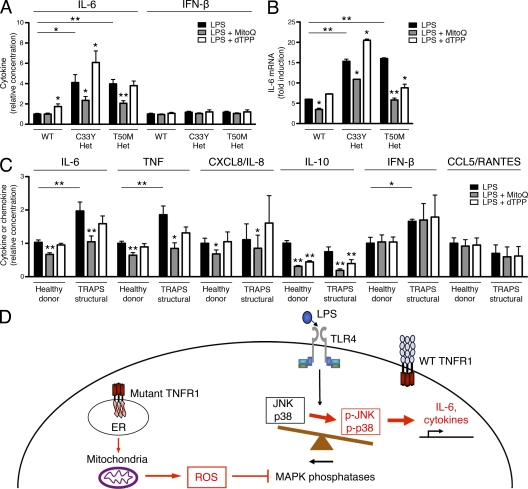
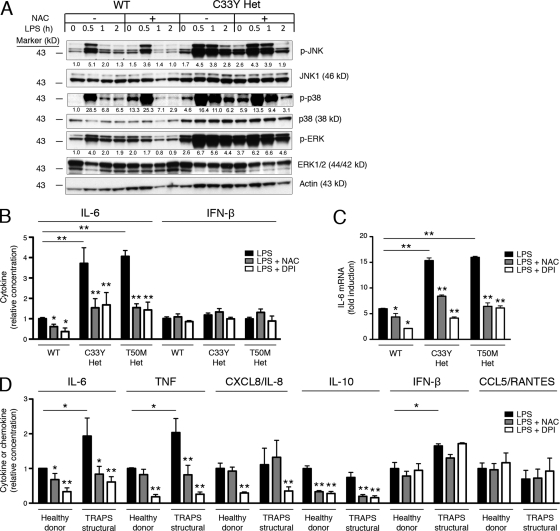
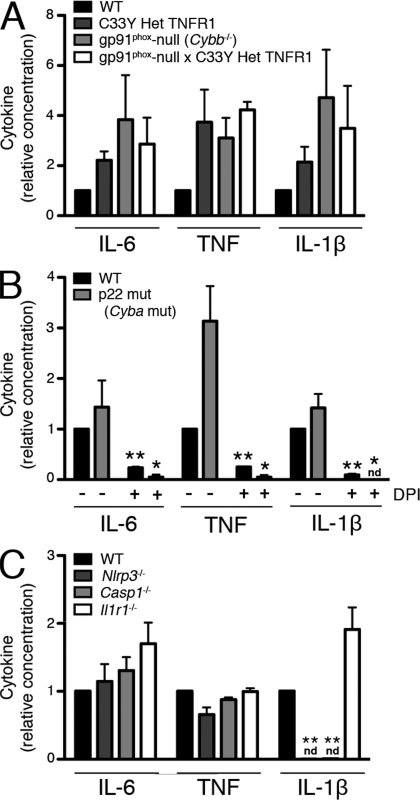
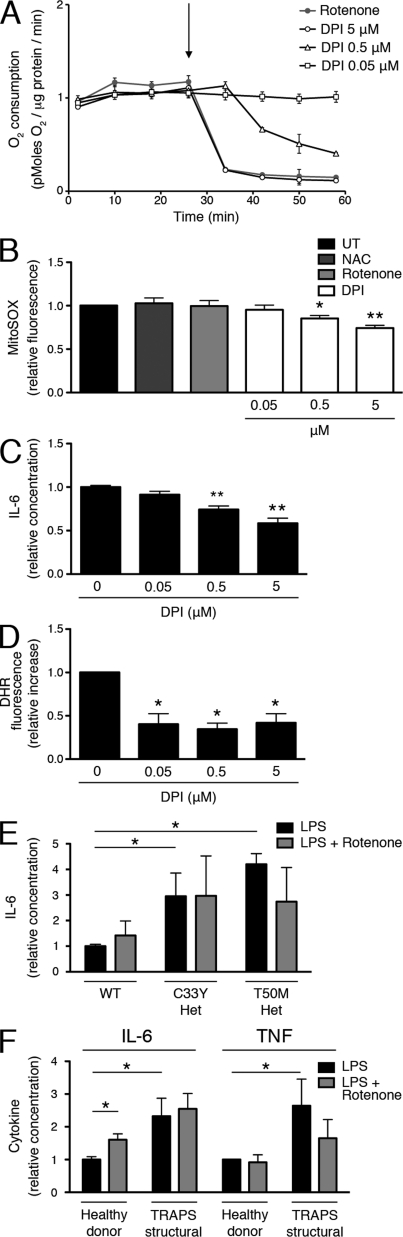
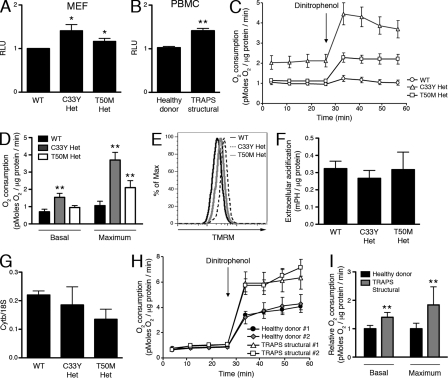
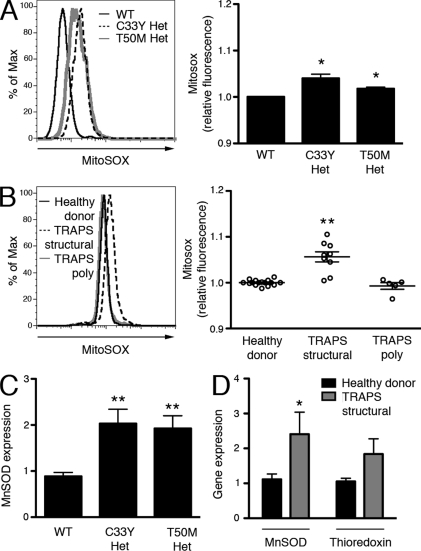
Reactive oxygen species (ROS) have an established role in inflammation and host defense, as they kill intracellular bacteria and have been shown to activate the NLRP3 inflammasome. Here, we find that ROS generated by mitochondrial respiration are important for normal lipopolysaccharide (LPS)-driven production of several proinflammatory cytokines and for the enhanced responsiveness to LPS seen in cells from patients with tumor necrosis factor receptor-associated periodic syndrome (TRAPS), an autoinflammatory disorder caused by missense mutations in the type 1 TNF receptor (TNFR1). We find elevated baseline ROS in both mouse embryonic fibroblasts and human immune cells harboring TRAPS-associated TNFR1 mutations. A variety of antioxidants dampen LPS-induced MAPK phosphorylation and inflammatory cytokine production. However, gp91(phox) and p22(phox) reduced nicotinamide adenine dinucleotide phosphate (NADPH) oxidase subunits are dispensable for inflammatory cytokine production, indicating that NADPH oxidases are not the source of proinflammatory ROS. TNFR1 mutant cells exhibit altered mitochondrial function with enhanced oxidative capacity and mitochondrial ROS generation, and pharmacological blockade of mitochondrial ROS efficiently reduces inflammatory cytokine production after LPS stimulation in cells from TRAPS patients and healthy controls. These findings suggest that mitochondrial ROS may be a novel therapeutic target for TRAPS and other inflammatory diseases.
活性氧 (ROS) 在炎症和宿主防御中具有既定作用,因为它们可以杀死细胞内细菌,并已被证明可以激活 NLRP3 炎性体。在这里,我们发现线粒体呼吸产生的 ROS 对于正常脂多糖 (LPS) 驱动的几种促炎细胞因子的产生以及肿瘤坏死因子受体相关周期性综合征 (TRAPS) 患者细胞对 LPS 反应性增强至关重要,这是一种由 1 型 TNF 受体 (TNFR1) 的错义突变引起的自身炎症性疾病。我们发现,携带 TRAPS 相关 TNFR1 突变的小鼠胚胎成纤维细胞和人类免疫细胞中均存在基线 ROS 升高。各种抗氧化剂可抑制 LPS 诱导的 MAPK 磷酸化和促炎细胞因子的产生。然而,gp91(phox)和 p22(phox)还原型烟酰胺腺嘌呤二核苷酸磷酸 (NADPH) 氧化酶亚基对于促炎细胞因子的产生是可有可无的,这表明 NADPH 氧化酶不是促炎 ROS 的来源。TRAP 突变细胞表现出改变的线粒体功能,具有增强的氧化能力和线粒体 ROS 生成,并且在 LPS 刺激后,线粒体 ROS 的药理学阻断可有效地减少 TRAPS 患者和健康对照者细胞中的促炎细胞因子产生。这些发现表明,线粒体 ROS 可能是 TRAPS 和其他炎症性疾病的新的治疗靶点。