Institut National de Recherche et de Sécurité, rue du Morvan, CS 60027, 54519, Vandoeuvre les Nancy Cedex, France.
Arch Toxicol. 2011 Sep;85(9):1035-43. doi: 10.1007/s00204-011-0651-z. Epub 2011 Feb 2.
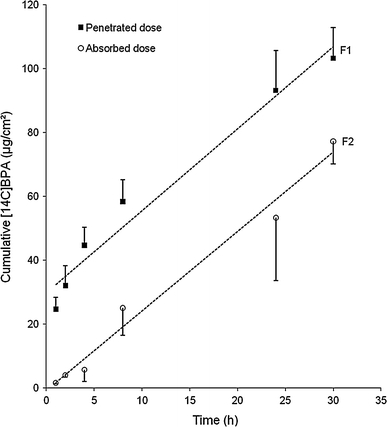
Bisphenol A (BPA) is a monomer used mainly in the synthesis of polycarbonates and epoxy resins. Percutaneous absorption is the second source of exposure, after inhalation, in the work environment. However, studies on this route of absorption are lacking or incomplete. In this study, percutaneous BPA absorption was measured in vivo and ex vivo in the rat, and ex vivo in humans. An approximately 12-fold difference in permeability between rat skin and human skin was found, with permeability being higher in the rat. In addition, inter- and intra-individual variability of up to tenfold was observed in humans. No accumulation of BPA in the skin was found during exposure. The skin clearance rate following exposure was estimated at 0.4 μg/cm²/h. Ex vivo and in vivo percutaneous absorption fluxes of BPA in the rat were in the same range (about 2.0 μg/cm²/h), suggesting that extrapolation to the in vivo situation in humans may be possible. The European tolerable daily intake (TDI) of BPA is 50 μg/kg body weight. However, many research projects have highlighted the significant effects of BPA in rodents at doses lower than 10 μg/kg/day. A 1-h occupational exposure over 2,000 cm² (forearms and hands) may lead to a BPA absorption of 4 μg/kg/day. This is 8% of the European TDI and is very close to the value at which effects have been observed in animals. This absorption must therefore be taken into account when evaluating risks of BPA exposure, at least until more relevant results on the toxicity of BPA in humans are available.
双酚 A(BPA)是一种主要用于合成聚碳酸酯和环氧树脂的单体。经皮吸收是工作环境中仅次于吸入的第二大暴露源。然而,关于这种吸收途径的研究还很少或不完整。在这项研究中,我们在大鼠体内和体外以及人体体外测量了经皮 BPA 的吸收。发现大鼠皮肤和人体皮肤的通透性存在约 12 倍的差异,大鼠皮肤的通透性更高。此外,在人体中还观察到了高达 10 倍的个体间和个体内差异。在暴露期间,未发现 BPA 在皮肤中积累。暴露后皮肤清除率估计为 0.4μg/cm²/h。大鼠体外和体内经皮 BPA 吸收通量处于同一范围(约 2.0μg/cm²/h),表明可以将其外推至人体的体内情况。BPA 的欧洲可耐受每日摄入量(TDI)为 50μg/kg 体重。然而,许多研究项目已经强调了 BPA 在啮齿动物中的显著作用,其剂量低于 10μg/kg/天。2000cm² 以上(前臂和手)的 1 小时职业暴露可能导致 BPA 吸收 4μg/kg/天。这是欧洲 TDI 的 8%,非常接近在动物中观察到的效应值。因此,在评估 BPA 暴露风险时,必须考虑到这种吸收,至少在获得有关 BPA 在人体中的毒性的更相关结果之前。